

With HBO’s It: Welcome to Derry now fully concluded, it feels fair to say that the show was ultimately a far richer and more impactful production than many were expecting. When you first hear that a new IT television series is in the works, which will act as a spinoff of the Andy Muschietti-helmed films from a few years back and not feature Pennywise as heavily in the first half, there’s a certain negatively-tinged connotation that comes with all of that. When you begin to weave in even larger elements, such as the fact that the series was planning to tackle the origins of the interdimensional entity known as It and characters from the expanded Stephen King catalogue, such as Dick Hallorann, there’s even greater reasons for doubt.
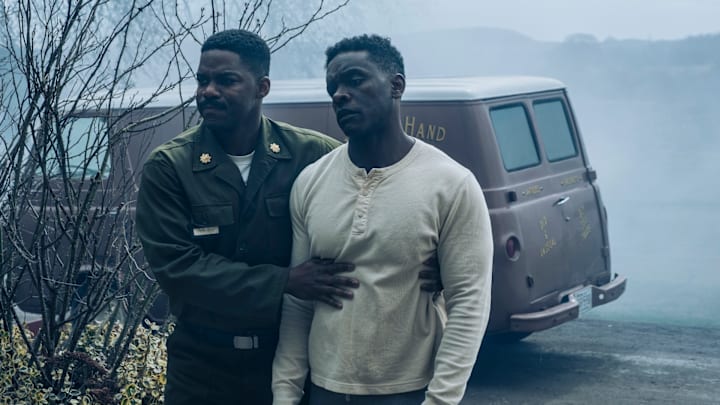
However, against all odds, IT: Welcome to Derry has emerged on the other side victorious, and as it turns out, Chris Chalk’s performance as Dick Hallorann was nothing short of fantastic throughout the majority of the show. However, in a strange twist of fate, by developing the character so much here, it kind of ruins his predetermined role in The Shining.

The origins of Dick Hallorann in Stephen King's books
Dick Hallorann originated in Stephen King’s 1977 novel, The Shining, as a cook at the Overlook Hotel. When the Torrance family comes to take care of the hotel during the offseason, Hallorann meets their young son Danny and becomes a key resource for him. See, Hallorann has extraordinary supernatural abilities, which his grandmother taught him to refer to as “shining.” Danny Torrance has similar abilities and is enlightened by Hallorann’s guidance. Crucially though, this where the different versions of The Shining diverge; in King’s book, Hallorann survives, but in Kubrick’s 1980 film, Hallorann is ultimately killed by Danny’s father, Jack Torrance, upon returning to the Overlook.
Since then, Hallorann has continued to play a role in King’s larger catalogue, appearing in both the book and film version of Doctor Sleep as well. As such, incorporating Hallorann into the 1962-set events of IT: Welcome to Derry isn’t a far cry at all, and the series actually does manage to utilize Hallorann’s abilities and develop him as a character in fascinating ways. This is all only further aided by the tremendous performance of Chris Chalk, who manages to both pay homage to prior onscreen iterations of the character and chart his own course.
The result is an on-screen iteration of Hallorann who feels like a definitive take on the character that's utilized in wholly new ways. However, that’s ultimately part of the problem.

Did IT: Welcome to Derry's nod to The Shining work?
Hallorann’s final scene in the last episode of IT: Welcome to Derry sees him ceremoniously announcing to the other characters that he’s secured a job at a hotel as a cook. When the others tell him to take care of himself, he asks, “How much trouble can a hotel be?” This cringe-inducing line feels like it should be being delivered with an outright wink to camera, which is egregious enough in and of itself. But on top of that, it feels so totally out of nowhere within the context of this character’s journey within the series as a whole. His eventual fate as a cook at the Overlook has literally nothing to do with his arc here, which makes this final inclusion so frustrating.
Had Hallorann's story in Welcome to Derry ended with his prior scene, in which he reclaims the authority of his ‘shining’ abilities in order to bring solace to some grieving parents at a funeral, it would have been a perfect ending for the character. Audiences could surmise he had entered a new era of his life and that sometime in the next decade-plus, he would have wound up at the Overlook. But in trying to so overtly and ham-fistedly tie this series directly into his role in The Shining, it worsens both of them.
 Add us as a preferred source on Google