

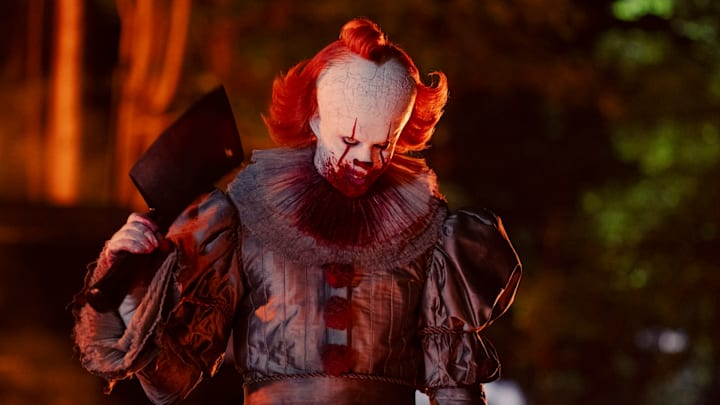
With the release of the final episode, “Winter Fire,” IT: Welcome to Derry’s first season has come to a close in a uniquely fitting way. While there is undeniable craft on display throughout the episode and some genuinely shocking bursts of vibrant ambition from within it, the finale as a whole is a malformed oddity whose structure fails to effectively cultivate a way for its biggest swings to land.
That’s not to say this is a bad finale or even a bad episode by any means; it’s often a very entertaining hour-plus of television. It’s just that for as great as the previous three episodes of the season were (the three best of the run by far, with each one improving upon the last) this can’t help but feel like a bit of a disappointment and a return to the muddy waters of the first half of the season.
So what works about “Winter Fire?” For starters, the scale. From its opening frame, this episode is one gargantuan-sized love letter to all things Stephen King. Narratively, that means that Jason Fuchs’ script weaves in story elements and homages to everything from The Mist to The Shining to Carrie and beyond. Visually, it means that director Andy Muschietti brings every ounce of his blockbuster-certified craftsmanship to the table here and delivers something that feels monumental in scope from the very outset. There are stretches in which this sense of grandeur and the panache behind it create some jaw-dropping moments, chief among them being the episode’s cold open.
As the principal calls all the students of Derry High School (minus the main characters, who are all elsewhere) together for an assembly, Pennywise steps out on stage and reveals himself to the crowd in truly gruesome fashion. The ensuing musical performance/horror sequence is among the episode’s very strongest beats, showcasing both Muschietti’s sadistically gleeful skill at staging such practical wonders, and Bill Skarsgård’s ruthless command of the stage as this character. Notably, this is a fairly intimate moment in the grander scheme of the episode, and yet the level of fidelity apparent in everything from the production design to the lighting to the cinematography to the staging all feels so grand. Every single element of the craft is honed in on delivering this monumental impact, and it gets things off to a really great start.

However, from there, things get a bit messier and a lot less focused. With its large ensemble of characters, IT: Welcome to Derry went into this last episode with a lot of different plot threads and character arcs still dangling in the air. While I don’t think an episode effectively and satisfyingly resolving all of these is infeasible, I will admit that I was curious as to how Welcome to Derry would even begin to pull off such a delicate balancing act, and the answer is that it didn't.
After taking Will hostage at the end of the previous episode, Pennywise just decides to take everyone hostage on his way out of town, stopping by the school and forming a literal wagon-trail, dragging the floating children along behind him as he attempts to escape the bounds of Derry now that the government has removed one of the natives’ pillars and opened the gate (if that all sounds like MacGuffin-fueled nonsense, that’s because it is).
But this entire narrative feels like a pretty sudden left turn, and one that doesn’t quite fit with what the series has been building to. It feels more like Pennywise and the showrunners realized this was the third act of the season and they needed to raise the stakes even more, so they just had the character take all the children as hostages. If Will’s kidnapping tightens the screws of tension, then the kidnapping of a hundred more kids should tighten them even more, right? Not really.
Instead, it just feels like a cumbersome element that all of the other characters have to work through, and one that generalizes a lot of the specificities of their arcs. Within the first fifteen minutes of the episode, all of the protagonists have resolved their interpersonal differences with one another and opted to all team up in order to stop It and save the children. It feels like the show cuts a lot of these interactions short and denies them resonance, in favor of getting to the big-budget, final showdown stuff, which is a strange choice given how anchored in character, emotion, and theme the best episodes of this season have been.
I would argue that these faults are even further exacerbated by the filming style of the finale. The entire climax of the episode is set atop a frozen lake in the middle of a large bank of fog, and the results feel far more digital and hazy than anything else in the series. Even when characters are supposed to be right next to one another, they feel miles apart, as Muschietti’s camera shifts from fluid long-takes to short, fractured coverage and fast cutting that keeps everyone isolated in their own frames. The fog element also makes much of the action (especially one mid-episode bit where all the adult protagonists fight back against some soldiers) practically indiscernible. Even something like the culmination of it all, where the proto-Losers Club gets the dagger to the tree (the MacGuffin to the place it needs to be) feels visually cluttered and overbaked in a way Muschietti has fallen into in the past, with films like IT: Chapter Two and The Flash.

What works for me about the finale is the performances. As mentioned previously, Bill Skarsgård continues to really shine as he struts his stuff as Pennywise here, and I do appreciate that Muchietti and co. seem intent on giving him new territory to explore here. I especially enjoyed his confrontation with Marge in the fog, which teases some of the more interdimensional time-jumping elements of the character in a way that feels narratively clunky, but Skarsgård sells the shit out of it nonetheless. Elsewhere, I found his mind-based showdown with Dick Hallorann (immaculately performed by Chris Chalk) really inspired stuff.
Similarly to Chalk, Jovan Adepo as Leroy and Taylour Paige as Charlotte continue to give incredible performances, filling every nook and cranny of these characters with vibrant life. I found Leroy’s arc across the season as a whole to be an extremely compelling one, and Adepo lands that plane with panache, quite literally. I really wish Charlotte had been given a bit more to do here, but I do love how much charisma Paige is able to instill in even her small beats in the episode’s final minutes, so that is to be appreciated.
However, another critique I would levy at the episode is that the whole thing winds up feeling bloated and indulgent, largely thanks to its prolonged epilogue. After the characters stop It and the conflict is essentially resolved, there’s still a full twenty-minutes left of runtime, all of which is devoted to wrapping up various character threads. It’s a strange structure, feeling like the show kind of pauses all the various elements at play to do a big-budget climax, and then proceeds to actually close them out after the conflict is finished. It makes for a stilted viewing experience.
Verdict
Altogether, “Winter Fire” is a solid episode of television and is far from a disaster, with really incredible filmmaking craft on display throughout. But, it is a huge step down in terms of quality from the previous run of episodes, and it all results in a big, loud finale that goes a bit off the rails. I’m excited to see what Muschietti and company have cooked up for next season, and feel that the strength of this season’s best episodes more than justify it as a worthwhile watch.
Episode grade: C+
 Add us as a preferred source on Google