

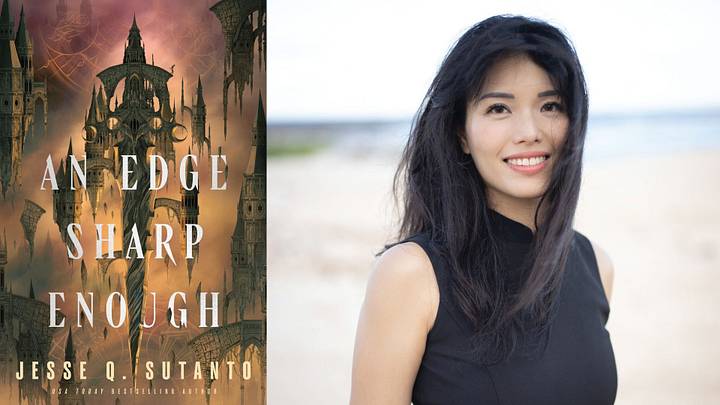
Jesse Q. Sutanto is known for making readers fall in love with characters who are funny, complicated and wonderfully unpredictable. The bestselling author behind the beloved Vera Wong's Unsolicited Advice for Murderers and the Aunties series has explored cozy mysteries, comic crime, YA and romance, but her latest novel takes her somewhere considerably darker.
With An Edge Sharp Enough, Sutanto finally brings to life the fantasy story she first began writing more than two decades ago. It is an ambitious dark fantasy set across two continents, following characters caught in a world where ancient magic is disappearing, political powers are rewriting history and the foundations of an entire civilization are beginning to crumble.
At the heart of the story is Mara, a physically fragile young woman raised in an unforgiving institution to become an assassin, whose discovery of a forgotten form of magic could change the course of a growing conflict. Elsewhere, scholar Livya Bellevue, her childhood friend Kaian and veteran commander Fonde find themselves drawn into a conspiracy involving a murdered president, a supposedly indestructible metal and the return of forces that were believed to belong to the past.
For Sutanto, this is also something of a homecoming, although perhaps not the straightforward kind. Having spent years building a successful career in other genres, she has returned to the manuscript that began her writing journey, substantially reworked it and finally found a home for a story she once thought might never be published.
We were delighted to sit down with Sutanto over email to discuss the long road to publication, the personal experiences behind Mara and her characters, the unexpected inspirations behind her magic system and the twists that await readers in An Edge Sharp Enough.

ASH ANJUM for WINTER IS COMING: Hi Jesse! We are so thrilled about An Edge Sharp Enough, congratulations on getting this fantastic story out into the world! This book started as your Oxford thesis over a decade ago and you went on to build an entire career in other genres before it finally found its home. What did it feel like to finally hold it in your hands?
JESSE Q. SUTANTO: Honestly, I had to take so much distance from this book in order to complete it that when I got the finished copy in my hands, at first, I just felt numb. It didn’t seem possible. It’s too large a realization to digest. How do you process a 20-year-old dream? I can only do it in little bites. Like, I would actually meditate and then consciously explore the reality of it and allow myself to feel the emotions without getting overwhelmed. And it’s beautiful. I cry when I think about it, about what a journey this book—and young me—has gone through.
WIC: Mara is one of those characters we're sure will stay with readers long after the last page. Where did she come from for you?
JQS: So because this was actually the first ever book I wrote, I did the same thing that many first-time authors do: I wrote…me. Mara is a misfit who isn’t very good at what she’s supposed to do. That was drawn from my own experience growing up. She is constantly body-shamed—I was also body-shamed, though for different reasons than her. She hates everything about herself, and I feel that so deeply. But she also has many layers. She finds that she has a huge capacity to love, and because of that, she also has a huge capacity to anger. All of that was drawn from my own emotions. I almost feel embarrassed reading her POV now because it’s so personal.
WIC: The four POV characters feel like four corners of the same broken world and yet they each have their own kind of loneliness. Was that loneliness something you were thinking about consciously as you wrote them?
JQS: So I wrote this when I was going through a really depressed stage in my life. I was living in England and I got seasonal affective disorder. I was also isolated and felt so lonely. I remember posting on this writers forum that I was so lonely I felt like I had forgotten how to chat and laugh in a social setting. So I think it was only natural that all of my characters were lonely, even though they were also surrounded by people.
WIC: The magic system, Art, feels so alive and deeply felt. Was there any specific inspiration behind it?
JQS: Okay, I wish I had a better answer for this, but here is the real answer: Art was inspired by the magic in World of Warcraft. Aahahaha! Sorry, please don’t hate meee! But truly, I was so addicted to WoW at one point. By the time I started writing this, I had stopped playing WoW, but it still left a huge impression on me. If you played the game, you might recognize some of the Art, such as Subtlety. Others, like Astral Art, were inspired by nature. I like to imagine that the stars, being so beautiful, could be a source of allure. After all, they are so mysterious and enchanting.
WIC: Mara and Lia's love is forbidden on pain of death and yet it is the emotional spine of the entire book. Was it always important to you that the great love story at the heart of this dark fantasy be between two women?
JQS: Yes and no. I come from an extremely heteronormative culture, where we are kept so strongly away from anything even remotely LGBTQ-coded that I could see two women kissing and I would go, “Aww they’re such good friends!” So female friendship has always been vital to me, and when I first thought of Mara and Lia, I thought of them as best friends. However, in my late thirties, I had an awakening of my own and it just decimated everything I thought I knew about myself. (I won’t go into detail as I live in a country where it isn’t safe to be publicly out.) Suffice to say, I realized that I wrote so many stories with female characters being obsessed with other female characters because…well, I grew up with those emotions without understanding them for what they were. And when I revisited this manuscript, I saw how ridiculous it was that I had written Mara and Lia as mere friends, just because I had been so sheltered from anything that wasn’t heterosexual. I realized that they were meant to be soulmates all along, and when I rewrote them as that, everything fell into place. Writing their relationship felt like I was finally writing my truth. (You know what, if you read Next Time Will Be Our Turn, you’ll know. Hehe.)

WIC: The Divine Empress sounds terrifying but she doesn't feel like conventional fantasy villainy. How did you approach creating her?
JQS: In the first book, I didn’t touch much on the Divine Empress, aside from that she was this off-screen villain. I had this feeling that I was going to have a lot of fun with her in book two. So in this book, she is an almost mythical figure made up of rumors and stories from various characters. But I recently finished writing book two, and I can safely say that I had sooo much fun with her! I can’t wait for book two to come out, honestly!
WIC: The twist in the final act has us completely floored. Without giving much away, how long did you sit on that secret while writing, and was there ever a version of the story where it didn't happen?
JQS: Aaah! I knew I was going to pull that twist before I started my rewrite and oh my gosh, when I tell you it killed me to have to plod through two-thirds of the manuscript before reaching it! I was cackling with glee when I finally got there. I was having so much fun! And no, there is no version of the story where it didn’t happen. Certain people had to die and certain people had to be heartbroken and I knew from the very beginning who they would all be. Muahahaha!
WIC: You've written cozy mysteries, comic crime, YA, romance, but this was actually the first thing you ever wrote. Does returning to it feel like a homecoming, or like meeting a version of yourself you'd almost forgotten?
JQS: Definitely the latter. It had been a while since I revisited fantasy. To be honest, after this manuscript failed to sell, I was so depressed that I went off fantasy for a long time. I couldn’t stomach reading the genre. So returning to it felt like meeting a very old friend—you feel comfort, but also nervousness because you know you’ve changed and you’re not quite sure how that change would affect your relationship.

WIC: World of Warcraft was apparently a real influence on the lore here! Are there other unexpected places this world came from that readers might not guess?
JQS: Okay I’ll just list out words that WoW fans should know: Rogue, Subtlety, Druid, Mage.
And for Discworld fans, because the whole adther vs dracerium thing was inspired by Discworld: Thud!, dwarves and the flame in the cave thing, CAPTAIN VIMES, Ankh-Morpork, Angua.
WIC: The Aunties fans, the Vera Wong fans, and now this whole new world of readers finding you through dark fantasy – what do you hope someone who has only ever known your cozier work feels when they close this book?
JQS: Horror? Hahaha! And also the knowledge that we are all made of many layers. All of us are complicated beings capable of varied tastes. I feel that society so often tries to box us into neat categories, but the truth is we are so wonderfully complex. We’re not just fans of one genre, we can be fans of multiple, wildly different genres. I think that’s part of the reason why I love to write such different things. I want to show that we as humans have so much range and we shouldn’t limit ourselves. I love that my readers are so game to try everything. I’m always saying I am blessed with the best readers, and that’s true! They love being warm and cozy with Vera, and they also love going on a murderous rampage with Mara. Right?

A huge thank you to Jesse Q. Sutanto for taking the time to talk An Edge Sharp Enough, and to Kelly Cronin for arranging the interview!
An Edge Sharp Enough is available now from Harper Voyager, wherever books are sold.
 Add us as a preferred source on Google