

Warning: There are story spoilers for The Legend of Zelda: Ocarina of Time below.
Nearly three decades ago, The Legend of Zelda: Ocarina of Time was released and quickly became regarded as one of the best video games ever. Now, in 2026, we have been reminded why. It's only fitting for an adventure that transcends the barriers of time to get a timeless remake that captures lightning in a bottle once again.
First and foremost, the original title got a fresh coat of paint. Now, low-polygon models have transformed into breathtaking views that bring a large fantasy world to life in astounding detail. Additionally, gameplay mechanics have been revamped thanks to the addition of a dedicated jump button and one analog stick that can freely move the camera. Furthermore, the game supports connectivity with the Nintendo Switch app to see hidden collectibles on the map in real time and easily reach 100% completion.
The list of upgrades goes on and on: small side quests were added, NPCs have improved dialogue, there's a new (albeit small) area to see statues of defeated enemies, and some areas have been changed to better fit modern level design. Despite this, the spirit of the original game remains intact, explaining why the remake is as beloved as the original title once was in 1998. But among all the changes introduced in Nintendo's latest release, there's one that stands out for all the right reasons.

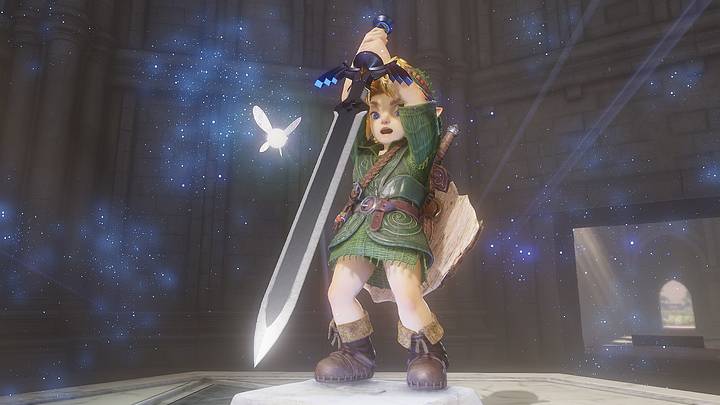
There's a new cutscene that plays when Link obtains the Master Sword in The Legend of Zelda: Ocarina of Time remake, and it adds a lot of context
Nintendo may have tweaked many elements of the original Ocarina of Time, but its story wasn't one of them. After so many years, the narrative of this legendary adventure is well-known: After the Three Golden Goddesses created the world and the land of Hyrule, they left behind a sacred relic that grants the wish of whoever touches it: the Triforce. This divine artifact was sealed away in a separate plane of reality called the Sacred Realm, making it impossible for most people to reach.
To ensure only those with good intentions could touch the Triforce, the pathway to the Sacred Realm was locked within the Temple of Time behind a gate that's opened with three Spiritual Stones. Moreover, the final key was the Master Sword—a Blade of Evil's Bane that can only be wielded by those pure of heart. As such, the princess of Hyrule, Zelda, entrusted a young Link with the mission to obtain all of these elements and reach the Triforce before it was too late. After all, Ganondorf, the evil leader of the Gerudo, was also after this artifact.
Link eventually obtains the three Spiritual Stones and finally wields the Master Sword for the first time. However, it is at this point that there's a great difference between the original version of The Legend of Zelda: Ocarina of Time and the remake.
In the 1998 adventure, the screen cuts to white after Link pulls the sword out of its pedestal, implying that the player has reached the Sacred Realm. Then we see Ganondorf emerge from a blank landscape. It is at that point that the villain reveals he was merely letting Link do the heavy lifting by opening the door to the Sacred Realm. Ganondorf laughs, and then Link wakes up seven years in the future as an adult.

Players are then bombarded with a lot of exposition dialogue, explaining that the leader of the Gerudo got to the Triforce first and twisted the world using its power. Moreover, it is also explained that Link was too young to be a hero, so the Master Sword sealed his body away in the Sacred Realm for seven years. It's a great twist, but one that played out a little too unceremoniously back in the day. Moreover, it also left plenty of room for questions to arise: How come Ganondorf beat Link to the Triforce? Why didn't the Hero of Time try to stop him? Why did Link's fairy companion, Navi, seem to have no recollection of the seven years that passed?
Fortunately, things are a little different in the remake, even if the overall story remains unchanged. After a young Link pulls the Master Sword out of its pedestal, we see him enter the Sacred Realm. In there, the Blade of Evil's Bane shines a bright beacon of light, illuminating the way straight to the Triforce. But before Link even gets the opportunity to move, the sword freezes him and Navi in time. The two heroes almost appear to turn to stone, while Ganondorf appears behind them.
The Gerudo leader delivers his monologue, explaining that he was merely using Link to reach the Sacred Realm, and then we see him walk directly to the Triforce. Just as he reaches the sacred artifact, the screen turns white, and the cutscene that follows plays out mostly the same as in the original title.
This is a small change, but one that greatly enhances the experience (which is a perfect summary of all the upgrades in the remake as a whole). Better yet, this plot point makes even more sense after playing a different The Legend of Zelda game that was released 13 years after the original Ocarina of Time.

Playing through The Legend of Zelda: Skyward Sword also enhances the experience
The story of The Legend of Zelda: Ocarina of Time has been a true marvel since 1998, but there's one element that didn't quite make sense back in the day: the role of the Master Sword. How can this blade freeze Link in time for exactly seven years? How can a weapon know that its wielder is still too young to become the hero of legend? And why can only people pure of heart use it? While these questions may not have been too relevant all those years ago, they were answered in 2011 another way.
The Legend of Zelda: Skyward Sword is the first chronological game in The Legend of Zelda timeline, and its story is all about the creation of the Master Sword. Throughout the game, players are accompanied by Fi—a spirit created by the goddess Hylia herself (who was, in turn, created by the Three Golden Goddesses, much like the Triforce). In the end, Fi seals herself inside the Master Sword, entering a deep, eternal slumber.
This reveal recontextualized the entire Legend of Zelda series because, in every game where players get to wield the Master Sword, we have also been accompanied by Fi. There's a sentient being inside the blade that has "awakened" on a few occasions, such as when Link nearly died in Breath of the Wild, to protect its master. So, it stands to reason that Fi was responsible for sealing away the Hero of Time in the Sacred Realm for seven years until he was ready to defeat Ganondorf. Perhaps this is an "Avengers: Endgame" scenario in which the heroes win in just one scenario out of thousands, but only if they lose first.
Overall, it's impressive that playing the Ocarina of Time remake in 2026 feels as magical as it did in 1998, but it's all thanks to the little improvements that Nintendo added as well as the many ways in which the lore has expanded ever since.
The Legend of Zelda: Ocarina of Time remake is out now on Nintendo Switch 2.
 Add us as a preferred source on Google