

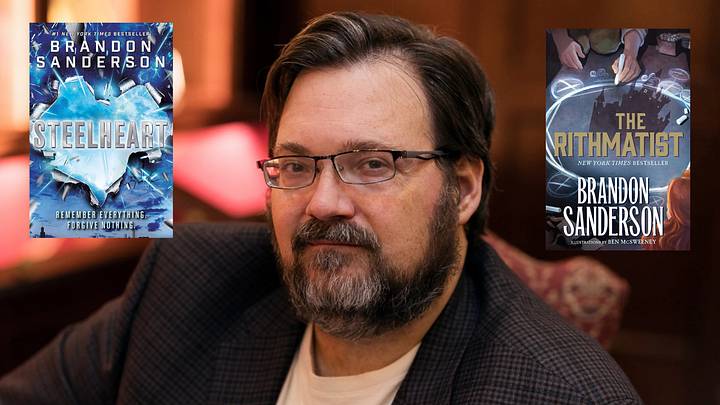
Brandon Sanderson is having a moment. In January 2026, Apple TV announced a landmark deal to bring his Cosmere universe to film and television with a Mistborn movie and The Stormlight Archive TV series both officially in development.
Sanderson himself is writing the Mistborn screenplay and has unprecedented creative control over both projects. Now, his young adult sci-fi Skyward is also heading to television.
Three major adaptations in the works at once is remarkable for any author. For Sanderson, it almost feels like the beginning.
Sanderson has published over 70 books. His backlist is enormously varied and packed with stories. Some are intimate character studies, while some are gonzo genre mashups. So with Hollywood officially paying attention, it feels like exactly the right time to look at these eight Sanderson books with rich premises and the kind of passionate fanbases that studios dream about. Some are standalone novels that could be a single film, while some could kickstart an entire series.
- Elantris (2005)
- Warbreaker (2009)
- The Rithmatist (2013)
- Steelheart (The Reckoners Trilogy) (2013)
- The Emperor's Soul (2012)
- The Alloy of Law (The Wax & Wayne Series) (2011)
- Tress of the Emerald Sea (2023)
- Yumi and the Nightmare Painter (2023)

Elantris (2005)
Elantris is Sanderson's actual debut novel, the first book he ever published. It is often the one that a lot of fans skip because it came before Mistborn made him famous. Well, that's their loss.
The story is set in the kingdom of Arelon, where a magical transformation called the Shaod used to randomly select ordinary people and turn them into Elantrians. Glowing, near-divine beings of immense power who lived in the beautiful city of Elantris and served their world as healers, builders and gods. Then, 10 years ago, the magic broke. Now the Shaod still claims people but instead of elevating them, it traps them in bodies that feel every wound but can never heal, that feel hunger but can never be satisfied. The afflicted are thrown behind the walls of Elantris, which has rotted from a paradise into a decaying prison. They cannot die. They can only endure.
Prince Raoden of Arelon wakes up one morning and discovers he has the Shaod. His father secretly exiles him to Elantris rather than reveal the truth, declaring him dead. Meanwhile, his betrothed, the politically savvy Princess Sarene of neighboring Teod arrives to find her groom supposedly gone, only to realize very quickly that something is very wrong at court. And circling both of them is Hrathen, a calculating high priest from an expansionist empire who has been sent to convert Arelon by any means necessary before his emperor's armies arrive.
It has everything: political intrigue, a rotting city full of tormented souls, a love story between two people who have never actually met, and a mystery about why the magic failed in the first place. It's contained enough to work as a single film but also rich enough to support a miniseries. The fact that this one still hasn't been optioned feels like a genuine oversight.

Warbreaker (2009)
Warbreaker has one of the most genuinely clever magic systems in all of Sanderson's work and it's told through some of his most entertaining characters. The world of Nalthis runs on something called BioChromatic Breath. Every person is born with one unit of Breath, a sort of life force that can be given away or collected. The more Breath you accumulate, the more powerful you become. You can "Awaken" inanimate objects by giving them commands, sense people nearby, perceive color with supernatural vividness and much more.
The ruling class of the nation of Hallandren are the Returned, people who died in moments of heroism and came back as literal gods, sustained by Breath donated by worshippers each week. Awakeners drain the color from objects as they use them. Into this world come two sisters: Vivenna, the eldest princess of the rival kingdom of Idris, who was raised her entire life knowing she would one day be sent to marry the terrifying God King of Hallandren, and Siri, the free-spirited younger sister who actually gets sent in her place when their father loses his nerve.
Vivenna follows to rescue her getting caught up in mercenary politics and conspiracy. Siri, inside the God King's palace, begins to discover that the man everyone fears might not be who the world thinks he is.
Add in Lightsong, a god who actively does not want to be a god and spends most of his time making sarcastic quips and trying to figure out what he actually believes, and Vasher, a mysterious figure who carries a sentient, deeply unsettling black sword called Nightblood. It's a political fantasy with some genuine wit and a romance that earns it. As a standalone film, it could be spectacular.

The Rithmatist (2013)
This one is strange in the best way and it would make an absolutely wild animated feature or live-action series for younger audiences. Also, adults who read it tend to love it just as much.
The setting is an alternate-history America called the United Isles where the continent is made up of islands rather than a landmass, and the technology is clockpunk where gears and springs power everything. The twist is that some people, chosen through a religious ritual, are gifted with the ability to practice Rithmatics, a magic system based entirely on drawing geometric shapes in chalk.
Rithmatists can draw lines of force that act as shields, lines of warding that repel enemies and two-dimensional creatures called Chalklings that come to life and follow their creator's commands.
The story follows Joel, a non-Rithmatist student at one of the country's eight Rithmatic academies, where he attends on a scholarship as the son of a chalkmaker. Joel is obsessed with Rithmatics despite having no ability to perform it himself. When Rithmatist students start disappearing from the school, leaving behind unrecognizable chalk patterns, he gets pulled into the investigation alongside the eccentric Professor Fitch and a talented but unfocused Rithmatist girl named Melody.
It's a YA mystery-fantasy with a procedural structure that would translate so beautifully to screen. The magic system is so visual, literally drawn on floors and walls, that the right animation style could make the dueling sequences look unlike anything audiences have ever seen. Think Your Name meets Sherlock Holmes. It's also the rare Sanderson book where the hero has no powers at all.

Steelheart (The Reckoners Trilogy) (2013)
This one has actually come closest to a screen adaptation before as it was optioned years ago but nothing ever materialized.
10 years ago, a mysterious cosmic event called Calamity appeared in the sky. Shortly after, ordinary people began developing extraordinary powers. The public called them Epics. And every single one of them, without exception, became a tyrant.
It turns out that power corrupts. Nobody who gains Epic abilities stays good. The Epics now rule cities like feudal lords. Chicago has been renamed Newcago and is controlled by Steelheart, who is considered completely invulnerable. Nobody has ever made him bleed. Ordinary people live as subjects under a class of god-like bullies and there is no superhero coming to save them.
Except there's an underground group called the Reckoners who are regular humans with no powers and study Epics' secret weaknesses and assassinate them one by one. 18-year-old David wants to join them because Steelheart killed his father. He has spent a decade obsessively cataloguing Epics and he knows something that once made Steelheart bleed.
It's an inverted superhero story for an era when audiences have superhero fatigue. The "heroes" with powers are the villains, and the drama comes from regular human beings using ingenuity to punch far above their weight. The trilogy has a full story arc with escalating stakes and a genuinely affecting conclusion.

The Emperor's Soul (2012)
This is the shortest entry on this list, but it won the Hugo Award for Best Novella and is frequently cited as some of Sanderson's finest writing. It's also the entry on this list that feels most overdue for a screen adaptation. It would make a perfect limited series of four or five episodes, or maybe even a tight film. In fact, Sanderson has even written a screenplay for it.
In The Emperor’s Soul, Shai is an artist-criminal who specializes in creating Forgeries, magical stamps that can rewrite the history of an object or a person. If you stamp a door, you can convince reality that it was always made of a different wood or that it was always painted red. If you stamp a person, you can rewrite their soul. This magic comes with deep philosophical implications. A Forged soul isn't fake, exactly. It's a different version of who someone could have been given different circumstances. It's as real as any other self.
Shai has been captured and faces execution, but before she can be killed, she's brought a proposition. The Emperor of the Rose Empire has been left brain-dead after a failed assassination attempt. His advisors need Shai to Forge him a new soul, one so convincing that no one will know the difference while they buy time to figure out what to do. She has 100 days. The advisors will monitor her constantly. And they plan to execute her the moment she's done regardless.
Shai's attempts to reconstruct the Emperor's soul require her to learn who he actually was, his childhood, his loves, his regrets, his secret shames. It's a small story with enormous emotional weight. For TV, the contained premise and rich interiority of the main character could produce something like a prestige-drama limited series.

The Alloy of Law (The Wax & Wayne Series) (2011)
Most people know Mistborn as the story of Vin, a thief who overthrows a dark lord using metal-based magic. Sanderson also wrote a second Mistborn era set 300 years later and it's arguably even more fun to read.
The world of Scadrial has industrialized. What was once a world of feudal oppression is now entering something like the 1890s with trains, electric lights, newspapers, urban crime. The old Allomantic and Feruchemical magic systems still exist, but now they coexist with guns and politics and high society. It's a fantasy Western that turns into a fantasy crime thriller.
Waxillium Ladrian is a Twinborn. He can both Push on metal objects (effectively giving himself jetpack-like mobility) and alter his own weight at will, who spent 20 years as a lawman in the frontier Roughs before being dragged back to the city to run his noble house. When a criminal gang called the Vanishers starts robbing trains and kidnapping women, Wax reluctantly picks his guns back up along with his quick-talking sidekick Wayne (who has the power to create bubbles that slow time) and a sharp-witted engineer named Marasi.
It's funny, action-packed and genuinely clever. With the Mistborn adaptation in development, the Wax & Wayne books could serve as a companion franchise targeting a more detective-adventure tone in fantasy.

Tress of the Emerald Sea (2023)
Sanderson wrote this one as a gift for his wife, inspired by her dissatisfaction with Princess Buttercup's passivity in The Princess Bride. Tress is one of the most purely joyful books in his catalog and it has a cinematic quality that practically begs for adaptation.
In this book, the planet of Lumar has no water oceans. Instead, its seas are made of aether spores and a single drop of water can trigger a catastrophic reaction, making sailing the most dangerous profession imaginable. Different seas contain different spores with different properties. Tress lives on a small island in the Emerald Sea, collects cups from sailors who pass through and has a simple happy life. Her best friend is Charlie, the duke's son, who tells her stories from around the world.
When Charlie's father forces him on a voyage to find a bride and Charlie ends up captured by the feared Sorceress of the Midnight Sea, everyone assumes he's simply gone. Tress doesn't accept that. She stows away on a ship, falls in with a crew of pirates, learns to use spore-based magic and crosses the most dangerous ocean in the world to save the person she loves.
It's narrated by Hoid, a recurring figure in Sanderson's Cosmere who appears across many books. His voice is witty and warm and gently self-aware in a way that gives the story an almost Pixar-like quality. The visual potential is also. Seas of glowing emerald spores, islands floating in toxic clouds, a Midnight Sea that reacts to light. As an animated film or even a live-action one, it could be a fantasy adventure for all ages.

Yumi and the Nightmare Painter (2023)
This might be the most visually striking book on this list and the one that would benefit most from a skilled director with a strong visual identity. It reads like a Studio Ghibli film crossed with a Korean drama, and it wears those influences openly.
The story is about two people in two worlds with no connection, until suddenly there is one.
Yumi is a yoki-hijo, a kind of traveling holy woman in a world of sun, stone gardens and spirits. Her entire life has been around stacking stones in intricate, gravity-defying formations to summon benevolent spirits that help the communities she visits. She is revered and completely isolated. She has never made a decision for herself.
Nikaro, who goes by Painter, lives in Kilahito, a city encased in permanent darkness lit by neon hion lines, where his job is to patrol the streets every night and capture the nightmares (semi-sentient creatures of fear that can devastate a city block) that seep out of the shroud.
One day, they wake up in each other's bodies. Neither understands why. Neither can communicate with the world around them in the other's form and they have to coach each other, ghost-like, through tasks they've never performed. What begins as a strange body-swap romance slowly deepens into something more unsettling as both realize their worlds may not be as separate as they appear. The truth underneath everything is genuinely heartbreaking and involves a machine that has been running a centuries-long deception.
The contrast between Yumi's world and Painter's would be extraordinary on screen. It's the kind of project that would reward a filmmaker with a strong aesthetic sense, someone who could make two visually completely different worlds feel like they're part of the same story. Among all the books on this list, it's perhaps the most emotionally affecting and the one most likely to make you cry. I'd give an arm and a limb to watch this get a screen adaptation.
Any one of these eight could be the next great fantasy franchise.
 Add us as a preferred source on Google