

The Lord of the Rings: The Rings of Power is back, and it's wasting no time getting into dangerous and exciting waters. The season 3 premiere, "Marnukh," focused entirely on the Sauron, the Elves, and the Dwarves. It was much benefited by that tighter narrative, but The Rings of Power has always been a show that likes its sprawl. In episode 2, "The Gift of Men," we see the scope begin to gradually widen as the island nation of Númenor steals the spotlight.
And my, what an episode for Númenor this is. The political turmoil on this isle of long-lived Men blessed by the Valar was one of the weaker elements of season 2, but in season 3 it comes out of the gate swinging. Not only was it one of the best episodes of the show so far for many of Númenor's key players, like Pharazôn (Trystan Gravelle), Isildur (Maxim Baldry), Míriel (Cynthia Addai-Robinson), and, especially, Eärien (Ema Horvath), but it might just be one of the best episodes of the show so far, period.
Númenor isn't the only storyline humming along in "The Gift of Men," either. The Dwarves and Elves also try to figure out what to do with their new captive, the Orc Marnûkh (Adam Young), while Sauron (Charlie Vickers) spends some quality time with his newest Nazgnagôl.
We've got a lot to talk about as we recap and review it all. Full spoilers beyond this point for The Rings of Power season 3, episode 2, "The Gift of Men."

Assassin's Creed: Númenor
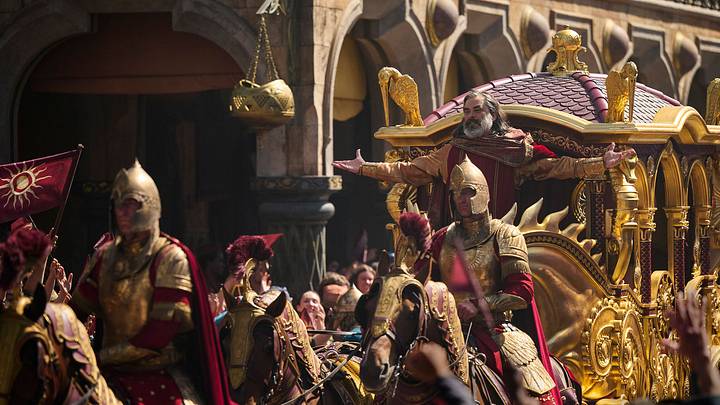
Right from the jump, it's clear that Númenor is going to feature heavily this episode. We begin with a parade for Ar-Pharazôn, where the king of the island waves to the cheering masses while hurling fistfuls of gold coins. The opening pan into Númenor's harbor and up its terraced cityscape is utterly gorgeous, and a firm reminder that The Rings of Power is one of the best looking shows on television. The parade, along with conversations within the chariot between Pharazôn and his close ally, Lord Belzagar (Will Keen), fill us in on how popular the king's rule has been these past fives years. Pharazôn has made the people of Númenor rich beyond their wildest dreams (though, I should note, the show doesn't go too deep into how he managed this feat), and they love him for it.
At least, those in his good graces do. Pharazôn soon falls into a trap set by the Faithful, where Isildur attempts to assassinate him. This entire sequence had me on the edge of my seat, with some fantastic direction that made excellent use of the impressive sets that The Rings of Power built for Númenor. Pharazôn is wounded but survives, while Isildur is forced to flee and his companion Haleth is taken prisoner.
A Nazgnagôl in waiting
We break briefly from Númenor following the assassination attempt and the debut of the show's freshly animated season 3 opening credits to resolve the premiere's cliffhanger. Theo (Tyroe Muhafidin) is one of two men left standing in the brawl for a Ring of Power, and he's at a disadvantage against a far larger and stronger opponent. Just as it looks like Theo might lose, however, Sauron notices the mark on his arm left by the hilt of the Mordor-forged blade from season 1. Taking an interest, the Dark Lord dispatches the other Southlander and asks Theo where he got the mark. Theo claims it was a blade passed down from his father, a man he never knew. To which Sauron eerily responds, "Would you like to meet him now?"
I could gush about Charlie Vickers in every single one of these reviews. Suffice to say, he continues to deliver the performance of a lifetime as Sauron, and these developments with Theo are easily the most interesting things to ever happen to the young Southlander. We leave off with Sauron discovering Marnûkh has surrendered to the Dwarves, and it's obvious that Sauron isn't going to take that lying down.
This seems to hint that Marnûkh is, in fact, betraying the Dark Lord. The ambiguity of whether that's the truth is a compelling mystery that weaves through the first half of season 3.
What to do with Marnûkh
We get one other scene before we head away from Middle-earth: the Dwarves, debating whether to toss Marnûkh back out of Khazad-dûm, or deliver him to Galadriel, who is the only person he will trust with his supposedly dangerous information about Sauron. While Narvi (Kevin Eldon) pushes to keep the Orc's appearance a secret so as not to call down Sauron's wrath, Durin (Owain Arthur) and Disa (Sophia Nomvete) are both strongly of the opinion that they should hand him over to the Elves, in case his information is sound. I like that the obvious possibilities of him being a spy are addressed immediately here; it makes the whole argument feel more realistic.
Ultimately, Thráin (Eddie Marsan) helps settle it by siding with Durin and Disa, delivering a poetic line that smacks of resolution. If only he wasn't so untrustworthy, I would have liked him in this moment. Marnûkh is handed over to the Elves, and the look of bemused resignation on Elrond's face speaks a thousand words. No matter what happens with the Orc, it will complicate things.

A spy alone in Númenor
From there, we're back to Númenor for a solid block of the episode. We catch up with Pharazôn and Belzagar several days after the attack, where the latter is making the case that Pharazôn needs to take harsher steps to snuff out the Faithful rebels on the island. After all, if the Númenórean can't get rid of them, then why should his people support his campaign to sail to Middle-earth and put that upstart "blacksmith" Sauron in his place? It's a pretty good point, and underscores one of the great strengths of the episode: a lot of the dialogue in this Númenor section is really, really good, conveying a ton about the different characters and how they view the world. It's fascinating to see how Pharazôn looks down on Sauron, since he doesn't actually know him and has an ego the size of Mount Doom.
The torture of Haleth has so far revealed no information about his attackers, so the king decides to put his most devoted follower on the case: none other than Eärien, the sister of Isildur and daugher of Elendil (Lloyd Owen), foremost among the Faithful who has gained a reputation as the "Man who carries the White Flame." (The White Flame, in case you forgot, is another name for Narsil, the sword Míriel gave Elendil at the end of season 2 which will one day be wielded by Aragorn.)
If there is one character who is the undisputed star of this episode, it is Horvath's Eärien. The immediate whiplash of seeing her as a cold, callous sycophant cuts deep; Eärien has never been an evil character, but her ideological split with her family in season 2 place her firmly in Pharazön's camp. Now, she seems to have gone fully native...at first. However, once she's alone with Haleth it's revealed that she's the spy in Pharazôn's ranks who leaked his carriage route to the Faithful, allowing them to set up their assassination attempt. The direction again shines, with a riveting shot that pulls focus between Eärien and Haleth when she reveals her secret.
Haleth refuses Eärien's gift of pain medicine, knowing it might make him more likely to talk. Instead, he simply charges her with killing him. The jaws of this terrible dilemma closing around her is one of the most immediately compelling beats I can recall The Rings of Power ever pulling off. The conflict the Eärien conveys — only when in private or no one else is looking — had me glued to the screen, as she announces she's gotten the name from Haleth and orders his death, before standing outside to listen to his final scream.
Of course, since Eärien herself is the spy, she had to supply a different name to Pharaôn. She accuses her maid, who is promptly hanged. This will come back to bite Eärien later, as that maid was extremely loyal to the King's Men, but for now she thinks it gets her off the hook. When you know that twist is coming, Belzagar's veiled comments about how Pharazôn will begin hunting the Faithful in the west take on a much more sinister meaning; this is him laying the trap for Eärien, which she falls straight into.
Fearing that the Faithful are now in danger, Eärien brings her concerns to a midnight meeting with her brother, Isildur. This is a key scene for Eärien's arc this episode, where she reveals the deep remorse she feels for her part in helping Pharazôn rise to power, and how "evil" it makes her feel to pretend to be such a vicious member of his entourage. It's beautifully written and acted by Horvath and Baldry.
Isildur then brings Eärien to meet with Queen Míriel (Cynthia Addai-Robinson), at a ruin just south of the Númenórean capital, where she's preaching to Faithful refugees on their way to the Havens in the west — the exact same hiding places which are now under threat. We find out that Míriel did not sanction Isildur's attack on Pharazôn, which adds a welcome bit of three dimensionality to the political struggle. Pharazôn may have deposed Míriel, but her insistence on not separating any Númenóreans into "us" and "them" is a wise and powerful rebuttal of using violence to strike back at him. It turns out that Pharazôn's confidence that his cousin wasn't behind the assassination attempt was spot on.
Isildur and Eärien present a plan to use a Palantír kept under guard in the palace to contact Elendil and warn him of the danger, and that Pharazôn has a spy among the Faithful in the Havens. While Míriel knows Elendil wouldn't want them taking the risk, she ultimately agrees to it anyway. Addai-Robinson only appears in this one scene of the episode, but it's a standout.

The thing about Thráin
Spies are just kind of the theme of this episode. Durin IV receives some unexpected guests at Khazad-dûm: two Nazgnagôl, who have come to demand the Dwarves hand over Marnûkh. The Nazgnagôl may still appear human under their masks, but this confrontation drives home that they are as eerily powerful in magic as they are physically. Just as one begins to hypnotize Durin with a creepy monologue, Thráin shows up to back him up, making the good point that if they raise a hand against the King of the Dwarves, it would be akin to declaring war — something he doubts Sauron gave them permission to do.
Durin is so relieved when the Nazgnagôl leave that he hugs Thráin, and we get our first big clue of the episode that something is off. Durin shows genuine emotion and vulnerability to his older brother...yet as the camera lingers on Thráin's face, he stares in a dead, uncaring way.
We find out later in the episode that this is because Thráin is, in fact, a spy working for Sauron. He meets the Nazgnagôl in the nearby forest, reprimanding them for coming into the mountain even as he gives them exactly what they want by directing them toward Rivendell, where Marnûkh was taken. We also learn that Thráin is setting a trap for Durin, which will undoubtedly end up with Thráin himself on the throne.
Once again, I like that The Rings of Power didn't string viewers along on the question of whether Thráin has nefarious motives. It seemed obvious something was off, and now that the show has owned up to it early, we can spend our time anxious over when and how it will ultimately come around on Durin, rather than on the fairly obvious mystery of whether Thráin had his own agenda.
Theo speaks with the dead
While the Nazgnagôl hunt for the Orc Marnûkh, Sauron is preoccupied making yet another Ring-servant to join their ranks. Since Theo believes his father died, Sauron is able to use necromancy to speak to him. All it requires is a little dirty work on Theo's part: cutting out the tongue of an Orc, so the dead might use it to speak.
This seemingly awakens spirits, who communicate via Black Speech through a brazier. Sauron translates, which doesn't seem dubious at all. He claims the spirits tell him that the name of Theo's father was Fäldred, and that he was in fact descended from a noble house of old who were the sworn stewards of Mordor, "blessed with certain powers." Sauron claims that this means Theo was destined to become king of the Southlands, and that he was drawn to the Dark Lord for a reason. The nefarious influence of Sauron on a vulnerable mind is on full display here, and Vickers plays it for all it's worth; proud, emotional, calculating, cold...all of it over the span of a few minutes. It's a masterclass in acting to watch.
While Sauron says many things Theo wants to hear, the nudge that pushes him too far is when the Dark Lord tries to convince him that his mother killed his father after finding out about his bloodline. Bronwyn was a healer, and that sort of murder is difficult to imagine for her, both for the audience and for Theo. He tries to reject Sauron, calling him evil, to which the villain ripostes with the excellent line, "The wise know there is no such thing."
Ultimately, Theo is swayed, and we cut away as he turns toward a ring that Sauron offers him. This sequence feels like it pays off a long-running plotline in a deeply satisfying way, and I'm so eager to see what will happen to Theo now that he's officially on the road to becoming a Nazgûl.

The last of the Elven smiths
In Rivendell, a council is held to hear out Marnûkh's information, consisting of Galadriel (Morfydd Clark), Arondir (Ismael Cruz Córdova), and Elrond (Robert Aramayo). The banter in this scene is solid, especially between Arondir and Marnûkh, who hold a very clear dislike for one another. Young is a scene stealer as the Orc, filling the void left by the death of Adar in season 2 quite well.
The information Marnûkh has for the Elves is, of course, that Sauron is attempting to craft a master Ring to control all the rest, even the three Elven Rings. The danger of this is immediately apparent, but the key is that Sauron hasn't quite figured it out yet. Marnûkh believes he knows what will crack the case: the last living Elven smith, Maitalle, who Marnûkh personally escorted to the dreaded Orc prison of Gundabad after the fall of Eregion.
There's quite a bit more debating and posturing after this revelation, all of which is enjoyable, but we all know where it's heading: a fellowship is formed to head north, in hopes of finding the Elven smith before Sauron realizes he's got her right under his nose. Arondir scraps his plans to go look for Theo in order to escort Galadriel and Marnûkh, and the trio set off. There are some pretty clear shades of Frodo, Sam, and Gollum in the way these three interact, but for now I'm reserving judgement on if it's too much. Either way, it's heartwarming to see Arondir and Galadriel actually growing closer as friends. Perhaps her loneliness can ease up a little, when she's on the road with one of the few people she actually trusts.
There is another angle here worth noting: Elrond finally caves and decides to convince Gil-galad to ask Númenor for aid. But what sort of Númenor will they find whenever they finally set sail?

Perhaps it is a gift...
With the Elves departing on their respective journeys, it's time to return to Númenor for the final act of the episode, where Eärien and Isildur enact their plan to use the Palantír to contact their father. A party is underway in the palace, to congratulate Pharazôn's son, Kemen (Leon Wadham) on his triumphant return from Middle-earth, and it provides the perfect cover. Kemen is a reprehensible character in the best of times, but it's strangely endearing to watch Pharazôn put him on the back foot by giving him a genuine compliment for all his accomplishments on the mainland. Pharazôn plans to properly declare Kemen his heir, which would lay the stage for their bloodline to control Númenor for generations to come.
While Kemen and Pharazôn have their reunion, Isildur and Eärien part ways. There's a weight to this scene that makes it feel like this goodbye could be for good, in just the right dosage to where it's powerful but not overbearing. Then they're off, each to their task: Eärien, to steal the key to the room where the Palantír is kept from Lord Belzagar's quarters, and Isildur to infiltrate that room after she's done so he can use the seeing stone to warn Elendil of the spy in his midst.
Things do not go to plan. While Eärien is ultimately successful in getting the key and Isildur does manage to talk with Elendil, we soon find out that she's been discovered as the Faithful's spy. It's to The Rings of Power's credit that it launches us directly into the consequences rather than letting things stew, with Eärien immediately brought before Pharazôn, Kemen, and Belzagar. Horvath does some incredible acting, vacillating between panic and the callous outer shell that Eärien wears like armor at court. But Pharazôn is implacable, and Gravelle perfectly matches Horvath's eneregy, exuding threat even when his voice is lowered in an almost congenial way.
The twist of the knife to Eärien getting caught is that the King's Men didn't even have a true plan to attack the Havens; instead, they used Eärien and Isildur to convince Elendil that there was a spy in his ranks, who was scheduled to meet with the King's Men at a specific location and time. Elendil will go to that meeting, and Pharazôn will be able to capture his greatest foe in one fell swoop.
Stricken by the knowledge that she may have doomed her family, and seeing there is no way out for her, Eärien mutters part of a beautiful line Isildur quoted earlier in the episode, reflecting on how death could in fact be a gift. She embraces that idea like armor, walks to the window, and jumps to her death. It was brilliant choice to have the men in the room be so stunned by this sudden action that they're left utterly speechless, each reacting in different ways.
We see the aftermath of Eärien's fall through the eyes of Isildur, who blends into the crowd of people who've flocked to the scene. Isildur's final words, denying knowing Eärien to keep up his cover, are heartbreaking; though the weird zoom on Eärien's face there knocked me out of the horror this final scene, unfortunately. It's a very small blemish on an otherwise exceptional episode.
Verdict
Eärien is not a character I ever thought overmuch about in The Rings of Power's previous seasons, but with this episode, her final hour of the series is firmly cemented as one of my favorite episodes of the show's run. The internal conflict of her existence as a double agent is extremely compelling, and after several missteps in Númenor during season 2, it's a breath of to watch the show handle its political drama elements this deftly. Add some great scenes in Rivendell, Mordor, and Khazad-dûm on top of all that, and "The Gift of Men" is an all-timer for The Rings of Power.
Episode grade: A-
 Add us as a preferred source on Google