

If you have watched Game of Thrones or House of the Dragon, you have heard the name Valyria whispered with reverence and dread. A city of dragons, sorcerers and impossible wonders and then, in a single terrible day, nothing. Just ash.
But what exactly was Old Valyria? Where did its dragons come from? Why did the Targaryens survive when everyone else perished? And what does any of this have to do with the White Walkers, the Iron Throne and the fate of the entire world?
This is the full story from humble shepherds to the most powerful empire the world had ever seen and the catastrophe that erased it from history.
- How Valyria began
- The Valyrian Freehold, the greatest empire the world had ever seen
- There were wars against Old Ghis
- The dark side of Paradise
- Where did the dragons actually come from? There are different beliefs
- Valyrian steel
- 40 noble houses, but only one makes it
- Daenys the Dreamer, the woman who saved her house
- The Doom of Valyria
- The Bleeding Years
- Dragonstone to the Iron Throne
- Old Valyria still matters
- The last living thing from Old Valyria
How Valyria began
The story of Valyria begins with shepherds. Roughly 5,000 before the events of Game of Thrones, the people who would become the Valyrians were an unremarkable community of herders and farmers living on a peninsula jutting south into the Summer Sea on the continent of Essos. They were, by all accounts, nobody special.
Then they found the Fourteen Flames.
The Fourteen Flames were a chain of active volcanoes, a ring of fire that circled their homeland. Deep in those volcanic wastes, the Valyrian shepherds discovered something that no other civilization in recorded history had ever found before: living dragons.
The dragons nested in and around the volcanic heat, thriving in conditions that would kill any other creature. Whether the Valyrians stumbled upon them by accident or sought them out deliberately is lost to time. What we know is what happened next. These early Valyrians tamed them.
Using a combination of blood magic and arts that have since vanished completely from the world, the Valyrian people forged a bond between themselves and the great winged fire-breathers. A bond so deep it ran in the blood. From that moment forward, everything changed.
The Valyrian Freehold, the greatest empire the world had ever seen
Armed with dragons as living weapons that could reduce a castle to cinders in minutes, the Valyrians built an empire. They called it the Valyrian Freehold, and for nearly 5,000 years, it was the dominant power on the entire continent of Essos.
The city of Valyria itself was an architectural marvel. Built inside and around an active volcano, with towers said to scrape the clouds, dragon roads paving the way to every corner of the empire, and palaces so close to the volcanic rock that the heat shimmered off their walls.
At the height of its power, Valyria's reach was extraordinary. But with power came hunger, and with hunger came war.
There were wars against Old Ghis
Before Valyria rose, the eastern continent was largely dominated by a different great empire called Old Ghis, a vast slave-holding civilization whose legions had ruled Essos for centuries. When the Valyrian dragon-lords began their expansion, the two powers clashed.
They fought not once or twice, but five times. And five times, the Ghiscari lost. No army of soldiers and shields, no matter how disciplined or numerous, could stand against creatures that breathed fire. By the time the fifth and final war ended, the Valyrians marched on the Ghiscari capital and burned it to the ground leaving nothing behind but ash.
The Ghiscari Empire was obliterated. Three of its slave-trading cities survived in diminished form: Astapor, Yunkai, and Meereen, the very cities that Daenerys Targaryen would later liberate in Game of Thrones.
The dark side of Paradise
The Valyrian Freehold was, by one measure, remarkably progressive. Its government was not a monarchy. It was a republic of sorts, where all freeborn landowners had a voice. Those incorporated into the empire were technically free citizens. On paper, it sounds almost enlightened.
In practice, however, Valyria learned the worst lessons from the empires it conquered. Having destroyed Ghis, a civilization built on slavery, the Valyrians enslaved the surviving Ghiscari people and worked them in the mines beneath the Fourteen Flames. Thousands died in the heat and the dark, feeding an empire's appetite for gold and precious metals. The Rhoynar people, too, were conquered and scattered, the survivors eventually fleeing all the way to Dorne in Westeros.
The Valyrian nobility also practiced something that would become a famous Targaryen tradition: incest. Noble houses married brother to sister, cousin to cousin. The ability to bond with and ride dragons was believed to run in the blood, specifically Valyrian blood, and keeping that blood "pure" meant keeping the dragons in the family.
There were 40 noble houses of dragon-lords at the height of the Freehold. Among them was a relatively minor family that history would remember above all others, House Targaryen.
Where did the dragons actually come from? There are different beliefs

George R.R. Martin, the author of A Song of Ice and Fire, has never given a definitive answer about the true origin of dragons and that ambiguity is entirely intentional. Here are the main accounts:
The Valyrian account: Dragons were born from the Fourteen Flames themselves, creatures of volcanic fire and the deep earth discovered and tamed by the Valyrians. This is the most widely accepted in-universe explanation.
The Asshai legend: A mysterious and ancient account suggests that an unknown people, now completely forgotten from history, first tamed dragons in the Shadow Lands beyond Asshai, far to the east. According to this story, they brought their knowledge to Valyria and taught the locals how to handle the beasts, then simply disappeared. This would mean the Valyrians did not discover dragon-riding but inherited it.
The Quarth Moon theory: In Game of Thrones, Daenerys hears a tale told in the city of Qarth that there was once a second moon in the sky that drifted too close to the sun and cracked open like an egg, spilling out millions of dragons. A metaphor, perhaps. Or perhaps not. The world of ice and fire does not always separate myth from fact so cleanly.
What is certain is that by the time Valyria reached its peak, dragons were deeply bonded to specific bloodlines through blood magic. The bond between rider and dragon was forged at a deep, possibly biological level. Only those of Valyrian blood could truly ride them. Other families tried to control dragons through sorcery and dragon horns. The Targaryens, and the Targaryens alone, had an innate connection.
Valyrian steel
No discussion of Valyrian power is complete without mentioning Valyrian steel, perhaps the most coveted material in the known world after the Doom. Lighter and sharper than any ordinary steel with a distinctive rippled pattern and an ability to hold an edge that defies explanation, Valyrian steel was spell-forged in the volcanic fires of the Fourteen Flames, almost certainly with the assistance of dragonfire.
George R.R. Martin has confirmed that the magic comes from the forging techniques and spells themselves, not merely the metal. The knowledge of how to create it was lost entirely when Valyria fell. Only the Free City of Qohor preserved the art of re-forging existing Valyrian steel but even they cannot make new blades from scratch. In Westeros, only 227 Valyrian steel weapons were recorded before Aegon's Conquest. Each one is a priceless relic. Each one is also, crucially, one of the few things in the world that can kill a White Walker.
40 noble houses, but only one makes it
Among the forty great houses of dragon-lords in the Valyrian Freehold, House Targaryen was not particularly powerful or prestigious. They were minor players on a crowded stage. What distinguished them, as history would prove, was one thing above all else: they listened to their dreams.
The Valyrian bloodline carried, for some of its members, a gift or a curse of prophetic vision. These were called dragon dreams. Vivid, impossible-to-ignore visions of events yet to come. Not every Targaryen had them. But when they came, they came with the weight of certainty.
The most important dragon dream in history was dreamed by a young woman named Daenys Targaryen, daughter of Lord Aenar Targaryen.
Daenys the Dreamer, the woman who saved her house
About 114 years before the Doom, so roughly 5,000 years after Valyria's founding, Daenys had a vision. She saw the complete destruction of Valyria.
She told her father. And unlike virtually every other powerful family in the Freehold, Lord Aenar listened.
To the rest of Valyrian society, this looked like cowardice, perhaps even madness. Aenar sold all of his family's holdings in Valyria, a move that would have been seen as humiliating, packed up his household, his people and, crucially, five dragons (including a young dragon who would one day grow into the largest in recorded history, Balerion the Black Dread), and sailed west across the Narrow Sea to an island off the coast of the continent of Westeros.
That island was Dragonstone.
The other 40 great houses of the Freehold laughed at them. Twelve years later, the Doom came. And every single one of those houses was gone.
The Doom of Valyria
No one knows exactly what caused the Doom of Valyria. The in-universe scholars argue about it endlessly, and that uncertainty is part of what makes it so terrifying. What is agreed upon is that all fourteen volcanoes of the Fourteen Flames erupted simultaneously. The explosions shattered the Valyrian peninsula, turning landmasses into scattered islands and created the haunted, toxic stretch of water now known as the Smoking Sea.
Millions died. Hundreds of dragons perished. Every great library, every spell-book, every archive of Valyrian history and knowledge was gone. The instructions for making Valyrian steel, the secrets of dragon-bonding, the records of five thousand years of civilization, all burned.
Three main theories exist about why it happened.
Natural catastrophe: The simplest explanation. Volcanoes erupt. The Fourteen Flames had always been dangerous. Perhaps the geological pressure simply became too great.
Magic gone wrong: The more unsettling theory, suggested by the in-universe scholar Septon Barth, is that the Valyrian blood-mages had been using powerful spells to control and contain the Fourteen Flames for centuries. Their sorcery was what kept the volcanoes in check. When those spells failed, whether through error, hubris or something more deliberate, the fires were suddenly unleashed all at once. The Valyrians may have caused their own destruction.
Divine punishment: Many in the world of Game of Thrones believe the Doom was the gods' revenge. The Valyrians practiced blood magic, human sacrifice and dark arts of transformation creating hybrid creatures and worse in the bowels of their city. Perhaps something cosmic came due.
The Bleeding Years
The destruction of Valyria collapsed the entire order of the known world. In the years after, a period historians call the Bleeding Years, the power vacuum left by Valyria's collapse tore Essos apart. Former subject states fought each other for dominance. The Ghiscari tried to reclaim their old empire but were too weakened; their colonies instead broke away and became the Free Cities like Braavos, Pentos, Myr, Volantis, and the rest.
Khalasars of horse-riding nomads, once kept in check by Valyrian power, grew bold and began raiding cities at will, accepting tribute to leave people alive.
The High Valyrian language, the tongue of the dragon-lords, fragmented into dialects that would eventually become the common languages of the Free Cities. Bits of Valyrian culture survived in scattered forms. But the heart of it was ash.
The city of Valyria itself still exists, technically. The ruins still stand on the largest surviving island, surrounded by toxic fog, volcanic fumes and whatever else has taken up residence in its empty streets. No expedition has returned from it intact. In Game of Thrones season 5, Tyrion Lannister and Jorah Mormont sail through the Smoking Sea and briefly glimpse the ruined skyline, a genuinely haunting moment in the series.
The only family of dragon-lords who escaped the Doom entirely? The Targaryens, safe on their island, mourning a home they would never return to and inheriting a world they had not yet conquered.
Dragonstone to the Iron Throne

For 100 years after the Doom, the Targaryens sat on Dragonstone. During that time, four of the five dragons they had brought from Valyria died. New dragons were hatched on the island, including Vhagar and Meraxes. And the family that had been minor nobility in Valyria slowly became the last dragon-riders on earth.
Then Lord Aegon Targaryen, sixth generation from Daenys the Dreamer, had a dream of his own, as we learned in House of the Dragon season 1.
He called it the Song of Ice and Fire. In it, he saw a terrible darkness sweeping down from the far north, an army of death that would destroy all living men unless the kingdoms of Westeros were united under a single ruler. A Targaryen ruler. Aegon took this dream as a mandate. He would conquer Westeros because the survival of humanity depended on it.
In 2 BC (Before the Conquest), Aegon the Conqueror launched his invasion of Westeros with his two sister-wives, Visenya and Rhaenys, each riding their own dragon. Balerion the Black Dread, with a shadow said to darken entire towns when he flew, led the assault. No army of men could stand against three dragons in open battle. One by one, the kingdoms of Westeros fell or bent the knee.
With the heat of Balerion's fire, Aegon melted down the swords of his defeated enemies and forged them into a single twisted throne, the Iron Throne. The most uncomfortable seat in history, because, as Aegon apparently believed, a king should never be too comfortable.
House of the Dragon takes place roughly 170 years after Aegon's Conquest, during the reign of his descendent Viserys I and the war over who would sit on that throne after him.
Eventually when Targaryen dragonriders died without heirs of pure enough blood, the dragons grew wilder and eventually vanished entirely. By the time of Robert's Rebellion, the last dragon had been dead for over a century.
Old Valyria still matters
Old Valyria is the founding plate of everything in the Game of Thrones universe.
The Iron Throne exists because of Valyrian dragons. Valyrian steel, the only weapon that can kill White Walkers, was forged in Valyrian fires.
The Free Cities, the slave trade that Daenerys dismantles, the High Valyrian language, the Faceless Men of Braavos (who have their own deep ties to Valyrian sorcery and the God of Death), all are direct products of the Freehold's rise and fall.
The Song of Ice and Fire prophecy that runs through the entire saga began with a dream in Valyria.
Even the White Walkers' return, the central threat of Game of Thrones, connects back to Aegon's vision, which connects back to Valyrian dreaming, which connects back to whatever magic the Valyrians unleashed when they first bonded themselves to dragons.
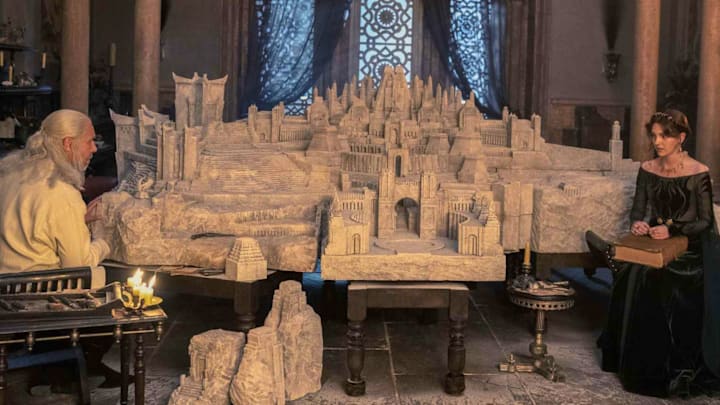
King Viserys in House of the Dragon spends his reign obsessively building a scale model of Old Valyria in his chambers.
The last living thing from Old Valyria
There is one final, quietly devastating detail worth noting.
Balerion the Black Dread, the dragon that Daenys Targaryen herself had claimed the night before her famous dream, lived for centuries. He survived the Doom. He flew Aegon the Conqueror across Westeros. He forged the Iron Throne. And he lived on, growing ever more enormous and ancient, until he finally died of old age in 94 AC.
For centuries, as empires rose and fell and the world forgot what Valyria had been, Balerion was still alive. The last creature to have seen Valyria with its towers intact, its dragon roads whole, its people going about the business of running the world.
When Balerion died, the last living link to Old Valyria died with him. What remained was only memory. And memory, as Westeros would discover, is a fragile thing.
Sources drawn from George R.R. Martin's A Song of Ice and Fire book series, The World of Ice and Fire companion volume, the Histories & Lore supplementary materials, the Game of Thrones and House of the Dragon television series, and the associated wiki documentation at A Wiki of Ice and Fire (westeros.org).
 Add us as a preferred source on Google