

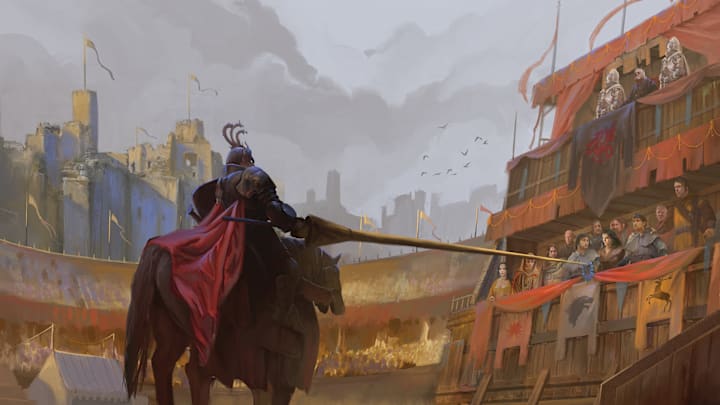
Mark Addy's King Robert I Baratheon only appears in the first seven episodes of Game of Thrones, and yet the rebellion he helped lead is one of the saga's most notable storylines. While never directly shown on-screen, Robert's Rebellion is a major catalyst in what becomes the HBO adaptation's core storyline. And yet, information about the war is only drip-fed to the audience as the show progresses. It's a vital period of Westeros' blood-soaked history, and so it's important to know how and why it happened.
Rebellions are nothing new in genre-heavy storytelling like Game of Thrones. However, George R.R. Martin's fantasy epic is among the minority when it comes to how Robert's Rebellion is chronicled. While most stories like this would follow a rebellion from its inception right through to its end, Game of Thrones picks up around 17 years after Robert's victory. As such, it's never at the forefront of the show, but is rather tantalizingly out of reach and dependent on context clues and dramatic, related revelations down the line. That said, there is a significant amount of official lore surrounding the conflict.

What started Robert's Rebellion in Game of Thrones?
Simple questions often have simple answers, but not this one. While it's not impossibly complex, it's not a straightforward matter, either. There are actually a few different reasons why Robert's Rebellion happened, but they're all interconnected. So, let's address them in chronological order. They're a mix of love, hatred, and unhinged madness — the perfect cocktail to set Game of Thrones in motion.
King Aerys II "The Mad King" Targaryen became unfit to continue to rule
What is arguably the bedrock of what would become Robert's Rebellion is the unusual cruelty of the ruling monarch at the time. King Aerys II gradually became less mentally stable over time, taking out his unearned anger and lust for punishment on his subjects. Many started to speculate that his erratic behavior and irrational paranoia were signs of a rapidly declining mental state. Regardless, the Iron Throne remained his, as there was no real precedent for removing a king from power by force.
While the Targaryens didn't act, Aerys' cruelty didn't go unnoticed by those in other Houses. The Mad King's actions should have been enough for the other Great Houses of Westeros to dethrone Aerys, but for a long time, they seemed equally paralyzed by the fact that the King was the King, and that was that. However, other factors did start to arise that gave certain key characters more personal reasons to rise up against the crown. Let's explore them.
Lyanna Stark voluntarily eloped with Prince Rhaegar Targaryen
If Robert's version of events were to be believed, then his reason for inciting the plot to take the Iron Throne and end the Targaryen dynasty was to seek justice for the woman he was supposed to marry. While Lyanna Stark (Aisling Franciosi) was betrothed to Robert, he claims that Prince Rhaegar Targaryen (Wilf Scolding) abducted his future wife, raped her, then murdered her. Although this is believed to be true throughout most of the show, it's eventually revealed to be a distorted version of what really happened.
In fact, Rhaegar and Lyanna were deeply in love, and it was her choice to elope with the heir to the Iron Throne, who had the marriage to his former wife, Elia Martell, anulled before leaving King's Landing. They were then legitimately married, and Lyanna died shortly after giving birth to their son, Aegon Targaryen — who was later revealed to the audience to be Kit Harington's Jon Snow. Robert's hatred for and jealousy of Rhaegar didn't allow him to even consider this version of events, and Addy's character was filled with the desire to rebel against the Targaryens at large, but mainly to take revenge against the man that Lyanna chose to be with. In other words, he all but extinguished an entire family tree because his feelings were hurt.
Ned Stark's father and brother were brutally murdered by the Mad King
The death of Lord Rickard Stark and his son Brandon (not the Bran who became king in season 8) was the biggest reason for Sean Bean's Lord Eddard "Ned" Stark to take up arms against the Mad King. Seemingly believing Robert's story about Lyanna being abducted by the Targaryens, Brandon (Ned's brother) rode to King's Landing and demanded her release. However, the Mad King had him falsely arrested for treason. Aerys then lured Rickard to King's Landing under the guise of negotiating his son's release, but also took the Lord of Winterfell prisoner. Rickard was then burned alive in the throne room while his son watched.
Brandon was given the hollow chance to save his burning father. The Mad King had placed a sword out of reach of Brandon, with the implication being that Rickard could be cut free before he cooked to death in his own armor. Brutally, the more Brandon strained to reach the sword, the more he choked himself with the device the Mad King had had placed around his neck. Both of the Starks died. This scene was shot for the original, unaired Game of Thrones pilot, but wasn't included in the final edit.
Instead, Nikolaj Coster-Waldau's Jaime Lannister, who was present at the grim execution, tells Ned about what happened in season 1. Ned inherited his father's title as the Lord of Winterfell and strengthened the Stark armies by marrying Catelyn Tully (Michelle Fairley), who had been his late brother's intended wife. He then marched on King's Landing with Robert.

Which houses fought against the Targaryens with Robert & Ned?
It goes without saying that Houses Stark and Baratheon were united in their decision to try to sack King's Landing and kill the Mad King. While Ned was motivated by the murder of his kin, Robert had a more generalized desire to extinguish the Targaryen dynasty by killing as many of them as he could. Still, the Rebellion wouldn't have been successful had it not been for the loyalty and winning over of the other Great Houses. Ned's marriage to Catelyn secured the loyalty of House Tully, as did the marriage of Jon Arryn to Lysa Tully (Kate Dickie). Because Jon was a sort of second father to Ned, House Arryn didn't hesitate to unite with the Starks and Tullys.
Even then, the fighting — which lasted roughly a year — struggled to make it clear who would emerge victorious. It was the Battle of the Trident that turned the tide. Robert finally killed Rhaegar during the battle, and the rebels made it clear that they were the favorites at this point. This caused the Houses Lannister and Greyjoy to defect, and Lord Tywin (Charles Dance) fooled the Mad King into allowing his army into King's Landing to help defend the city, concealing the fact that the Lannister army had switched sides. Once inside, it wasn't long before Jaime earned his derogatory Kingslayer title, and the Rebellion was over. The Rebels were victorious.

The immediate fallout of Robert's Rebellion in Game of Thrones
The most obvious turn in the wake of Aerys' death was that Robert became King. While Ned could arguably have taken the Iron Throne instead of his friend, Robert's claim hinged on being a slightly more prominent leader in the Rebellion, as well as having Targaryen blood from his mother's side. Ned remained Lord of Winterfell, and Jon Arryn became Robert's Hand of the King. To mend the distrust between Houses Baratheon and Lannister, Lord Tywin offered his daughter (Lena Headey's Cersei) for Robert to marry and solidify the bond between the families. They tied the knot, and I think we all know how that played out.
Houses Tyrell and Martell had remained loyal to the Targaryens throughout Robert's Rebellion, but surrendered once Robert was on the Iron Throne. They pledged fealty to him as the new King of Westeros. Perhaps the most notable impact of Robert's victory isn't directly referenced in Game of Thrones, but is instead revealed in House of the Dragon. Despite being set before Game of Thrones, the HBO spinoff offers up a fascinating side-effect relating to the end of the Targaryen dynasty.
House of the Dragon reveals that a prophecy with the annoyingly meta title of "The Song of Ice and Fire" is passed down from each King to their heir. So, it's likely that both Aerys and Rhaegar knew about this prophecy, which cryptically teased the arrival of the Night King and the Army of the Dead in Game of Thrones. Because Robert slotted himself so violently into the line of succession, he had no way of knowing what was coming for the living.
Therefore, if the Targaryen dynasty had continued as it always had before Aerys' death, then whoever was in power when Game of Thrones began would have been alert to the looming threat, and maybe it would have been handled more effectively than it was. Robert didn't know, and so couldn't pass on this information to his fraudulently installed heir, Joffrey (Jack Gleeson). Not that Joffrey would have listened, or even believed Robert. Regardless, this is an underappreciated detail in the fallout of Robert's Rebellion within the larger Game of Thrones universe.
Game of Thrones is streaming now on HBO Max. We'll also get to learn more about Robert's Rebellion in the upcoming stage play, Game of Thrones: The Mad King.
 Add us as a preferred source on Google