

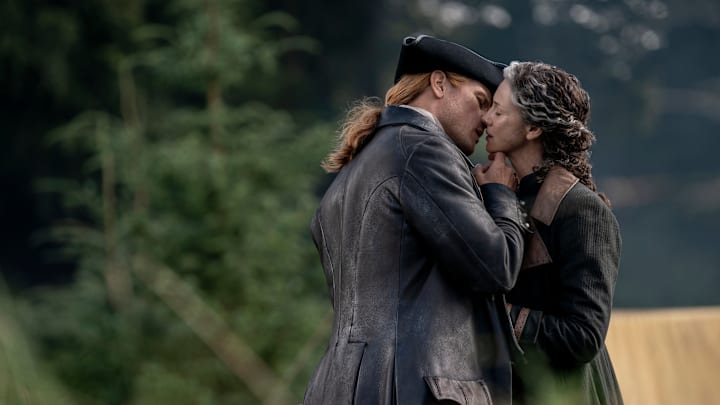
After eight seasons and nearly a decade of heartbreak, devotion, and war, Outlander has ended. The whole episode felt like a callback to season 1, starting with the title, “And the World Was All Around Us,” the same sentence that concludes Diana Gabaldon’s first novel, and continuing with the return of the beloved original version of the Skye Boat Song.
All of this perfectly set the mood for the emotionally charged finale, which brought Claire and Jamie’s story full circle, blending romance, fate, and the supernatural in a way that reflected everything the show has represented since 2014 but at a cost.
The Outlander finale simply did not give closure to fans.
Spoilers ahead for the Outlander finale.
The Outlander series finale follows the long-foreshadowed Battle of King’s Mountain. Jamie behaves like a man deeply aware of his fate: he puts his affairs in order, has a last conversation with his daughter Brianna, and spends precious time with Claire. It’s clear that the tension doesn’t come from the danger of battle itself, but from whether Jamie’s destiny can be avoided—a fate many time travelers on the show have tried unsuccessfully to change.
Despite its entertaining political elements, Outlander has always worked best when focused on Claire and Jamie’s bond, as well as Sam Heughan and Caitríona Balfe’s undeniable chemistry. The finale understands that completely. Much of the episode is shaped by their intimate and conversational scenes. The abundance of tender scenes between Claire and Jamie in the finale almost feels like compensation for their glaring absence throughout much of season 8.

The battle itself unfolds rather quickly and in a brutal way, ending with the British surrender. Jamie and Claire share a relieved expression: the battle is over, and he has survived. But just as the viewers have started to celebrate, Major Ferguson shoots Jamie in the chest.
Claire collapses beside him, refusing to leave his body. Eventually, she seems to accept his death and lies down next to him as if they’re both going to sleep in their bed. Claire exhales one last time and dies beside her husband.
From there, the episode shifts into something dreamlike and ambiguous. The finale abandons realism in favor of emotional symbolism, revisiting Claire and Jamie’s special moments throughout the whole show with a montage.
Just as fans had speculated, the finale gave a solution to a season 1 mystery. We see Jamie’s ghost outside Claire’s window in 1945, the same scene from the pilot. But he doesn’t stay there. He goes to Craigh na Dun, touches the stones, and leaves blue forget-me-nots when his feet touch the ground. It’s like Jamie was the one who put everything into place so that Claire would find him. Their story had always been a history loop, both predestined and self-created at once.
The camera goes back to Jamie and Claire—now dead and with her hair fully white. And suddenly, they both gasp awake together.
Why the Outlander finale doesn’t fully work
Rather than delivering a “conventional” happy ending or leaning into the tragic vein of the story, Outlander chose ambiguity. Don’t get me wrong—ambiguity can work well in finales, as seen with series like Lost.
Here, it mostly feels like the writers refused to commit to an actual ending and preferred leaving things open.
Did Jamie die? Was he resurrected? Did Claire somehow heal him? Are they alive at all? The episode hints at all these possibilities without fully exploring any of them. By the end, the audience—and not just them—is left more confused than satisfied.
Sure, it is a fitting conclusion if you focus on the more sentimental aspects. Claire and Jamie’s love story never truly ends because it exists outside ordinary time, and Outlander has spent eight seasons demonstrating it. Underneath the impactful moral of the story, the emotional payoff feels almost manipulative.

The finale suffers from season 8's pacing problem
Despite being the longest episode of the season, the finale still suffers from major pacing problems. Nearly everything surrounding Claire and Jamie’s intimate scenes feels uneven and underdeveloped.
Considering the series spent nearly a decade building these relationships and storylines, the finale feels strangely rushed. Supporting characters are quickly pushed aside, major arcs receive minimal resolution, and entire emotional threads are wrapped up with a few quick conversations. The extended Fraser family barely receives the attention they deserve. The result is an ending that feels surprisingly impatient.
Still, even a disappointing finale cannot completely erase what Outlander accomplished at its best. The series gave television one of its most enduring romantic pairings, and Heughan and Balfe carried the material with remarkable consistency from beginning to end. Their performances elevate every scene they are in, and that made all the difference in the finale.
As a final chapter, “And the World Was All Around Us” never fully lands. As a longtime fan, I certainly appreciate the romance and callbacks, but I also feel frustrated that a series built on such rich emotional storytelling ended with so many unanswered questions and so little narrative clarity.
In the end, Outlander’s ending is not disastrous—just deeply unsatisfying. It offers moments of beauty and strong performances, but they are buried beneath a messy, overly mystical conclusion that struggles to deliver the payoff this monumental story deserved.
 Add us as a preferred source on Google