

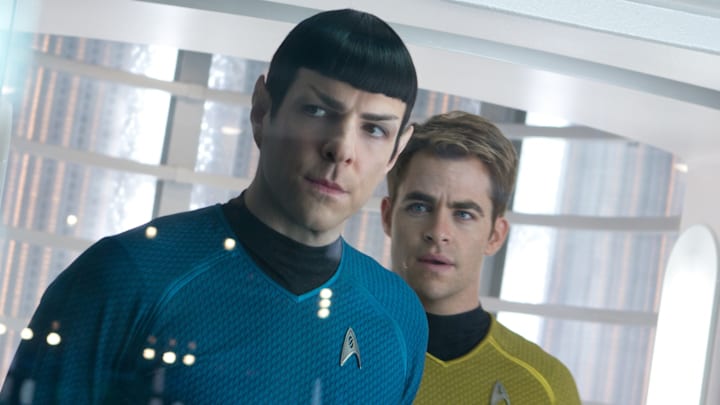
Just days ago at CinemaCon 2026 in Las Vegas, Paramount Skydance confirmed what fans have been waiting nearly a decade to hear. Star Trek is returning to the big screen. The new film, reportedly helmed by Dungeons & Dragons: Honor Among Thieves duo Jonathan Goldstein and John Francis Daley, won't be connected to any previous movie or TV show. It's a full reset and a completely new story.
Which means the Kelvin Timeline is officially done.
For all the frustration that surrounded Star Trek 4's decade-long development hell, there's something worth pausing for here. J.J. Abrams' reboot trilogy gave us three distinct movies, a stacked ensemble and a version of the Enterprise that genuinely made even non-Trekkies care. Before we race toward whatever comes next, let's give these films their due, ranked from worst to best.

3. Star Trek Beyond (2016)
The third installment of the Kelvin Timeline finds James T. Kirk midway through the Enterprise's five-year mission, quietly burning out and questioning whether all of this is still worth it. Then a distress call sends the crew into a nebula where a warlord named Krall ambushes them, tears the Enterprise apart in one of the most spectacular ship-destruction sequences put to film, and scatters the crew across an unknown planet.
From there it's a survival story where they find each other, find a way off the planet, and stop Krall from unleashing a weapon capable of wiping out the Federation.
There's a real argument to be made for Beyond as the most genuinely Star Trek film of the three. Written by Simon Pegg and Doug Jung, it strips everything back to the franchise's core question — what do these people mean to each other and what do they stand for? — and answers it with more honesty than either of its predecessors.
The character pairings are the film's single greatest achievement and Beyond is smart enough to break up the usual groupings. Spock (Zachary Quinto) and Dr. Leonard "Bones" McCoy (Karl Urban), stranded together and forced to rely on each other produce some of the best material either actor got across the entire trilogy. Their dynamic has the texture of a decades-long friendship disguised as mutual irritation; Bones needling, Spock deflecting, both of them quietly grateful the other is there, which is, of course, exactly what it is. It's funny and surprisingly moving.
Montgomery "Scotty" Scott (Simon Pegg) gets his own unexpected showcase, teaming up with Jaylah (Sofia Boutella), a resourceful alien survivor who's been marooned on the planet for years. Meanwhile, Hikaru Sulu (John Cho) finally gets a genuine command moment that he handles with the kind of quiet authority the character deserved all along. And young Pavel Chekov (Anton Yelchin - we love and we miss you), the youngest of the crew at barely 17 when the voyage began, gets to be Kirk's right-hand man on the ground. Yelchin, tragically, died before the film's release and Beyond was dedicated to his memory. Watching him here, knowing what was to come, is its own kind of bittersweet.
Visually, Justin Lin brings a different stylistic approach to the trilogy than Abrams, with less lens flare and more chaos and scale. The destruction sequence of the Enterprise is jaw-dropping. And Starbase Yorktown, the gleaming floating city at the edge of Federation space, is one of the most beautiful pieces of sci-fi production design of its decade.
Idris Elba's Krall, once the film reveals his full backstory, works as a genuine dark-mirror villain who gave everything to Starfleet and felt abandoned by it, whose rage is legible even if his methods are monstrous.
Beyond landed in a brutally crowded summer of 2016 and it never found the audience it deserved. But there's also a structural looseness to the middle act that the other two films, whatever their flaws, don't have. Beyond is the Kelvin film that most clearly knew what it wanted to be. It just didn't quite stick the landing.

2. Star Trek (2009)
The film that started it all opens with a Romulan named Nero arriving from the future, who is burning with grief over the destruction of his homeworld, and in doing so splintering the timeline into an entirely new alternate reality. We watch a young James Kirk grow from a reckless Iowa kid into a cadet who earns command of the Enterprise faster than anyone thought possible.
Alongside him, a young Spock navigates being torn between two worlds, Vulcan and human, while the crew assembles piece by piece with McCoy, Uhura, Sulu, Chekov, and Scotty. And threading it all together is the older Spock (Leonard Nimoy, returning) who bridges the timelines and gives the whole thing an emotional anchor it desperately needs.
This is as clean a franchise revival as we've seen in modern blockbuster filmmaking. The 95% on Rotten Tomatoes isn't hype and Abrams and his writers found a way to honor 50 years of Star Trek without being buried by it, using the alternate timeline as a narrative permission slip that freed them from continuity without disrespecting what came before.
What makes the 2009 film work so deeply, though, is the chemistry between Chris Pine and Zachary Quinto. Pine plays Kirk as all instinct and bravado, Quinto plays Spock as suppressed and precise, and yet every scene they share crackles. The tension between them and the two fundamentally different ways of being in the world, learning slowly and grudgingly that they need each other, is extremely compelling.
By the end of the film, when that partnership clicks into place, it genuinely feels like something has been earned. But the wider ensemble is the real revelation and this is the film that introduces them all. Karl Urban's Dr. Leonard "Bones" McCoy practically channeling DeForest Kelley without ever doing an impression of him, finding the warmth and the exasperation and the loyalty that defines the character and making it entirely his own. The scene where a newly-recruited Kirk sits next to him on a shuttle, this nervous, unhappy man listing his ex-wife's grievances as justification for joining Starfleet, is the funniest and most instantly endearing character introduction in the trilogy. You know Bones completely in three minutes.
Zoe Saldaña's Nyota Uhura arguably gets more to do here than the character ever did in the original series. She's sharp, competent and has a dynamic with Spock that adds an entirely new dimension to both characters. John Cho brings a quiet, unshowy authority to Hikaru Sulu that makes every scene he's in feel slightly steadier. And Anton Yelchin's Pavel Chekov, the youngest and most enthusiastic person on the ship, is pure joy every time he's on screen. Yelchin plays him with an enormous amount of heart and the character's eagerness never tips into irritating because Yelchin is just genuinely good in the role.
Simon Pegg's Montgomery "Scotty" Scott doesn't appear until late in the film, but he makes an immediate impression, all comic, warm, endlessly inventive and completely in love with the Enterprise. The fantastic rapport he has with the rest of the cast from the jump is a testament to how well this ensemble had already calibrated itself.
And the dynamic between all of them, this group of people too young to be doing what they're doing, somehow doing it anyway, finding in each other the family none of them quite had, gives the movie an energy that's genuinely difficult to manufacture and impossible to fake.
Visually, Abrams and cinematographer Daniel Mindel pushed the Kelvin aesthetic hard. Warm, sun-drenched, flare-heavy in a way that felt genuinely fresh at the time and gave the future an almost photographic quality. The Enterprise herself, reimagined from the original but faithful to its spirit, looks extraordinary.
The one thing holding the 2009 film from the top spot is its villain. Eric Bana's Nero has understandable motivation but almost no screen presence. He's a placeholder where a great antagonist should be and the film knows it, which is perhaps why it front-loads so much of its emotional energy into the Kirk-Spock and crew dynamic instead.

1. Star Trek Into Darkness (2013)
The sequel picks up with a rogue Starfleet operative, introduced as John Harrison, launching a devastating terrorist attack on Federation leadership after which Kirk takes the Enterprise on an unsanctioned manhunt to the Klingon homeworld. What he finds when he gets there is more complicated than a simple villain.
Harrison is not who he claims to be, the mission is not what it seems and the real threat may not be coming from outside the Federation at all. It's a story about institutional corruption, about leaders who weaponize loyalty and about what happens when the chain of command asks you to do something you know is wrong.
Here's the thing about Into Darkness that gets lost in the discourse. If you watch it free of baggage, free of nostalgia, free of the protective instinct that long-time fans rightfully have for what came before, you are watching one of the best-crafted big-budget sci-fi films of the 2010s.
And a lot of fans genuinely can't do that. It's understandable. When a film remixes something with so much legacy, the remix is always going to feel wrong to the people who loved the original most. But for a viewer who came to Into Darkness without that history? The villain reveal lands. The emotional beats hit. The stakes feel real. There's a reason it became the highest-grossing Star Trek film ever made. Audiences responded to it, even if the most dedicated corners of the fandom did not.
Benedict Cumberbatch's performance is controlled, cold and magnetic in a way that makes every scene he occupies feel dangerous. When he's sitting in a holding cell and somehow still the most powerful person in the room, you believe it completely. It was called a tour de force at the time and it wasn't wrong.

But the real reason Into Darkness earns the top spot is what it does with every single member of the ensemble, and we mean every single one. Not a character beat was missed.
Kirk is no longer the scrappy underdog of 2009. He's a captain and this film forces him to actually reckon with what that means. Having been handed command perhaps before he truly deserved it, he faces the gap between confidence and wisdom in ways the first film only gestured toward. Spock has made progress on his emotional journey but not nearly enough, and Into Darkness leans into that gap with real precision. And the Kirk-Spock dynamic, already strong, becomes something deeper here as they finally stop pretending they don't need each other.
Dr. Leonard "Bones" McCoy gets to be the moral compass of the whole operation, the one in every room asking the question everyone else is avoiding, and Urban plays it with a bluntness that never tips into self-righteousness. His chemistry with Pine and Quinto feels three-dimensional, the kind of trio where you understand every relationship in the group without it needing to be explained.
Nyota Uhura's relationship with Spock gets the kind of honest, difficult texture that most blockbusters would flatten out. Scotty has his own arc here, and the moment he resigns his commission rather than follow an order he doesn't believe in is small and true and completely in keeping with who the character is. Hikaru Sulu gets an acting captain moment that's genuinely intimidating. Sulu telling Harrison exactly what's going to happen to him, with absolute calm, and is one of the film's best scenes.
And Pavel Chekov, barely out of the navigator's chair and suddenly in an engineering jumpsuit, runs the length of the ship trying to hold everything together in his staple anxious and brilliant way.
Every person on that core crew gets a moment. Not a single character is wasted. And that is extraordinarily rare.
And then there's the iconic radiation chamber sequence and the infamous role reversal. In the 1982 original, it was Spock who climbed into the warp core and sacrificed himself to save the ship, and it was devastating. Into Darkness flips it completely. This time it's Kirk who crawls in, Kirk who is dying on the other side of the glass while Spock stands there with nowhere to put his hands, unable to close the distance, unable to do anything. Pine and Quinto, separated by a pane of glass, with barely any dialogue between them — that moment, it destroys you. Because these actors have spent two films building a specific, irreplaceable thing between them, and in this moment you realize, with some surprise, that you are entirely invested in it.
Visually, Into Darkness is the most ambitious and the most beautiful of the three films. Every frame feels considered — the chase through future San Francisco, the devastation of Starfleet headquarters, the claustrophobic tension of Harrison's holding cell, the vast cold loneliness of space. The production design of the future Federation reaches a level of grandeur here that makes the world feel genuinely real, genuinely worth protecting. And Michael Giacchino's score, as across all three films, does more emotional heavy lifting than it ever gets credit for.
Does the script have seams? Yes. Could the villain's identity have been deployed with more confidence, more conviction and less hedging? Probably. But the argument that Into Darkness is a lesser film requires you to look away from everything it gets right and what it gets right is the hardest thing in franchise filmmaking, as it makes you feel something real about characters you already know. It's visually spectacular, morally rich and starred by an ensemble doing the best work of their run.
Watched with fresh eyes, without the weight of what it was supposed to be, Into Darkness had everything.
The Kelvin cast gave us three films across seven years and if Chris Pine's gracious parting comment "Have fun, good luck, live long and prosper" is any indication, there's no bad blood. This version of Star Trek ran its course and it's left behind a stronger pop-culture footprint than even its box office suggests.
 Add us as a preferred source on Google