

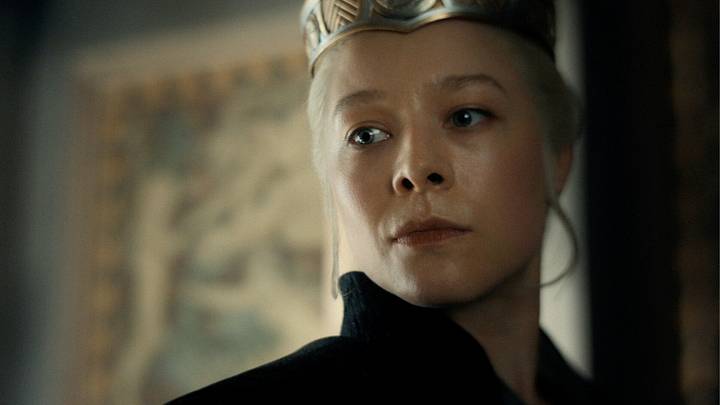
It's nearly time for the dragons to dance. This Sunday, HBO will premiere the third season of House of the Dragon, its wildly ambitious prequel series to Game of Thrones which details a brutal Targaryen civil war in which rival branches of Westeros' dragonriding first family slaughter each other because they can't agree who should sit the Iron Throne. On one side, there's Queen Rhaenyra Targaryen (Emma D'Arcy), the named heir who spent all of last season ruling in exile from her castle on Dragonstone. On the other, the forces of King Aegon II (Tom Glynn-Carney), who have already undergone at least one major power shift thanks to a fiery betrayal from his younger brother, Aemond One-Eye (Ewan Mitchell).
How will these factions collide in season 3? And can it finally pay off the years-long hype for the Dance of the Dragons civil war, which has so far left fans divided with its slow start and underwhelming cliffhanger finale for season 2?
Having seen the first four episodes of the season, I can honestly say I'm extremely torn on whether House of the Dragon hit that mark. There are undeniably epic set pieces to be had here, and when the show leans into them, it does it pretty much better than anything else on television. The much-anticipated Battle of the Gullet more or less lives up to all the hype that showrunner Ryan Condal stirred in the months leading up to its release. There are also quiet moments the show does better than anything since its first season, and I'd go so far as to say they're at least as good as any of the action.
At the same time, House of the Dragon seems unable to resist making strange decisions that leave me scratching my head, from those that broke my immersion by making me outright laugh at inappropriate moments, to others which awkwardly tried to pay homage to parts of the book to varying degrees of success, to yet others where I caught myself muttering "what were they thinking?" under my breath as I watched.
I thoroughly enjoyed most of what I've seen of House of the Dragon season 3 so far. At the same time, I can't recall the last time a show left me so utterly divided about whether I thought it was succeeding at telling the story it set out to tell or not. Obviously, as a book reader I'm coming to this show with a lot of baggage, just like many other book-first fans, and that isn't necessarily a fair way to judge the series — though I do think it has merit, and is perfectly reasonable, to analyze this beast from an adaptation perspective as well.
As such, I'm going to put on two caps for this review. First, I'm going to talk about the show as a whole, focusing on the production and story in ways that I think are more relevant to viewers who haven't read George R.R. Martin's novel Fire & Blood. Then, I'm going to put on my bookish cap and dig into the can of worms that is my issues with House of the Dragon season 3. I will be keeping things SPOILER-FREE as much as possible.

The start of House of the Dragon season 3 is really the end of season 2
The third season of House of the Dragon picks up right where season 2 left off, with Rhaenyra fresh off her meeting with Alicent Hightower (Olivia Cooke) where it was agreed she would take King's Landing and the Iron Throne, all while a fleet of pirates from the Free Cities sailed to ambush Corlys Velaryon's (Steve Toussaint) blockade of the city and armies were on the move in the Riverlands. None of that should be much of a surprise considering that the second season was originally planned to run for 10 episodes, before a mandate from the studio saw it cut down to eight, with its final two moved to the following season.
For the most part, the first two episodes of House of the Dragon season 3 really do feel like they should have been episodes nine and 10 of season 2. If there was any sort of significant rework of them to make them fit as season openers instead of closers, I failed to notice. That said, they do work as a pretty explosive way to kick off the season, especially the aforementioned Battle of the Gullet and the climax of Episode 2. By the time the show hits its third episode, it's easy to forget about this slightly odd pacing altogether. Of the four I've seen, Episode 3 is my favorite by a wide margin, but it would not have worked at all as a season opener. It was the first time I felt House of the Dragon season 3 was gelling not just as a follow-up to season 2, but as a full new season in its own right.
All this is to say, the show comes out of the gate strong and doesn't really let up until Episode 4, which makes some very weird decisions that did not work at all for me. Season 3 hits the ground running in a way neither of the previous two seasons could, because it was forced to include what should have been the season 2 climax as its premiere. That will no doubt please fans who've wanted more bloodshed in the series, and in that regard, I don't think they'll be disappointed.

House of the Dragon season 3 is fantasy TV at its most spectacular
The place where House of the Dragon truly shines is in its production value. From its absolutely top tier cast, to its brilliant costuming, lavish sets, keen direction, fantastic scoring from Thrones veteran Ramin Djawadi (who does some of his most interesting work on the franchise in years) and more, there is never any doubt that HBO is producing fantasy television at the highest level here. That's especially true of the dragons. Do I wish some of them got more screentime? Of course. But it's undeniable that any screentime the dragons do get in this show is nothing short of award-worthy. It's never been clearer that House of the Dragon's titular monsters are being brought to life by some of the finest VFX artists in the business, who are at the top of their game.
In terms of the sheer spectacle of it all, House of the Dragon does not disappoint. That isn't relegated to just the dragons, either. Many of the show's longtime actors, like Matt Smith (Daemon Targaryen), Olivia Cooke, and Emma D'Arcy deliver some of their best work of the series in the episodes I've seen — especially D'Arcy, who should be a total shoe-in for an Emmy nomination this season. Newcomers like James Norton (Ormund Hightower), Dan Fogler (Torrhen Manderly), and Tommy Flanagan (Roderick Dustin) also bring something valuable and interesting to the show's sprawling cast. Any time any of them is on screen, I found myself paying slightly more attention. I'm looking forward to seeing more of them in the back half of the season.
If you want to watch solid fantasy television that will wow you with its special effects, battles, incredible acting and sets and costumes and more, then House of the Dragon easily fits that bill — and its third season fits it just about better than ever. I may not have liked the Battle of the Gullet quite as much as the Battle at Rook's Rest last season, but I'd never deny that it's a riveting setpiece that's a blast to watch. The show has grown into its own, and that means that it's a more confident production than ever that will undoubtedly entertain viewers.
All that said, we now have to talk about the reason I am not just ridiculously over the moon about House of the Dragon season 3 — and after giving it a lot of thought, it mostly boils down to one thing. Let's get into the Fire & Blood reader side of this review.

House of the Dragon's writing fails what should be a great season
At a press conference ahead of season 3, showrunner Ryan Condal reiterated multiple times that the show is a "very faithful adaptation" of Fire & Blood. Yet while it does land some of the large beats well, like the Gullet, I can't help but feel this is completely, utterly untrue. Once it leaves behind its two big story moments in the first two episodes — plot points that are so essential they are all but impossible to cut — the show makes so many deviations it may as well be telling a different story, albeit with a few familiar sign posts along the way.
Were that story good, I could get behind those deviations. Episode 3, for example, certainly has many plot elements that aren't in Fire & Blood, but does most of them so well I didn't mind it outside of one particular storyline. But often the deviations are just plain odd, or take something from the book and implement it in a just slightly worse way that left me wondering why it was altered at all.
To be clear, these aren't all things that will just jump out to book readers. There are also moments I fully expect show-only watchers to frown at, too, including some absolutely horrible handling of Alicent Hightower in the season's first few episodes and a scene which should stand as a dark turning point for Rhaenyra but makes absolutely no sense in the wider Game of Thrones franchise as it's established on screen.
There were many of these moments, enough that even when I was fully invested in watching House of the Dragon, I could count on there being at least one scene each episode that would jar me out of the episode. Ormund Hightower is another example; for as much as I have looked forward to the character, and as much as James Norton is absolutely killing it in the role, I think the writing has utterly failed at making him feel like a cohesive member of the same great house as Otto (Rhys Ifans), Alicent, and Gwayne (Freddie Fox).
There are also a number of moments that do the exact opposite of what George R.R. Martin laid out in his book, or speed-run them in a way that isn't nearly as coherent. Rhaena Targaryen (Phoebe Campbell) has a plotline this season that is pretty much guaranteed to be controversial with book fans, and so far I'm still not convinced it was a good choice for the series. Criston Cole (Fabien Frankel) quietly became one of the most interesting characters on the show last season, only for much of that hard-won development to go out the window here.
Daeron Targaryen, the youngest son of Alicent Hightower, is another similar sticking point. The show held back Daeron until season 3, which put an unnecessary amount of pressure on landing his introduction well. I wish that I could say that it pulled it off, but from what I've seen, I have very little confidence in how the show is handling Daeron or anything associated with him and his dragon Tessarion.
I could keep listing the things that took me out of House of the Dragon season 3, but I think you get the idea. For every storyline House of the Dragon is handling seemingly well, such as Rhaenyra's descent, there are two others that left me shaking my head. And it all comes back to the writing, and the overall plan for the season, more than the execution of anything that actually ended up on screen.

The problem with these writing issues is two-fold. One is that this show is adapting the work of George R.R. Martin, and for as good as the writers on House of the Dragon often are, they simply are not on the same level as Martin, who is a generational talent in the fantasy field. When the show goes off on its own trajectory, many of the beats it introduces simply do not live up to those they're trying to replace from Martin's book, regardless of whether they're big ones or even small lines of dialogue.
That spills over into the second problem: Martin is an extremely methodical writer when it comes to one event causing the next, and the next, until it all becomes a total pressure cooker that leads to breathtaking moments like the Red Wedding. House of the Dragon plays fast and loose with its cause and effect, to the degree that the next big battle it's setting up after the Gullet already feels destined to fail to me, because thus far it has so thoroughly botched the set up of it. I don't doubt the spectacle will be fun to watch, but I'm much less convinced it will make any sense.
There's still time for House of the Dragon to turn around these frustrations I've had, but it hasn't given me a lot of confidence that it's going to do it. So for as much as I have enjoyed season 3, I have a feeling that by the time all's said and done, it's going to be remembered as a season which frustrated fans of the source material just as much if not more than season 2. I hope it goes over better with the general audience, and I don't doubt that it will...but I'm not expecting it to have the sort of impact of say, A Knight of the Seven Kingdoms, a small-scale show that proved astute storytelling and charming performances were more than a match for dragons any day.
Verdict
House of the Dragon season 3 is a big-budget fantasy spectacle that is the absolute definition of must-watch television. For any flaws it may have in conversation with its source material, or even the general telling of its story overall, it's impossible to deny the cultural footprint and filmcraft at work in this show. There simply is not anything else on television like it. It's painful, because with such incredible people working on the series it's easy to see how it could be even better than it is, were it not so strangely reluctant to lean on the book that it's adapting. As it stands, I fully expect House of the Dragon season 3 to blow audiences away and frustrate them in equal measure.
Grade: B
 Add us as a preferred source on Google