

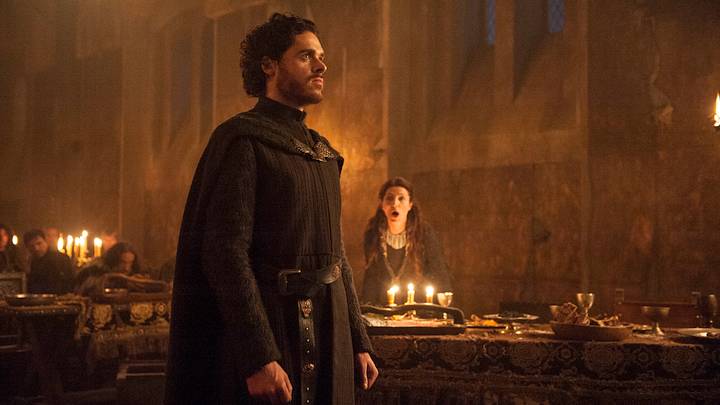
13 years ago, audiences worldwide tuned in to watch the ninth episode of Game of Thrones season 3, titled “The Rains of Castamere.” Fans of the book series already knew what was coming, but the rest of the world was oblivious to the horrors awaiting on the other side.
In fact, most believed that the happy ending that's normally promised in any fantasy tale might finally be within grasp. However, the sequence that followed not only changed television history as a whole but also left spectators with their jaws on the floor in disbelief at what they had just witnessed.
The Dothraki usually say that a wedding without at least three deaths is considered a dull affair, but the Freys and Lannisters took this phrase a little too literally.
13 years later, and we have not gotten over how brutal, dark, and hopeless the Red Wedding really was. Watching that moment for the first time was a unique experience that hasn't really been replicated on that scale by any other show to date. Not only that, but the television landscape has changed so much over the last few years that having another Red Wedding moment now would be rare (if not impossible).

It's unlikely we'll ever get another Red Wedding
The Red Wedding is a massive accomplishment for many different reasons that are extremely hard to replicate nowadays. For starters, it was impossible for audiences not to grow attached to the Starks, especially since they appeared very frequently on screen. Although just a little over two years had passed between the show's pilot and the Red Wedding, we had witnessed nearly three seasons of television by that point, spending multiple hours watching the same story.
Unfortunately, the same cannot be said of most modern TV shows, where those same two years usually amount to the waiting period between seasons. The longer audiences spend without watching a specific character on screen, the more their emotional attachment fades away (and that's assuming a modern show can make it to a third season in the first place).
Another key detail to take into account is the era in which the Red Wedding happened. Back in 2013, heroes were usually protected by the script, and somehow they would always find a way to save the day. Granted, key secondary characters could bite the dust, as was the case with Dale Horvath in The Walking Dead. However, audiences saw Robb Stark as the natural heir to the main hero's role, especially after the passing of his father, Eddard Stark. Surely, Game of Thrones wouldn't kill one of its main characters (again), right?
This was a clear and direct message to fans of the series: no one in this tale would ever be safe. Just three seasons in, anyone could bite the dust in a heartbeat, leaving spectators with a real sense of dread and uncertainty for the rest of the series.

Nowadays, it isn't surprising for many stories to kill a seemingly important character halfway through. Case in point, Clair Obscur: Expedition 33 did exactly that in the video game world. Furthermore, some projects will even craft a big death just for the “shock factor,” even though this tactic risks being poorly received. However, Game of Thrones truly made history with the deaths of Robb, Catelyn, and Talisa.
The Red Wedding also came during a very unexpected moment. This wasn't a big series finale or the payoff after a big cliffhanger. Instead, tragedy struck during a moment that was supposed to act as a peaceful celebration. Nobody was prepared to witness such carnage, and yet, this moment didn't come completely out of the blue either.
If you rewatch Game of Thrones, you'll see small teases and hints that point towards the Red Wedding eventually taking place. During Episode 4 of the very first season, it is mentioned that Lord Walder Frey is going to celebrate his 90th name day and plans to take another wife. From that point onward, audiences are presented with cleverly hidden clues that suggest something bad is about to happen.
Another thing that worked in favor of the Red Wedding was its brilliant execution. Honorable characters died in the most dishonorable way possible, and it all happened in a matter of a few minutes, leaving you in a state of genuine shock.
Glenn's death in The Walking Dead is a similar TV moment to the Red Wedding, but one whose execution was met with mixed reactions. After all, Glenn had just been the subject of a fakeout death a season before. Furthermore, The Walking Dead tried to fabricate a lot of anticipation by refusing to show who Negan killed at the end of season 6, leaving audiences on a big cliffhanger and making them wait for a resolution until the premiere of season 7.

The opening moments of Walking Dead season 7 and the Red Wedding are very similar on paper. After all, the two feature the deaths of beloved characters, and fans of the source material already knew what was coming. However, the execution couldn't have been any more different, and that's why Game of Thrones made TV history (for the better).
Another detail to take into consideration is that Game of Thrones was at the top of its game when the Red Wedding happened. While series like Stranger Things and The Boys also became global phenomena, their respective finales—which featured deaths—came after what fans considered to be a streak of underwhelming episodes.
Last but certainly not least, it's hard to deny that it's much easier to come across spoilers of a beloved TV series or movie nowadays. Take Avengers: Doomsday, for example; countless reports have revealed who will make a comeback and what will happen. Even the movie's opening has been broken down in detail. Fortunately, the Red Wedding took audiences worldwide by surprise, as it wasn't spoiled ahead of time (unless you were familiar with the source material, that is).
In conclusion, is it possible to replicate the Red Wedding? Technically speaking, yes. However, for that to happen, a show would need to have yearly releases, allowing audiences to grow attached to its characters. It would need to reach a third season (at the very least), and it should be able to craft a completely shocking moment that was foreshadowed earlier. And, of course, the execution of this moment should be spot on, and the big deaths shouldn't be spoiled ahead of time...
So, no. I guess we're not getting another Red Wedding.
 Add us as a preferred source on Google