

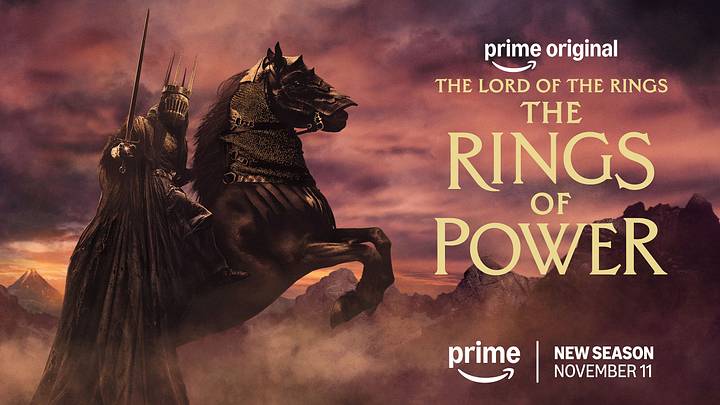
Season 3 of The Lord of the Rings: The Rings of Power is blessed with the best opening sequence yet, black sand amassing into smoky, swirling shapes. It’s a perfect metaphor for the mysterious, elusive rise of Sauron’s forces in this season, and for his blacksmithing mission to forge the One Ring. Libby Dempster’s costumes carry much of the season’s mood, and showrunners Patrick McKay and J.D. Payne, who executive produce and write, have saved some spectacle for this episode.

Númenor moves at pace
The Númenor storyline is finally advancing at pace, with the first inklings of Pharazôn (Trystan Gravelle) becoming jealous of Sauron and his encroaching dominion of Middle-earth. In the Akallabêth, one of the last chapters of The Silmarillion, this envy sends him sailing to Middle-earth to humble the Dark Lord, setting off a chain of events that brooks Pharazôn’s well-deserved downfall. Season 4 should be the season to finally complete this key Second Age tale, since season 3’s focus appears to be the Dark Lord’s mission to complete the One Ring.
Isildur's assassination attempt on Pharazôn reflects a subtler act of defiance in The Silmarillion. He steals a fruit of the White Tree before Pharazôn can have it burned, and nearly dies doing it. The show’s version is louder but carries the same message—Isildur won’t let Pharazôn destroy the spirit of old Númenor.
After season 2 separated Isildur and Elendil, the joy of their reunion is every bit as heartwarming as it should be, and even better done under the mystical gaze of the Palantír. The way thought and reality dissolve and blur recalls the Pensieve from the Harry Potter movies, which is an evocative communication of the Seeing Stones’ diverse magical potential. The story of Eärien, an original character, comes to a devastating conclusion, making way for season 4 to focus fully on Númenor's book plot.

Sauron the Necromancer
Sauron (Charlie Vickers) raising the dead for Theo (Tyroe Muhafidin) never happened in the books, Theo being an original character. However, it throws long-time fans and Tolkien obsessors a bone in its throwback to The Lay of Leithian. Here, an early version of Sauron called Thû lived as the necromancer of the Wizard’s Isle, with “phantoms” and “wandering ghosts” doing his bidding.
Centuries later, Sauron hid in Mirkwood as the Necromancer of The Hobbit. The show has found his oldest face. Serving horror movie witchcraft and psychics, Sauron's eyes roll back in his head as he speaks to Theo's father, fleshing out magical processes that have sparked imaginations for decades. The Nazgnagôl are moving towards being totally subservient to the ring, moving and acting in sync, which makes them appear like one will in nine bodies.
This episode reveals that Eddie Marsan’s Thráin, another original character, has joined Sauron too. This strains canon somewhat—Tolkien wrote that the Dwarves resisted domination, and the Seven fed only their greed for gold. In the legendarium, they were given to “Dwarf-Kings,” most of whom were unnamed. Nonetheless, the Orc Marnûkh is given to Elrond by the Dwarves to be escorted to Galadriel to provide vital intel that could save Middle-earth. Marnûkh is also an original character, but he riffs off Orcs like Shagrat and Gorbag who dream of escaping from the “big bosses” in The Two Towers.

Galadriel’s fight continues
The original character Arondir (Ismael Cruz Córdova) and Galadriel (Morfydd Clark) working together feels meant to be—these two primary heroes from season 1 match each other’s skill. Meanwhile, Galadriel can’t escape Sauron’s seduction even from afar, with Marnûkh meeting her and commenting that Sauron had said she was beautiful and hadn’t lied, for once.
Gundabad is Khuzdul, in the Dwarves’ language, and is identified as the place where an Elven smith with key intel on making Rings of Power is being held. This sets up what may be the season’s (uncanonical) central quest — Galadriel, Arondir and Marnûkh head there in the hope of preventing Sauron from completing his masterwork. In lore, Gundabad was sacred to Durin’s folk as the place where Durin awoke, and in later ages it became an Orc stronghold, which this episode gets right.
Book readers may catch the Nazgnagôl refer to a “trifle,” a nod to the Mouth of Sauron’s wording in The Lord of the Rings. Likewise, Galadriel later refers to her temporary team-up with Arondir and Marnûkh as a fellowship. Just like in Tolkien’s famous LotR novel, they'll travel light, fast, and as friends—or as close as Orcs have come to befriending Elves on screen or page, anyway.
The Rings of Power season 3 is streaming now on Prime Video. Catch up on the new characters of season 3 and the season’s release schedule.
 Add us as a preferred source on Google