

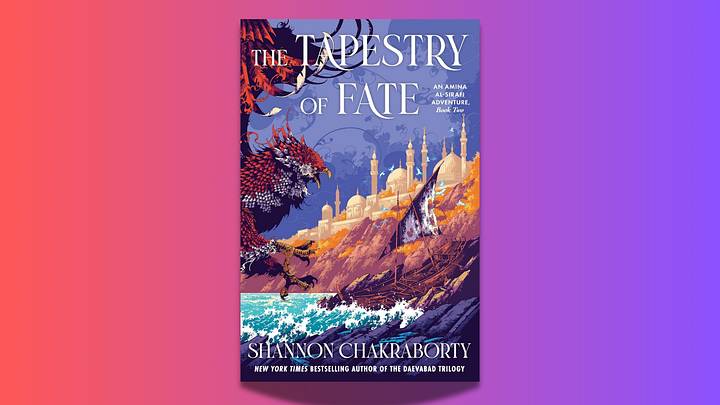
Shannon Chakraborty, the New York Times bestselling author of the Daevabad Trilogy, spent years building a reputation for fantasy that is as historically rigorous as it is genuinely fun. Her stories are set in the medieval Islamic world populated by characters rarely centered in the genre, crackling with wit and consequence.
The Adventures of Amina al-Sirafi extended that reputation into swashbuckling new territory, introducing a middle-aged Muslim pirate captain and mother as its hero. The book became an instant bestseller. The sequel, Chakraborty believes, is even better.
The Tapestry of Fate (Harper Voyager, May 12, 2026) sends Amina on an impossible quest to steal a fate-rewriting spindle from a sorceress on an island no one can escape while managing a suspicious daughter at home, a spirit husband who has caused a diplomatic incident and the ragtag crew fans have come to love in the first book. We sat down with Chakraborty to talk about how the book came to be, what it cost her to write it and what's still to come for the worlds she's built.

A happy accident involving loom weights
It was something of a happy accident, actually. Chakraborty had originally intended the next Transgression, the magical artifacts Amina is tasked with retrieving, to be something more traditionally “epic fantasy.” A weapon, perhaps, or the Mortar of Mithridates that appears in the book's opening. But while drafting, she happened to be listening to a history of textiles, and something clicked.
"It just blew my mind," she said, "to really grasp how utterly commonplace the making of textiles was to people's lives, particularly women's lives." Loom weights, she noted, are among the most frequently discovered artifacts at ancient archaeological sites, and yet they're almost never the things we talk about when we discuss the past. We learn about luxury goods and weapons. The spindle, by contrast, is unglamorous, domestic and almost entirely associated with women's labor which, of course, made it perfect.
"With this trilogy, I wanted to examine the different sort of lives women lived in history, show different ways of being a woman, and here was the oft-unappreciated item and tradition," Shannon said.
The imagery rippled outward from there. So much of The Tapestry of Fate is concerned with Amina seizing control of her own story, charting her own course and here is a literal instrument capable of rewriting fate itself. Words like weave, spin, and spindle quietly saturate the novel.
There is, in fact, an actual tapestry at the story's heart. "It works even better," Chakraborty noted, "because so much of the story is about Amina seizing her own fate and wanting to write her own story... well, how does that pan out when confronted with an instrument that can do literally that?"
She also shared a detail that delighted her. Midway through writing a scene in which the antagonist, a sorceress-weaver, holds her spindle while casting a spell, she paused and thought, “‘Did I just accidentally reinvent the magic wand? Is there actual history behind this?’”
"I would be very curious to know," she said. She suspects there might be.
The hardest book she's ever written
When The Adventures of Amina al-Sirafi came out, she was in the hospital. Her infant, barely a week old was at home, while doctors cycled through blood pressure medications trying to prevent a stroke. This followed a dangerous pregnancy that had ended in an emergency induction, and came in the middle of a years-long medical crisis involving her eldest daughter. Writing a sequel to a book about a swashbuckling mother-doing-her-best felt, in her words, like "a cruel joke."
Chakraborty shared that she took breaks. She worked on other projects. She tried to extend herself grace. The sharpness she had always relied on, the ability to hold intricate historical details in her head, to write without an outline, felt gone. "My brain felt like Swiss cheese," she said. "I was struggling to hold the shape of the story I wanted to tell in my head, gone the moment my family life would pull me away again."
So she changed direction. She allowed herself to build something new including a city, an antagonist, a magic system entirely of her own invention unmoored from the historical research that typically anchors her work. And crucially, she let Amina stop trying to balance everything, "because it's impossible." As she put it: "I told another story. One that let me break out of my usual historical work into a city, antagonist, and magic that I entirely invented and created and loved."
"I think it's even better than the first book," she said. And we couldn't agree more.
The book also is an upgrade to how it handles its antagonist. Where the villain of The Adventures of Amina al-Sirafi was, in Chakraborty's own assessment, fairly flat, The Tapestry of Fate gives us Queen Lab, a fully realized character whose perspective and origin story Chakraborty found "one of the most creative, challenging and enjoyable things I've ever written." She learned early in the drafting process that one of the very first written words in human history is a term for an enslaved woman of foreign origin, a record of a transaction.
"All of our literature, our grand civilizations," she said, "and there's its beginning stemming from the need to succinctly record the transaction of an enslaved woman stolen from her home." Queen Lab's story is, in part, a response to that fact, an attempt to "interact with history in an entirely new way."
When a friendship breaks
Chakraborty always knew she wanted the second book to shine a spotlight on Dalila and the friendship at the heart of the series, partly because female friendships remain underrepresented in SFF, and partly because she wanted to examine how those relationships transform over time.
"From starting out as two young, dashing criminals on the high seas," she said, "these women have gone in incredibly different directions."
Amina retired, had a child, and has been slowly reclaimed by the overwhelming gravity of family life. Dalila chose differently, dedicating herself entirely to her craft and her passions. The questions that arise from that divergence are ones Chakraborty clearly finds rich territory. How has it panned out for each of them? How does it affect how they view the other and her choices? "In many ways, these were aspects that simmered below the surface of the first novel, finally exploding in the second when all these quiet judgments and hidden secrets come pouring out."
And when a friendship genuinely breaks, when there's real betrayal and heartbreak, how do you come back from that? "Can you?" she asked. The answer, characteristically for Chakraborty, is complicated.

Book 3: Amina meets the Mummy?
Chakraborty confirmed that the draft of Book 3 is already done. Fans waiting anxiously can breathe a sigh of relief, as there will not be a three-year gap between books this time.
She was willing to share one tantalizing detail about the next artifact Amina will be pursuing: it comes from Egypt. In her words, delivered with evident relish, “Amina meets the mummy!”
On the collector's front, FairyLoot and Waterstones will both have special editions of The Tapestry of Fate. Details are still to be announced, but if the editions for the first Amina book are any guide, collectors will want to keep an eye out.
Door to Daevabad remains open
Chakraborty is not closing the door on Daevabad. She has ideas and she is "actively toying" with them but she's also being honest with herself about the timing and what she owes herself as a writer.
"By the time I'm ready to write it," she said, "will it still feel right? That depends on how much time has passed." She floated the possibility of short stories, or perhaps something for a newsletter, as a lower-stakes way back into that world first. A full return is not off the table but it's just not on the calendar yet.
What she does know is that after finishing the Amina trilogy, she wants to challenge herself with something genuinely different. She has a few ideas. But the prospect of a fresh canvas, after two trilogies rooted in the medieval Islamic world, seems to genuinely excite her. "I need a break from trilogies," she laughed.
She also took a moment to acknowledge what she hopes readers take from Amina's story more broadly, something that clearly runs close to the bone.
"Being a mother has brought me unparalleled joy," she said. "Yes, balancing a career and friendships and your general passion and inner life with the raising of small humans is sometimes simply impossible in certain seasons of your life. In the end, the kids will come first and that is okay."
Amina's greatest adventure, she noted, will always be her daughter "even if that's not what the legends talk about."
Chakraborty laughed when asked what readers should brace for at the end of The Tapestry of Fate. "I wouldn't say painful," she offered, carefully. But based on her editor's reaction? Prepare for painful.
The early responses she's seen suggest readers will finish the book very, very eager for Book 3. (We can confirm) Given that the draft is already done, at least we won't have to wait long.
The Tapestry of Fate by Shannon Chakraborty is published by Harper Voyager and is available now. You can read our review of the book here.
 Add us as a preferred source on Google