

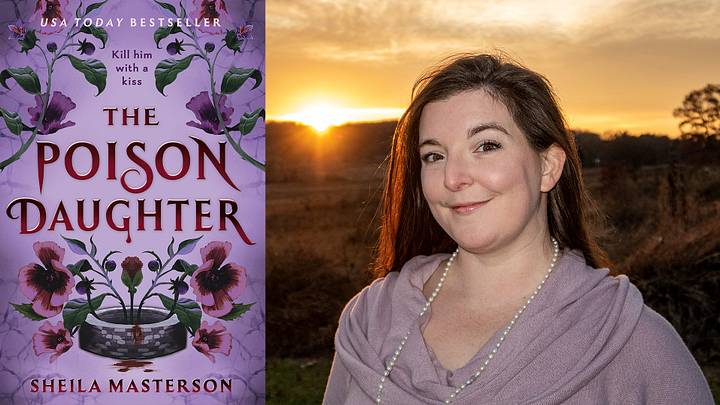
In a world saturated with romantasy, it's often hard for an author that stands out amid the ever-growing options of new books, popular books, and so many others. However, Sheila Masterson has broken the mold and more with her traditional release of The Poison Daughter.
Over the last couple of months on the market, The Poison Daughter has remained a bestseller, shooting to #1 on The New York Times Hardcover Fiction Bestseller list. It became a pick for the classic Book of the Month club and has earned an impressive 143,000+ ratings on Goodreads.
The book follows Harlow, a woman with a poison kiss that she uses to punish evil men. However, when one of her targets turns out to be her newly betrothed, her life becomes much harder as she struggles to figure out what his family’s real ploy is—and what he truly wants — without falling for him.
But making The Poison Daughter the success it became wasn’t easy. We had the chance to talk with Masterson about how she brought Harlow, Mountain Haven, and the whole story to life, despite every aspect of it going against the mold.
Why Harlow was older than the typical heroine
If you’ve read any romantasy book nowadays, you’ll notice there’s a trend. Many heroines are in their early 20s, sometimes their late teens. It’s rare to find a bestselling book in the genre where the character is over 25. In The Poison Daughter, Harlow is pushing 30, which is essentially blasphemy in the romantasy community.
But Masterson was honest, saying a big reason was that she really wanted to explore a character in that “next stage of life,” because in your late 20s, you have a lot more independence, but haven’t yet been entirely “humbled” by the world.
“I think that that was really fun to explore because at that age you have enough independence to get into trouble, but not enough experience to have been humbled by the world," she explained. "And so it can be really fun to write characters like that because they're still kind of learning and growing, and I think that stage of life is like you're figuring out who you are away from your family, kind of like moving into the world, getting more experiences, and that's a very fun thing to write…I really wanted to write about someone who was sort of in this next stage of life, which is…maybe separating from your friend group a little bit, or getting into a relationship, or maybe having kids. There’s a lot of different stuff that happens in your 30s, and I feel like now that I'm 41, I'm removed enough from my early 30s to reflect on it.”
Masterson also stated that another big reason for Harlow being an older main character is because of her poison kiss. While she has had sex before, Harlow has never really kissed someone in a truly intimate manner. It made the character interesting:
“I really loved the idea of writing a character who had a little more life experience, and I think in particular for Harlow, because she has a poison kiss, and I knew that that was going to affect that level of intimacy, which is something that most of us take for granted. I loved the idea of writing a character who was more experienced with physical intimacy because she's older and she has been married before and all these other things, but who does not have much experience with the more emotional intimacy because kissing is very intimate, and we do take it for granted because we do it all the time. You get your first kiss when you're, like, in high school or college or whatever.”

Harlow’s chronic pain is a reflection of those who have experienced it
Something that also goes a little against the typical romantasy mold is chronic pain. There has been some representation within the genre—most notably Violet Sorrengail in the Fourth Wing franchise, and her issues with her joints—but most of the time, this has remained a pretty unwritten part of romantasy.
Harlow, however, suffers from intense pains that cause her to vomit, lie down, and oftentimes be locked away in her room because of how weak she is in those moments. It often resembles a lot of the experience of recurring migraines, and it’s something she cannot heal.
Masterson, who has suffered from chronic pain herself, wanted to write a character that shows how chronic pain affects someone in their everyday life.
“I've had chronic migraines basically my whole life. I don't remember a time before having them," she said. "It does affect so many things about your life and how you approach the world. Anybody who has chronic pain understands that…you kind of get used to it, but I really wanted to write a story that was not just about a character who had this, but a character who was living with this. Not just surviving, but, ‘How do you live with a condition like this? Does that limit you? And what does it look like to be constantly confronted with the limitations of a body that just will not do what you want it to do?’ Which is the experience of so many people who have any kind of chronic illness.”
Masterson also wanted to dive into the world of emotional vulnerability, specifically with Harlow and Henry, and how he doesn’t treat her any differently even after he learns about what she goes through:
“Falling in love in general is very vulnerable. Harlow is a very closed-off person. She's not very forthcoming. She's not very comfortable with vulnerability, and there is sort of a forced vulnerability that comes with being chronically ill that can be really hard to wrap your brain around because at some point, you know that you are going to need that person more than they need you, and that is so uncomfortable. I wanted to show what it looks like to be a good partner in that scenario. So I think with Henry, he is a character who understands that to treat her differently or to try to solve what is going on with her would be frustrating for her. His approach of just kind of treating her the same — he's still teasing her, he’s treating her basically the exact same — while it's going on, that's what she really needs in that moment.”
Essentially, Masterson just wanted characters like Harlow to make someone out there feel seen and heard with their own issues, and that feel like they’re not alone. She’s really proud of what she has written for that:
“I really wanted to write a book that made people feel seen, and I feel like what I always come back to as an author is I want to write books that make people feel less lonely in their experiences. And it's been probably the most rewarding thing about putting out this book is how many messages I've received from readers who are chronically ill…saying ‘this perfectly describes the frustration that I feel, and how uncomfortable it is when I'm coming into a new relationship or how I deal with my family,’ all of that stuff. So that is probably one of the things with this book that I'm the most proud of.”
The impact of women in the romantasy genre
While there have been plenty of fantasy books over the last several decades or so, the romantasy genre has faced constant criticism for focusing too much on spice, romance, or anything aside from the actual fantasy plot. And oftentimes, they are written by women.
However, The Poison Daughter features several scenes of women storytellers who speak stories that are compelling, romantic, and explicit, and everyone loves them, a clear commentary on the impact of the romance genre. Masterson said that a big reason she put that in was to focus on how romance, as a genre, is the only one that does not center entirely on the male gaze, and it’s a large reason why women love this genre so much:
“Everybody acts as if these books haven't been around for years. ‘The Flame and the Flower’ by Katherine Woodiwiss came out in the '70s, and it sold so many copies…people have said things for years about romance books. It’s always been a punchline for most of the industry, and it's very frustrating because romance is the only genre created by women for women. It is the only genre that does not center the male gaze, and people, including women, are so uncomfortable with something that does not center the male gaze because that is what we're all programmed into from birth. I did want to say something about it because I think it's such a problem, and for a lot of women, people will say, ‘Oh, it's not that deep. It's just smut,’ blah, blah, blah. But I don't think that that's true.”
Masterson also reflected on how there are times when women, when they are younger, aren’t properly taught about sexual culture, like safe sex or consent, and often romance books can be what exposes them to these important ideas.
“I think in a culture where we don't teach women about sexuality, we keep them from having conversations about consent, and we don't coach them through any of that as they're growing up," she explained. "Sometimes the first information or the first conversations that women see around sex, consent, and all of these different things are in fiction books, and it should not be like that. I wish it was not like that. But the reality is that this is where a lot of people are getting their information — and I'm not saying that any books, any fiction books, should be used as an instructional guide — but I am saying that I do think that there is an important conversation to be had about the fact that people feel a need to constantly put down these books because they center female pleasure, female gaze, and again, I'm saying female, but I just mean non-male gaze.”
The author also commented on the fact that there are plenty of other fantasy books out there that have sexual content — using Game of Thrones as an example — but because it centers more on the male gaze rather than female, it’s not talked about as much:
“It’s particularly frustrating because when there's a book written by a man, for example, ‘Game of Thrones,’ where there is a lot of sexual content, but it feels sometimes like the only acceptable sexual content in books is non-consensual sexual content. And I'm like, ‘I feel like we can do better than this.’ People having real conversations is always going to be a good thing. Every time we get more language to have conversations with our partners or to talk about our preferences or to explore new things, I always think that that's a good thing.”

The journey from indie to traditional publishing — and why it was never going to be a series
The Poison Daughter was actually originally published on October 3, 2025, as a self-published novel. However, because it blew up, it took the traditional route a year later and already has a TV adaptation in the works at Hulu.
We asked Masterson if she ever saw this happening for her book, and the author answered that she had a “feeling” about this novel but never would have imagined it would explode as it did:
“I had a feeling about this book from the beginning. I knew that there was something kind of special and different about it, but I couldn't quite put my finger on what. And to your point about traditional publishing, this book is 235,000 words, which is about 100,000 words longer than most publishers would like to see. And so I knew... I wouldn't have even bothered to query it. I knew it was really good, and I knew that people would like it, but I didn't even bother to query it. I was always hopeful about it, but this has been so fast and so long that this has gone on now and is so much bigger than I could have ever expected.”
Masterson said that there were certain things in the novel that she never thought would do well in traditional publishing within the world of romantasy — mainly about Harlow herself:
“I knew that the book needed to be that way. I have other stories where I've been able to cut a lot or rework, but I knew that this story was kind of what it was. She's older… it's a longer book. She's mean. She's not a nice girl, you know? She is literally a serial killer. So I knew that these things were sort of adjacent to things that were popular, but not necessarily something where a publisher would be like, ‘Yeah, that.’”
However, she also says a big factor contributing to its success is one key thing — timing, and that a lot of people were tired of certain people “not being held accountable.” Harlow was an answer to that:
“I think that there have been a lot of things going on in our world where we see a lot of powerful men, in particular, not being held accountable, and I think that there was a great appetite and a lot of it was luck and timing. I worked really hard on this book. It took me three years to write. But I also think that some of it was luck and timing in that a lot of readers were looking for a book where men would be held accountable for their actions. And I think that that played a big part in the success.”
As for why the book remained that long, and why she didn’t want to split it up, Masterson said the length just felt right for the story she was telling. Cutting it in half ran the danger of having a book one that felt like it was all set up for a payoff that wouldn't come until the sequel:
“I knew it was gonna be a standalone, mostly because I only had time in my schedule to put out one book and also because I don't have the whole story. I don't plot the whole thing out. I just can't. I've tried. It's just not the way my brain works. I usually have kind of the broadest idea, but when I thought about the plot arc, I knew there was no real good way to break it up so that it wouldn't feel like a setup book and a payoff book… so it was really important to me to feel like I was doing the story justice first…I would've loved for it to have been way shorter, but I'm a big believer in following the story….I always want to be doing justice to the story… but I definitely was not expecting it to be quite that long, for sure, and I would not necessarily aspire to that in the future, because it’s a lot to hold in my brain at once.”
A series adaptation of Sheila Masterson’s ‘THE POISON DAUGHTER’ is in the works at Hulu.
— Film Updates (@FilmUpdates) August 3, 2026
(https://t.co/6KFL2tRXzB) pic.twitter.com/UCMNVlYigO
Would Sheila Masterson ever return to enemies-to-lovers again?
The Poison Daughter is a pretty great example of how a true enemies-to-lovers should be written, but would Masterson ever return to it? The answer was a pretty easy ‘not so soon,’ because she admits that kind of story was very hard to write in romantasy:
“Enemies-to-lovers is so hard. It's so hard to write well. You need a lot of space. I think that's the other thing about the book being longer: in order to pace out a good enemies-to-lovers arc, you do really need some time, and it needs to be believable that they're moving through several different stages, that they don't just jump from hating each other to loving each other, and that they actually have the time to begrudgingly respect each other, maybe form some sort of friendship, maybe then move to love, you know? I'm not saying I would never do it again, but I think I would definitely not be quick to jump back in on that one because it's such a high-skill thing.”
However, another trope that Masterson would easily do again is one that many readers are familiar with — forced proximity, which The Poison Daughter has plenty of.
“I really love forced proximity. I think it's the most fun," she said. "No matter which kind of romance trope you're running, it's always fun to me because ... I just love to see the characters together, and I'm one of those people who, when I'm reading a romance book, I'm like, ‘I want them together in every scene.’ So I love forced proximity.”
Honestly, as a girl who also loves a good forced proximity trope, The Poison Daughter has that and more. And with all the different kinds of romantasy books out there today, it is a blessing to get to live in the same timeline as one that’s so against the grain, but still hits all the same points we love so much in the genre.
The Poison Daughter is out now from Slowburn in bookstores everywhere. You can find out more about Sheila Masterson's work at her website.
 Add us as a preferred source on Google