

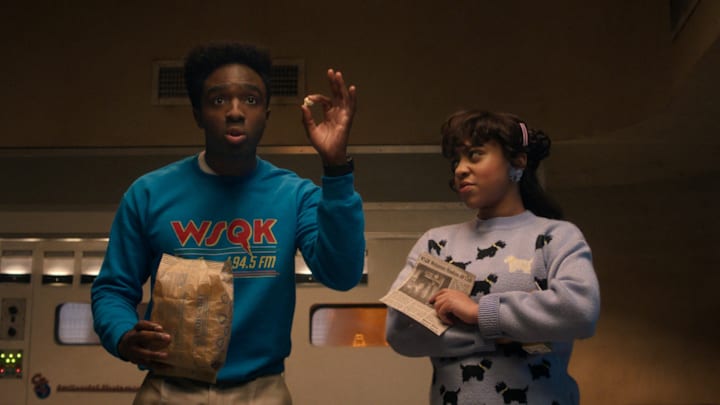
Stranger Things is a series that deals with big concepts and ambitiously scaled storylines. Across the series’ five seasons there have been giant monsters, interdimensional travel, time displacement and more. And yet, for as out there and lore-heavy as some of the show has been, it has always remained imminently accessible to audiences across the globe. Indeed, this ability to distill dense concepts into simple visualizations or explanations is an indispensable contributing factor to the show’s massive success, making sure that everyone has always felt welcome at the Stranger Things table rather than ostracizing less genre-literate viewers. After all, Stranger Things was doing parallel dimensions years before the multiverse would become such a popular cultural touchstone across everything from Rick and Morty to Everything Everywhere All at Once to the Marvel Cinematic Universe.
Within the universe of the show, this meant that characters tended to use short-hand or easily digestible vernacular to refer to the more out-there concepts. This has been true from the very outset, as the names of even now iconic elements such as the Demogorgon and the Upside Down were generalizations used by the child characters within the show. Whenever they were facing some big concept that was difficult to talk about, the characters would propose ‘theories’ within the universe of the show that doubled as explainers for the audience. However, in its fifth and final season, Stranger Things has chronically overdosed on these ‘theories,’ to the point that it might be terminal.

In the first season of Stranger Things, when trying to come to terms with the idea that Will Byers had been abducted and taken into another dimension that was just beneath their own, Eleven takes her friends' Dungeons & Dragons game board and flips it upside down, revealing total blackness beneath. This gave birth to the phrase ‘the Upside Down’ within the show and within the culture surrounding it, precisely because of how effective and efficient of an explanation this was. In the seasons to come, this kind of reliance upon easy explainers and specifically links to D&D persisted, as the kids used them to communicate with each other and the audience.
However, these were used sparingly, and only when tackling big ideas which required audiences to make logical leaps of their own in order to stick with the narrative. In its fifth season, the show has opted to employ these far more generously, and seemingly for every little thing that happens. It feels like every other scene this season has one of the dozens of central characters proposing a new ‘theory,’ many of which have zero actual in-story evidence to back them up. The result is that there’s way too many of them flying around for any of them to make an actual impact, and it just feels like all of the characters are operating off of incredibly stupid theories, constantly.

A perfect encapsulation of this is an egregious one that appears early on and has persisted all the way into the finale: Lucas’ theory that Vecna’s masterplan is all going to culminate in a final attack on the anniversary of the date that Will was initially abducted. He proposes this theory in the second episode of the season, with literally no evidence, and everyone just rolls with it as if it is fact. Even worse than that though, is the fact that he apparently is correct, since that is what’s happening in the story. This reveals the ultimate folly of these scenes in this season; they aren’t there to offer shorthand for characters or audiences, they are there as thinly disguised ways for the show’s creators to just directly tell the audience something in the bluntest way possible.
This overreliance on the technique has dumbed it down and turned what used to be a real strength of Stranger Things into a tragic pitfall. Every time a character has picked up an inanimate object and begun to try and explain their latest theory this season, the result has been exhausting rather than exhilarating; a far cry from the earlier seasons’ implementation of it.
 Add us as a preferred source on Google