

Fantasy movies transport us to magical worlds, but some do it with such stunning visuals that they become unforgettable feasts for the eyes. They create entirely new realities that still take our breath away years later.
There are movies where the visuals actively tell the story, where color palettes shift to reflect emotions and where you can pause at any random moment and find yourself staring at something genuinely beautiful. From hand-drawn animation to groundbreaking CGI to practical effects that still hold up decades later, these films represent the absolute peak of visual storytelling.
Here are 12 fantasy movies that redefined what cinema could look like. Whether you're a diehard fantasy fan or just someone who appreciates gorgeous filmmaking, these are essential viewing.
1. Pan's Labyrinth (2006)
Guillermo del Toro's dark masterpiece is set in 1944 Spain during Franco's regime, brilliantly mixing war-torn reality with a haunting fairy tale world. Young Ofelia escapes into a mysterious labyrinth where a faun tells her she's a lost princess who must complete three dangerous tasks to return to her kingdom, all while her cruel stepfather hunts rebels in the forest.
Del Toro shot this in the misty forests of Spain's Guadarrama mountains for a haunting blend of grim reality and magical fantasy. The film uses mostly practical effects in complex makeup and animatronics instead of CGI. The Pale Man, with eyes in his hands, is one of cinema's most terrifying creatures. Del Toro used color to separate the two worlds. Cold blue-grey tones for the military scenes and warmer more vibrant colors for the fantasy sequences. Every creature was hand-designed from del Toro's notebooks which he'd been keeping for 20 years.

2. The Lord of the Rings Trilogy (2001-2003)
Peter Jackson's epic adaptation takes us through Middle-earth, from the cozy Shire to the dark lands of Mordor. The story follows a small hobbit named Frodo who must destroy a powerful ring by journeying across Middle-earth, joined by a fellowship of heroes trying to save their world from darkness.
Filmed entirely in New Zealand over 18 continuous months, the trilogy used the country's breathtaking landscapes to bring Tolkien's world to life. Jackson combined sweeping helicopter shots of mountains and valleys with groundbreaking visual effects. The creation of Gollum through motion capture was revolutionary. The attention to detail was incredible, from hand-crafted chainmail armor to scale models and forced perspective to make hobbits look small. The trilogy won 17 Academy Awards total including all 11 it was nominated for in 2004.

3. Spirited Away (2001)
Hayao Miyazaki takes us into a magical bathhouse for spirits in Japan, blending traditional and Western Meiji-era architecture in this enchanting tale. Ten-year-old Chihiro's parents are turned into pigs at a mysterious abandoned theme park, forcing her to work at a bathhouse for spirits to save them and find her way home.
This hand-drawn masterpiece from Studio Ghibli is based on real Japanese bathhouses, especially the Dōgo Onsen and buildings from the Edo-Tokyo Open Air Architectural Museum. Miyazaki's team drew every single frame by hand, creating incredibly detailed environments. The film uses color masterfully as warm, pastel hues for daytime scenes shift to bright neon lights at night.
4. Avatar (2009)
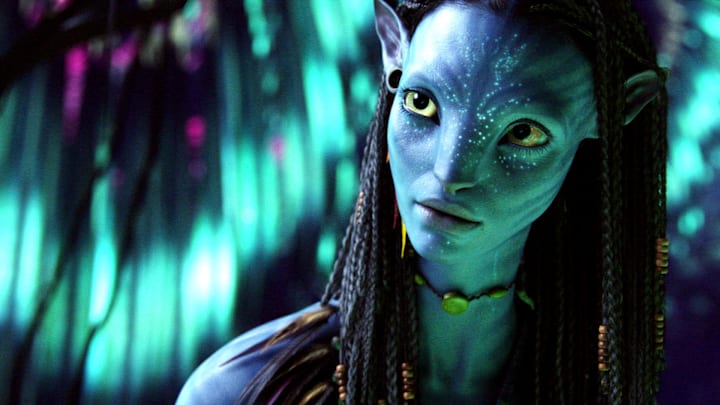
James Cameron created Pandora, a lush moon with floating mountains and bioluminescent forests for this groundbreaking sci-fi fantasy. The movie follows a paralyzed Marine who uses an alien body to infiltrate the Na'vi people on Pandora, but falls in love with their world and joins their fight against human invaders trying to mine the planet's resources.
Cameron spent 15 years developing Pandora's ecosystem before filming. The bioluminescent forests glow with blue, green and purple light inspired by Cameron's night-diving experiences and a dream he had at age 19. Cameron pioneered new motion-capture technology and 3D cameras that let him see actors as Na'vi in real-time while filming.
The film's jungle scenes were inspired by Hawaii and New Zealand. Every plant and animal was designed with real biology in mind, making Pandora feel like a living breathing world. It redefined what CGI worlds could look like for years to come.
5. The Shape of Water (2017)
Guillermo del Toro returns with this lush romance set in 1960s Baltimore inside a secret government research facility. A mute cleaning woman falls in love with an amphibious creature being held captive in a Cold War research lab and plans to help him escape.
Del Toro creates a color-saturated world and the film uses rich teals and blues to create an underwater atmosphere even in dry scenes. The 1960s period design is meticulous, from vintage appliances to retro movie theaters. The creature design is both beautiful and alien. Throughout the whole movie, Del Toro fills every frame with symbolic water imagery in rain, reflections and flooding as the story unfolds.
6. The Fall (2006)
Tarsem Singh crafted this visual masterpiece set in a 1920s Los Angeles hospital where a hospitalized stuntman tells an epic tale to a young girl. The story becomes darker as his depression grows, blurring fantasy and reality across fantastical locations spanning 28 countries.
Tarsem shot this across 28 real locations in 18 countries over four years using no CGI or green screen. Every surreal landscape is real, from India's stepwells to Namibian deserts to Indonesian rice terraces. The costumes are also wildly imaginative, mixing historical periods and cultures. The color palette is impossibly vibrant with deep reds, blues and golds. It's one of the most visually intoxicating films ever made.

7. The Wizard of Oz (1939)
Victor Fleming's timeless classic takes us from Kansas to the magical Land of Oz as Dorothy is swept away by a tornado to a magical land where she must follow the Yellow Brick Road to find a wizard who can send her home.
The shift from sepia-toned Kansas to vibrant Technicolor Oz was revolutionary for 1939 and still iconic today. The production design created unforgettable images including the Yellow Brick Road, the Emerald City, ruby slippers, flying monkeys and the Wicked Witch's castle. For 85 years, this film has somehow influenced every fantasy movie that came after it. The Technicolor process made colors pop in ways audiences had never seen before and the makeup and costumes were groundbreaking for their time.
8. The Dark Crystal (1982)
Jim Henson and Frank Oz created an alien fantasy world with dying lands and mysterious castles. A young creature called a Gelfling must find and repair the Dark Crystal to restore balance to his dying world and stop the evil Skeksis.
Henson created an entire alien world using only puppets and practical effects. The creature designs are intricate and organic, from the wise Mystics to the terrifying vulture-like Skeksis. The use of practical effects gives everything a real quality that CGI can't match. It's a dark, gorgeous fairy tale that still looks unique today.
9. Big Fish (2003)
Tim Burton blends Southern Gothic reality with tall-tale fantasy in this Alabama-set wonder. A son tries to understand his dying father by piecing together the wild, fantastical stories he's told all his life involving giants, witches and magical towns.
Burton is at his most visually whimsical here, creating a magical Southern fairy tale. The town of Spectre feels frozen in time. The witch's eye reveals deaths reflected in glass. A giant named Karl is both terrifying and gentle. Burton uses golden, warm colors for the fantasy sequences and more muted tones for reality. The circus, the river and the final funeral scene are all so beautifully composed.
10. Hero (2002)
Zhang Yimou's film unfolds in ancient China during the Qin Dynasty. A warrior tells the king about defeating three assassins, but each retelling uses different colors and reveals different truths.
Zhang Yimou uses color like no other director. Each section of the film is dominated by a different color in red, blue, white, green, and each represents a different version of the truth. The fight choreography is balletic and gorgeous, especially the battle in the yellow leaves and the lake fight in green.
11. Stardust (2007)
Matthew Vaughn bridges Victorian England and the magical kingdom of Stormhold in this charming adventure. A young man crosses a wall into a magical realm to retrieve a fallen star for his beloved, but discovers the star is actually a woman and they're both being hunted by witches and princes.
This underrated gem has a magical glow to it. The wall between worlds is simple but effective. Claire Danes literally glows as the star radiating golden light. The sky pirate ship sails through clouds above the kingdom. The witch's castle has a creepy, decaying beauty. Robert De Niro's airship is colorful and whimsical. The film balances fairy tale prettiness with darker, more dangerous visual elements.

12. Howl's Moving Castle (2004)
Miyazaki creates a magical steampunk Europe with walking castles and war-torn skies, where a young woman is cursed to become an old woman and finds refuge in a magical moving castle owned by the mysterious wizard Howl as war breaks out around them.
The moving castle itself is a spectacular creation, a walking machine cobbled together from turrets, legs and chimneys that breathes smoke and clanks across hillsides. Miyazaki's hand-drawn animation brings flower-filled meadows to life with incredible detail.
The bombing sequences are both beautiful and devastating, with planes silhouetted against colorful skies. Howl's transformations and the magical doorway that opens to different locations are a statement of Miyazaki's boundless imagination.
The next time you watch one of these films, take a moment to appreciate the incredible artistry that went into every frame. These are the movies that remind us why cinema is a visual art form and why fantasy, when done right, can be the most beautiful genre of all.
 Add us as a preferred source on Google