

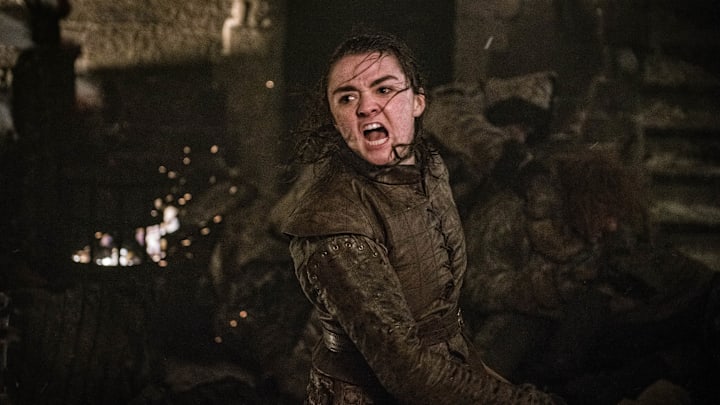
We've been celebrating the 15th anniversary of Game of Thrones' premiere all month long here at Winter Is Coming, but today, April 28, is extra special. Seven years ago on this day, the White Walkers stormed the castle of Winterfell in the third episode of season 8, titled "The Long Night," and a desperate alliance between the people of the North and Daenerys Targaryen's armies fought them to the brink. It was a desperate moment where the forces of the living very nearly lost it all and the continent of Westeros was almost consumed by the undying horde. And when Arya Stark used her Faceless Man training to assassinate the Night King, it turned into arguably the biggest fist pump moment of Game of Thrones' divisive final season.
Much has been said about "The Long Night" over the years, and often it leans toward the critical. From the idea that the White Walkers' reign of terror over Westeros should have lasted longer than it did to the extreme dimness of the episode's visual palette, people have found plenty of things to dislike about this crucial episode of Game of Thrones. Perhaps indicatively, it holds a 74% rating on Rotten Tomatoes — not bad, but still far from the highs that many of the show's other big episodes boast. If Game of Thrones season 8 was divisive as a whole, so was the wildly ambitious battle episode at its heart. You have to take the good with the bad, and this seminal episode is a perfect encapsulation of that quandary.
To me, "The Long Night" stood out as an exceptional part of Game of Thrones' run. It paid off the White Walker invasion, something which was teased from the very first pages of George R.R. Martin's A Song of Ice and Fire novels, and it did so in utterly jaw-dropping fashion. It featured a slew of important character deaths, and captured the terrifying feeling that our heroes were facing a literal zombie apocalypse that threatened to wipe out all human life on Westeros. And while it was a wall-to-wall action episode that clocked in as the longest installment of the show at 82 minutes, it managed to juggle its myriad characters so well that it was never anything less than edge-of-your-seat television.
"The Long Night" was Game of Thrones' most ambitious episode by far
Directed by Miguel Sapochnik and written by David Benioff and D.B. Weiss, "The Long Night" was easily the most impressive episode of television that Game of Thrones ever attempted. The series completely rebuilt the set for Winterfell for the show's final season in order to have more room to flesh out the clash with the White Walkers. Filming spanned 11 weeks, nearly triple the amount of time it took to produce the Battle of the Blackwater in season 2 or the Battle at the Wall in season 4, and more than twice as long as the Battle of the Bastards in season 6. And of course, all 55 days of the shoot were done at night, in freezing temperatures, to simulate the utter darkness of a White Walker apocalypse.
Topping all of this off is the fact that Game of Thrones wasn't only filming "The Long Night" during this period. The series was also filming the following episode, "The Last of the Starks," at the same time, often utilizing the same Winterfell set, during the day time with different cast and crew members. For those who had roles to play in both, bouncing back and forth was hellishly exhausting.
To this day, no fantasy battle on television has ever come close to the scale of "The Long Night" from a sheer production standpoint, and for good reason. As Jaime Lannister actor Nikolaj Coster-Waldau said in the tell-all book Fire Cannot Kill A Dragon, "If that hadn't been the last season, there would have been a mutiny halfway through the night shoots."

Looking back on "The Long Night," the main feeling I have is gratitude that we got to witness this episode of TV in the first place. It's easy to nitpick now, but the fact that no other show has come close to the same scope for a battle episode since speaks for itself.
That said, there are a few fatal flaws to this episode which kept it from becoming even better. If Game of Thrones had addressed these major issues, I firmly believe "The Long Night" would have gone over even better with fans, and likely wouldn't have been quite so divisive.
And no, the lighting is not one of them — we're talking about a literal darkness-themed apocalypse, and I will always defend the aesthetic choice to make that darkness so oppressive that it seeps out of your TV. You watch this episode at night with the lights out like a proper horror movie, or you don't bother watching it at all. I don't make the rules.

"The Long Night" needed more truly shocking deaths
While "The Long Night" has no shortage of bloodshed, as evidenced by the massive pyres the survivors burn outside of Winterfell at the start of the following episode, it does suffer from a plot armor problem. There are around two dozen important cast members at the Battle of Winterfell. Of those, seven meet their end before the sun rises: Dolorous Edd Tollett, Lyanna Mormont, Beric Dondarrion, Jorah Mormont, Theon Greyjoy, the Night King, and Melisandre. It's the highest death count of any episode of Game of Thrones.
The problem is that every single one of those deaths feels preordained, or like a fitting, comfortable conclusion for characters who likely would have had no real role to play after the White Walker invasion ended. Game of Thrones built a reputation for stunning audiences with its shocking character deaths, but in this, one of the most important episodes of its entire run, the series opted for what amounts to a culling of secondary characters instead of killing off (or even permanently maiming) any of its major players.
The result is that every single main character outside of Theon, whose redemption hinged on defending his former home, is miraculously fine at the end of the apocalypse. The level of plot armor goes through the roof and results in some truly silly scenes, like Brienne of Tarth and Jaime Lannister fighting a horde of undead by themselves with their backs to the wall and somehow making it out completely unscathed, or wights getting loose with all the defenseless people in the crypts and somehow not coming even close to harming a single one of the four key characters trapped there.
There are some well-placed and moving death scenes in "The Long Night." Melisandre's final farewell feels perfect, Edd's sudden demise is brutal, and Beric Dondarrion's sacrifice to save Arya Stark gives his whole arc extra weight in hindsight. But the one thing truly missing is a death that floors viewers; that doesn't feel earned or like fate jolted against someone with a promising future, in that way that so many of the best Game of Thrones deaths do.
When George R.R. Martin was penning the books, he set out to keep them unpredictable. This led to the premature demise of typical hero characters like Ned and Robb Stark, or characters who seemed like they would play much bigger roles, like Oberyn or Quentyn Martell. And, unfortunately, the deaths in "The Long Night" are the opposite: safe and predictable.

The North needed to lose the Battle of Winterfell
The other major flaw of "The Long Night" isn't something within the episode itself, but with the overall arc of the season as a whole. It might be hard to believe, but the White Walker invasion only spans four episodes of Game of Thrones. The Night King leads his army past the Wall in the finale of season 7; we get a hint of how they destroyed Last Hearth in the premiere of season 8; and then by the end of the second episode of season 8 they're at the gates of Winterfell, which sets up their first real appearance since breaching the wall in Episode 803.
I hold that "The Long Night" as a finisher to the zombie apocalypse was nearly perfect…but it shouldn’t have been the first time we saw the White Walkers of the season. We needed to feel their invasion gain some real, painful wins before being vanquished. We’d been waiting since the very first scene of the series for the White Walkers to get south of the Wall and wreak havoc. To have it all neatly wrapped up in one episode was always going to feel disappointing, even if that episode itself was sublimely good in execution.
We needed the fight to bleed farther south, to fulfill Daenerys' eerie dream from George R.R. Martin’s novel A Storm of Swords of burning white walkers on dragonback at the Trident in the Crownlands. Even if the dream is meant to be a metaphor more than purely prophetic, it has always felt like Martin's plan was for the White Walker invasion to be more substantial than it was in the show. I went into the Battle of Winterfell fully expecting the living to be routed, beginning a beleaguered flight south until a final, even more desperate resistance could be put up at the Neck or the Trident.
Even if the show didn't want to commit to that sort of arc and keep the final battle at Winterfell, driving home the horror of the White Walkers eradicating every living person in the North would have helped this climactic battle feel more earned. As it stands, they kill a bunch of people off-screen, before fighting and losing one major battle against the living. The White Walkers deserved a fuller story for their invasion, and if Game of Thrones had given them one, I strongly suspect "The Long Night" as a whole would be remembered even more fondly than it is today.

Just as dawn arrived over Winterfell after the battle, our 15th anniversary month celebration of Game of Thrones is drawing near its conclusion. But we're not at the end quite yet! There are a few more days left to go as we honor this beloved fantasy series with more retrospective content. See you in Westeros!
More Game of Thrones:
 Add us as a preferred source on Google