

It's been 15 years since Game of Thrones season 1 first aired on HBO, and the series made us realize no one was safe with just four episodes. Those familiar with George R.R. Martin's books were well aware of this going into HBO's adaptation. However, newcomers didn't have the same idea of what to expect — and at the beginning of season 1, the fantasy show had yet to earn its reputation for being one of the most brutal on television.
The later chapters of Game of Thrones season 1 laid the groundwork for that image, though, with seasons 3 and 4 really driving it home. Incidents like the Red Wedding made it clear that this wasn't your traditional hero's journey, but rather, a story where the characters' decisions had real, sometimes devastating consequences. Many will point to Robb Stark's demise as one of the clearest deliveries of that message, but season 1 told us that no one was safe on four separate occasions — all of which built on one another to make that point.
Game of Thrones proved no one was safe with four season 1 episodes
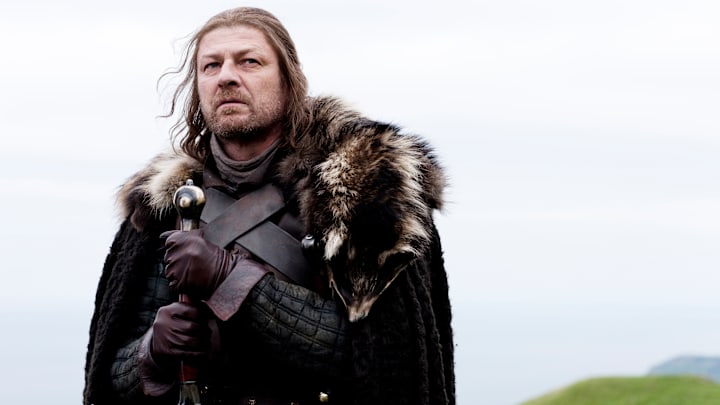
Game of Thrones season 1 got a lot of attention for killing off Ned Stark, who felt like the main character — and the moral compass — of the opening chapter. When "Baelor" saw him losing his head, after both viewers and Ned were led to believe he'd be sent to the Wall, it was a jaw-dropping moment. Those who weren't shocked by it in the HBO show were almost certainly speechless when it happened in the first Song of Ice and Fire book. And that's because leads, especially those who exhibit honor and decency, tend to have a certain amount of plot armor in traditional stories.
Needless to say, Ned's death was a clear signal that Game of Thrones wasn't playing by those rules. It actively sought to subvert gerne conventions, and as a result, no one was guaranteed protection. Not even those you'd normally expect to survive. Later deaths, like Robb's and Catelyn's, proved that Ned's fate wasn't a one-off. However, Game of Thrones season 1 underscored how merciless its world was multiple times during its latter half. Ned's death might be the most noteworthy of the first outing, but his loss wasn't the only one to convey that.
In fact, Game of Thrones started to prove no one was safe in season 1 Episode 6, "A Golden Crown." Looking back, Viserys Targaryen's death seems inevitable. After all, he was a terrible person with no true leadership qualities, and spending any more time with him would truly have become grating. However, in many other stories, he would have been forced to grow into his role as the rightful heir to the Iron Throne. Once again, Game of Thrones defied expectations and killed him instead, giving his expected story arc to Daenerys instead.
Immediately after Viserys' death in "A Golden Crown" came Robert Baratheon's demise in season 1 Episode 7, "You Win or You Die." This was less surprising, as royals weren't going to be safe in a power struggle for the throne. Still, Robert's death came on suddenly and without much fanfare. And the fact that the king could so easily be removed from the equation left little hope for less powerful players to survive the political machinations of Westeros.
And while Game of Thrones season 1 Episode 8 took a break from major deaths — though I suppose you could make the case for including Syrio Forel and House Stark's entire entourage in there — episodes 9 and 10 continued the series' ruthless approach. As mentioned, "Baelor" brought about the most surprising turn of events with Ned's beheading. And the season 1 finale, "Fire and Blood" proved the nail in the coffin for Khal Drogo, just as we were starting to hope magic might save him.
Individually, the deaths of supporting characters like Viserys Targaryen, Robert Baratheon, and Khal Drogo didn't feel like turning points, despite how they bucked expectations. But taken together — and placed on either side of Ned's death — they helped form the picture of Game of Thrones as a series that was fearless when it came to kiling characters. And the show continued to build on that reputation right through its series finale.

Game of Thrones continued to build on the foundation the second half of season 1 laid
In just a handful of episodes, Game of Thrones season 1 laid the foundation for so many future character deaths. The Red Wedding didn't feel over the top or tonally inconsistent because the series had already established itself as willing to go there. And it continued to grow bolder in its willingness to kill characters, whether they were undeserving children, like Shireen and Myrcella Baratheon, or characters we'd invested years into (ahem, Daenerys).
This foundation didn't just help future deaths land. It kept viewers constantly on edge, as they knew their favorites were always fair game. This made conflicts and action sequences that much more tense, though it was clear tragedy could strike even during the quieter moments. And, in some ways, the reputation Game of Thrones built for itself made it more surprising — and more satisfying — when characters actually did survive. Few Game of Thrones characters got fates they deserved, but Jon being resurrected or the Starks getting happy endings were cause for celebration. Fans knew how easily their stories could have gone sideways, as we'd seen it happen so many times over Game of Thrones' eight seasons.

We're celebrating the 15th anniversary of Game of Thrones all month long here at Winter Is Coming, with dailys retrospectives, editorials, quizzes, lists and more looking back on the show's iconic run. Setting off on a rewatch? We've got you covered for reading material.
More Game of Thrones:
 Add us as a preferred source on Google