

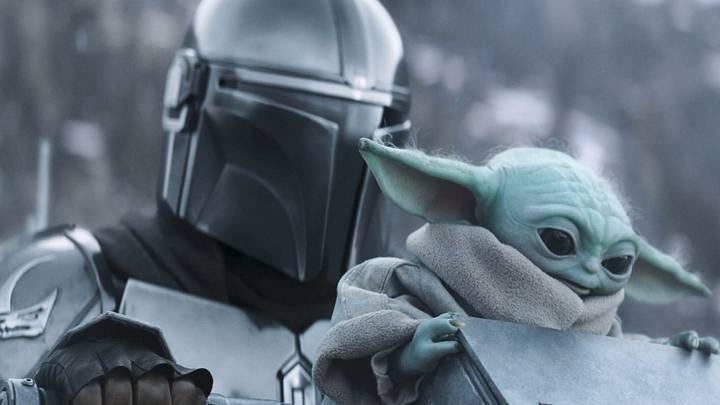
The initial social reactions and reviews for Jon Favreau’s The Mandalorian and Grogu have hit the web, and to say that they are mixed would be an understatement.
The film that was supposed to be Star Wars’ long awaited return to the big screen after a seven-year absence instead seems to be predominantly evoking feels of boredom and malaise in critics thus far, with many equating it to a couple of mid-tier level episodes of The Mandalorian TV series being haphazardly stitched together into a feature length runtime.
To this end, one of the only positive refrains that several notable reviews have toted is that the film does live up to its marketing promise of being a predominantly standalone story, rather than getting bogged down in the ins-and-outs of all its various tie-in characters or background lore.
Given the ways in which the late-stage marketing has attempted to emphasize this, and is almost certainly going to even further prioritize it now that the reviews have been largely negative, a much clearer picture of Disney’s playbook here is coming into play: The Mandalorian and Grogu is just Disney attempting to reheat Solo: A Star Wars Story’s leftovers.
Star Wars should’ve learned from previous release strategies

When it released in 2018, Solo: A Star Wars Story was not viewed a critical or commercial success. It got middling-to-positive reviews, and made over $100 million over the four-day Memorial Day weekend in the U.S., but that was a paltry sum compared to both its budget and the expectations that Disney had for it.
Prior to this, Disney had released three Star Wars films in back-to-back-to-back years, with The Force Awakens in 2015, Rogue One in 2016, and The Last Jedi in 2017. Each of those installments made over a billion dollars at the global box office each, and judging from Disney’s bullish plans to continue releasing a new Star Wars movie every year for the foreseeable future after that, the company was very much expecting Solo to do the same.
However, that didn’t happen, and Solo instead became the black sheep of Disney-shephered era of the franchise. Though there were initial plans for sequels and spin-off series starring the new batch of actors that the film had introduced as younger iterations of these legacy characters, such as Alden Ehrenreich as Han Solo and Donald Glover as Lando Calrissian, these were all eventually put out to pasture.
Instead, Solo’s underperformance wound up playing an integral role in inspiring Disney to pivot Star Wars to streaming full-time, something that The Mandalorian and Grogu is now a direct result of and response to.
Despite all of this, Solo was exactly as advertised: a hooting-and-hollering space western co-written by franchise veteran Lawrence Kasdan, that served as a standalone, pulpy adventure serial within the larger Star Wars galaxy. It eschewed the larger mythos of the grand saga in favor of smaller-scale fare, predominantly rooted in Han Solo’s gunslinging antics.
And now, The Mandalorian and Grogu is very much swinging for the exact same thing, but doing so without learning any lessons from the commercial underperformance of Solo itself.
Prior to Solo, all of Disney’s Star Wars films had released in December. Though the initial plan was for The Force Awakens to release in May of 2015, it wound up getting delayed to December, and inadvertently finding a perfect spot for the film to soar.
In the years that followed, Rogue One and The Last Jedi maintained this release window, each getting a full several months of runway to dominate cultural conversation and the box office, free of the kinds of regular blockbuster competition that summer months would bring. Solo, on the other hand, was released in May; the once traditional release window for George Lucas’s Star Wars films in decades past. This put it immediately in the aftermath of films like Avengers: Infinity War, and a mere six months after the release of The Last Jedi.
After literal years of conditioning audiences to expect a new Star Wars film come the Christmas season, Disney and Lucasfilm cut themselves down at the knee in a backwards-minded attempt at fan service, resulting in Solo getting lost in the shuffle.
In the minds of audiences, it wasn’t a big Star Wars event film; it was just another summer blockbuster that was tangentially connected to a big IP. And now, with The Mandalorian and Grogu projected to open even lower at the box office this May than Solo did back in 2018, it looks as though Disney is both failing to ape the aesthetic strengths of Solo and failing to learn the lessons of its box office underperformance.
 Add us as a preferred source on Google