

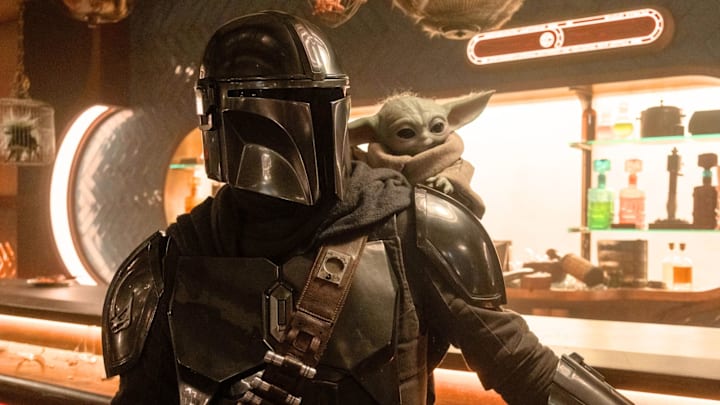
In just the past few weeks, Disney has gone into full-blown overdrive in attempting to market their newest Star Wars movie, Jon Favreau’s The Mandalorian and Grogu, in a completely different way. The question is, of course: is this really the way?
Prior to about a month ago, there was little-to-no positive buzz surrounding the first theatrically-released Star Wars movie in seven years, which is as surprising a sentence to write as it is to read.
But after spending years actively deprioritizing the theatrical grandeur of the once exclusively theatrical galaxy far, far away in favor of pivoting people to the streaming platform, Disney+, that was the reality that Disney and Lucasfilm were facing. They had spent years utilizing targeted marketing campaigns to either get people to sign up for or maintain their subscription to Disney+ to see the further adventures of characters like the pop culture sensation that was Grogu.

Disney’s change in strategy
This worked for years, until Disney, amidst a regime change (former boss Bob Iger came back to replace Bob Chapek; it’s a whole thing that’s not really worth digging into here, but suffice it to say it was a mess) seemingly suddenly realized that Disney+ wasn’t actually making them much in the way of profit, and they were instead sinking billions of dollars into productions that were netting next-to-nothing in returns.
As such, Disney suddenly and pretty blatantly pivoted back to theatrical with projects like Moana 2, which was originally planned to have been a straight-to-streaming series that was then haphazardly retrofitted to be released theatrically. While the artistic merits of the movie might have proven questionable to critics and audiences alike, it was a financial slam dunk, with Moana 2 making over a billion dollars at the box office.
In the wake of this success, Disney restructured its use of Disney+ into primarily that of a marketing and brand-testing resource. Things that had performed well on Disney+ over the years, such as Moana, Lilo & Stitch, and Zootopia, had respective follow-ups or live-action remakes prioritized as theatrical ventures, while releasing official marketing material with deceptively small-fonted descriptions to the streaming service.
This resulted in casual viewers scrolling through Disney+ and seeing an option for something like Zootopia 2, just as the film hit theaters. Users, especially children, would excitedly click on the option, only to realize it was an extended trailer for the film in-question, rather than the film itself, urging viewers to go see the film in theaters instead.
This proved a successful strategy for the House of Mouse, which is how audiences go The Mandalorian and Grogu as the first Star Wars movie in so long. The Mandalorian TV series had proven to be a consistent success on Disney+, so when it came time to decide what could act as Star Wars’ reintroduction to the theatrical realm after the disaster that was 2019’s The Rise of Skywalker, Disney opted for this as a safe bet. However, in the years since initially making that decision, it has aged in increasingly worse ways.
When Disney started rolling out promotion for The Mandalorian and Grogu last year, it was all built around the idea that audience had a deep reverence for these characters, the story they had been involved with in the TV show, and the movie’s connections to the larger Star Wars universe. The first trailer went to great lengths to spotlight characters like Rotta the Hutt and Zeb Orrelios, characters who only the most hardcore of fans could even hope to recognize. To call the subsequent response tepid feels like an understatement; there was a lack of buzz around the project.
However, in recent weeks, Disney may have panicked following reports predicting that the film would see the lowest opening box office weekend for a Star Wars film in decades, and pivoted hard. Now, all of the marketing, from the TV spots to the interviews and beyond, has centered on the film being a “standalone” adventure story that doesn’t require extraneous knowledge of the other films, TV shows, or animated projects. But for as much as Disney might try to make this work, there’s one glaring flaw in this plan: it’s still not true.
The Mandalorian and Grogu looks to be, like Moana 2 before it, a handful of streaming TV episodes that have been condensed to be released as a feature-length film. Prior to the film getting greenlit, Favreau was actively working on a fourth season of The Mandalorian, but that project was suddenly cancelled when this film was put into production.
Even just from looking at the list of characters who are announced to show up in this film, it’s pretty obvious to any onlooker that this is not just some standalone adventure story; it is very much the kind of deeply self-referential Star Wars stuff that Favreau has been making for years now. But will the marketing deception work? We’ll have to wait and see.
The Mandalorian and Grogu hits theaters on May 22.
 Add us as a preferred source on Google