

Few shows have the guts to completely reinvent themselves. Then again, few shows are as iconic as Interview With The Vampire, daring a 180 degree shift in tone and content in its junior year, rebranding as The Vampire Lestat. Episode 1 of season 3, titled “Detroit” heralded this new direction like a prophet announcing a deadly curse.
The show didn’t just change its name to signal a new protagonist; season 3 is a continuation but also a re-write with a completely different vibe. The transition between the season 2 finale and the premiere of The Vampire Lestat cut like a knife and shook the series to its very core. Like Lestat (Sam Reid) himself, the dissonance is disorienting but infinitely alluring.
If The Vampire Lestat is Lestat’s descent into his own internal Inferno, “Detroit” is the antechamber to hell, exquisitely preluding all that will follow. The premiere introduced our narrator almost as a new character. Lestat, who has so much to say and who’s never so far been allowed to speak for himself — always recounted through the memory of others — finally gets to tell his own story. This, already, is spinning the world on its axis; it is not as simple as a role reversal or like passing the baton from Louis (Jacob Anderson) to Lestat; like on a continuous rollercoaster, Reid went from co-protagonist in season 1 to haunting the narrative in season 2 to absolute main character and narrator in season 3.

The Vampire Lestat Episode 1 recap
The episode’s opening scene is set in the future, after the season’s events have taken place. We gather that a quasi-apocalyptic event — beside Lestat’s own demise — has taken place and the survivors participate in an auction to bid on what remains of Lestat’s music. Louis and Armand (Assad Zaman) looking worse for wear along with Talamasca agent Raglan James (Justin Kirk) are among the fiercest bidders. The entirety of the season is narrated by Lestat himself to whoever won the bidding war for his recordings.
Every single scene is one of Lestat’s self-described failures. We can certainly appreciate his self-awareness and the way he, posthumously, admits he should have stopped his path of self-destruction at any given point before it led to the apocalypse.
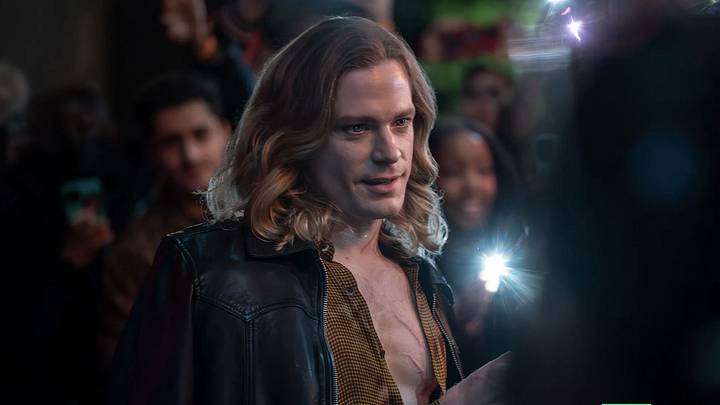
The concert, number 30-something on the tour and one of many the audience will be fortunate to witness this season, kicks off our journey into Lestat’s rock career. Lestat, who loves classical music and opera, leans into the chaos of rock and roll because it’s freeing, allowing him to escape the constraints of adequacy. It certainly works with his vampire persona, a charade he performs every night on stage when he pretends to be a human pretending to be a vampire. It’s all very Theatre de Vampires, with the same illusion at play, fooling your audience into a fictitious revelation that hides the truth in plain sight: that they are food.
The song "Long Face" eloquently speaks of what Lestat must feel for Louis, creating the expectation for a situationship of sorts between the two. Throughout the episode, we are set up time and time again, led to believe it’s Louis that Lestat is texting, with that mysterious “Toi” (French for you) as his interlocutor’s contact name.
While Reid could lead and ace this as a one-man show, his scenes with Daniel Molloy (Eric Bogosian) are some of the most entertaining to watch. Daniel and Lestat’s antagonistic banter is one for the ages, and I think Daniel addressing Lestat as “The Cuntessa!” will go down in history. They’re both taking the wrong approach to the interview, Daniel going straight for the throat and Lestat doing everything he can to sabotage his attempts by minimizing questions or answering with completely unrelated trivial facts and questions of his own. He does, however, also provide interesting commentary on the state of the world and of the music industry. “A good nation was making itself great again… again.”
Lestat has infinite reserves of talent (and so do Daniel Hart, the series composer who wrote all songs this season, and Sam Reid, who inhabited them so hauntingly) and he thinks highly of his musical abilities and of his ways of attracting fans as if they were prey. “The lights on Tay Tay’s eras have dimmed,” he says to Daniel. “It’s my era now.” It’s clear there can only be one showgirl in town. His fans are devoted, but even pure rock’n’roll struggles in this day and age of TikTok videos and short attention span and poor artistic appreciation.
Why Lestat chose to start a band to set the record straight is a ludicrous question, because it’s clear that the Brat Prince has a visceral relationship with music. More than once this episode, we see music quite literally trigger Lestat. First, when Larry’s playing irritates him to the point of breaking into the band’s practice and destroying a guitar, and then when the second Detroit concert causes an full-blown panic attack on stage.
At any rate, Daniel’s question serves to introduce the first flashback, which shows a healthy-looking Lestat, happily composing and playing piano in his grand Montreal apartment for Louis on FaceTime. Their teasing back and forth suggests that they do this often, that they are both healing and growing back together. It’s heaven of Lestat flirting with his husband like a blushing schoolgirl for approximately two minutes until a notification pops onto Lestat’s iPad screen — yes, he must have Google alerts for Louis’s name — and shatters all the certainties and the trust that Lestat had slowly rebuilt.
The in-universe book, Interview With The Vampire, comes in like a wrecking ball. As soon as Lestat becomes aware of its existence, the enormity of the betrayal seems to be the only thing in the world. Even the children showing up at his door for trick or treating are cosplaying as the characters, as people from Lestat’s life. As Lestat reads, the inaccuracies and the blatant lies pile up, and he loses faith in Louis, and presumably cuts all contact with him. He needs an outlet for his rage, and rock is conveniently in the building next door.
Back to the present, despite the glamour and the love from a small but dedicated following of fans, Lestat is not in a good place. He even admits, in a text he doesn’t send, that he is struggling, that he needs help. He’s living the rock tour experience to the fullest, but even he knows that indulging in hedonistic pursuits and drugs is not the answer to help his loneliness and fix his heart, broken time and time again and never properly healed.
In private he composes and sings melancholic songs that better reflect his true feelings, but the narrative has a tendency to interrupt him whenever he’s quietly playing to himself, seeking solace, seeking to feel his emotions. The snippet of the heart-wrenching song we hear in Episode 1, which goes, “My little heart’s reflection / You’ve got a confession / You used to find –” will continue later in the season.

During his second concert in Detroit, as he performs "Black Licorice," yet another provocative song about Louis, Lestat’s rage gets the best of him and brings about a full-on breakdown on stage. His past, his traumas, his muses demand retribution. As he rides down the overdose, a hallucination of the fan he almost drained, Baby Jenks, prophetically announces his incoming psychosis in the form of all his traumas demanding space in his brain, manifesting like vengeful ghosts.
Yet he chases the high to avoid feeling, chases that ostentatious fun he sings about to escape from his past. As he overindulges, he misses so many signs until danger is staring at him in the face and a coven of 20 regional vampires — Armand apologists, of all things! — is trying to kill him. Daniel and Sam Barclay (Christopher Geary), former playwright, Talamasca agent, and currently a DJ, come to the rescue. In the heat of the fight, Lestat smashes through a wall and reveals his vampiric nature to all the party-goers, including his band who were none the wiser. Outed and caught red-handed while killing his would-be murderer, and still under the effect, Lestat opts to flee the scene, flying away.

Next, we see him retching in a repugnant motel room, still bloodied-up from the fight and coming off the overdose. He has texted his mysterious interlocutor multiple times asking for help, until they announce they have arrived. And just when the entire audience will be expecting Louis to appear, we are treated to a much direr introduction. In comes the vampire Gabriella (Jennifer Ehle), Lestat’s fledgling, mother, lover. And with that Oedipal cliffhanger, the episode ends.
This episode introduced a few more characters. The band - Tough Cookie, Alex, Larry and Salamander - each with their reasons and desires, their fearsome lawyer Christine, Lestat’s social media manager (and co-worker with benefits) Dee, and a couple of fans we’ll see again later. Oh, and Yarda, of course, Lestat’s human body double, hilariously played by Sam Reid.
“Detroit” is an incredibly strong season — no, series — opener. It’s got everything it needs to tease the audience into full obsession, including a big spoiler for how it will all end. It subtly introduces the themes that will haunt every subsequent episode, and it sets the tone for a new Lestat, a new series, a new interview or, rather, confessional.
This season promises to be hell for Lestat. And this — a full-blown panic attack, overdosing, dissociation, hallucinations, and a fight to near death — is just a prelude.
Episode rating: A
The Vampire Lestat airs Sundays on AMC and AMC+. Read our full season review here.
 Add us as a preferred source on Google