

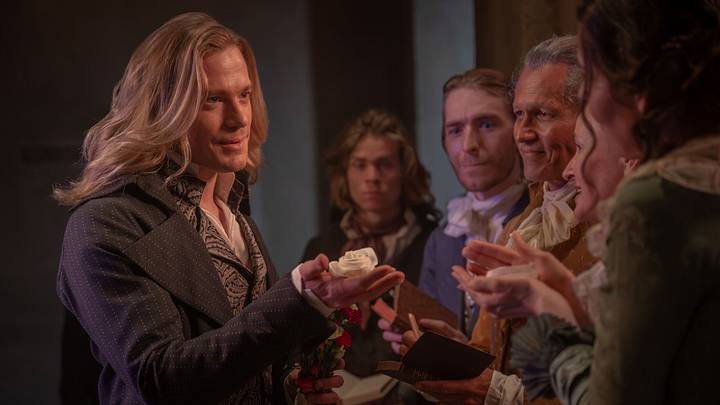
Third time’s the charm, except every episode of The Vampire Lestat so far has been dazzling, maddening, tantalizing, ludicrous to the point of absurdity, and episode 3 is just as transfixing, “Toronto” subtly shifts the narrative yet again, and in doing so hits all the right spots.
The majority of the episode is dedicated to Lestat (Sam Reid) performing — not music this time, but his carefully curated persona of pure hedonism and sarcasm, untouched by all. The audience finally gets to dig deeper and peek at a glimpse of what’s marring in his psyche, at the ghosts lurking underneath the surface. The episode alternates a levity, courtesy of its protagonist’s deflective facetiousness, with the tragic subject matter that it’s covering. Trigger warning: the episode contains visuals and narration of two rape scenes and we will touch upon them here.
FULL SPOILERS ahead for The Vampire Lestat episode 3, "Toronto."

Interview With The Vampire... Lestat
Lestat finally acquiesces and sits down for a filmed interview with Daniel (Eric Bogosian), taking the journalist on a journey through his years in Paris, after he left Auvergne. The interview starts with the iconic incipit from The Vampire Lestat book by Anne Rice and then cleverly cuts to the theme song, making the whole episode the interview.
Lestat’s unwillingness to open up is clear as day to Daniel, who notes that the older vampire uses songs inspired by his past as a disguise, as a red herring, as a distraction to avoid truly having to confront his story. Lestat counters that his songs may take inspiration from his life, but that they are pregnant with universal commentary. He uses vampirism as a metaphor for contemporary society, and insists that his rockstar career is about art itself, pure expression, regardless of success metrics.
Daniel is relentless in his reiterated question about Lestat’s stutter, believing he can use the same interview tactics that worked on Louis and Armand in Interview With The Vampire seasons 1 and 2, but Lestat is five steps ahead and this, remember, is an elaborate performance. “He found me shallow,” Lestat will later think of Daniel, “I gave him every reason to.” Just like he does every night, Lestat wears a costume and a mask and starts acting, letting Daniel believe that he’s got him, that he is finally in a place where he will reveal his true feelings and secrets. Too late, Lestat will come face to face with the realization that he’s truly taken the joke too far with Daniel.
As in every season of this show, the narrator chooses what parts they wish to share and it’s evident that Lestat is being intentionally selective of the events. At one point, he becomes too engrossed in his memory and retelling and forgets to edit out his mother’s presence. In order to maintain her secret, he quickly makes up a story about her dying soon after being turned, but it doesn’t land as spectacularly as some of his other lies, and I’m surprised Daniel did not prod him further.

Nicolas
It’s telling that Lestat chooses to start his narration not when he killed the wolves, but when he first heard Nicolas (Joseph Potter) play the violin. Meeting Nicki in Paris is not just the beginning of their romance, but the start of Lestat’s longest-running love, that for music. In this light, Nicolas is both Lestat’s first partner and an instrument for that fateful encounter. At the start of the interview, Lestat tries to downplay Nicki’s importance to him, saying, “It was a first love, not a great love,” to minimize the pain, a tactic he employs also when speaking of Magnus.
He presents Nicki as yet another failure, a terrible sin. And in some way it is, you realize by the time Lestat reaches the end of his retelling, eyes swelling with blood tears, as he relives the memories of his raw desperation at Nicki’s utter derangement. It’s a devastating scene: Lestat gently communicates to Nicki that he and Armand want him to take a break from the theatre, and Nicki deflects and projects his frustration (and jealousy) onto a futile letter opener, cuts his very hand and tosses it in the fire. Potter and Reid are incredible scene partners here, in the way they serve opposite emotions — Nicki’s delirium and Lestat’s anguish — and still play off each other.
Nicolas burning his limb is an allegory: never again playing the violin, losing what drew Lestat to him, severing their love. It’s also a foreshadowing of what’s about to happen to the rest of his body, pushed into the fireplace by Armand (Assad Zaman) as Lestat complicitly stood there, unwilling to stop him but unable to take responsibility and put an end to Nicki’s suffering.
Maker and destroyer, this seems to be Lestat’s pattern when it comes to those he loves. First Nicolas, then Louis, then Claudia. It’s his inescapable curse, born not of Akasha’s blood, but of his urge to self-sabotage.
When Lestat gives in and confesses he watched Armand kill Nicki, Daniel is so engulfed by the act, by his tears and broken voice, that he doesn’t realize he’s being played — and neither do we, completely enthralled by the emotions that have overtaken Lestat.

Magnus
The audience is vaguely familiar with the story of Lestat’s turning from season 1 of Interview With The Vampire, so the sequence doesn’t need to follow a linear path. This is probably for the best, because of how crude the whole thing would have been. What we get is Daniel baiting Lestat into admitting the violence of his making, calling Magnus (Damien Atkins) his abuser, insinuating what Lestat doesn’t want to admit. Lestat waves the implications away, in another carefully-crafted performance in which he deflects, overgesticulates, smiles at the crew and the camera, jokes inappropriately… but the cracks are about to show.
Lestat can’t go there, and relive that agony, even in the safety of his own mind. In a hysterical directorial choice, the story of his kidnapping, rape, and turning is told in the format of a music video to the notes of the very song Lestat wrote for Magnus, "Your Biggest Fan," where he’s acting out the part, and Magnus himself even lip-synchs to the lines in the chorus. It’s genius, as it allows to show the story and not skip over it or censor it, but it is also in line with Lestat’s need to wave away his trauma.
Now that he’s taken the lid off Pandora’s box, his past demands a reckoning. Once Lestat is finally alone, literally running (driving) away from his issues, they catch up with him. The ghost of Magnus, a figment of his imagination, appears, to enact his violence once more. First dressed in his rags, the way he was when they met, then in Lestat’s merch, as if to remind him that he was his first admirer. As he’s attacked by his own mind, Lestat finds himself praying the way he prayed when he was Magnus’s hostage. Lestat relives the double violation of his rape and his unwilling turning, as if it was happening all over again, so much so that he loses control of his car, crushes it, and barely escapes the explosion.
Many things on TVL are not meant to fully make sense when you first watch the episodes. Magnus’s torturous words to Lestat, “We eat your soul at the long table. 68 courses so far,” will become clear at the end of the season.

The shattering Claudia parallel
Lestat’s rape scene is made all the more powerful (and excruciating) by the superimposition of Claudia’s diary entry in which she recounts, with no half measures, her own assault at the hands of Bruce. That, too, was a fact we were aware of from previous seasons, but revisiting Claudia’s suffering as a mirror to Lestat’s and narrated by Louis (Jacob Anderson) will be sure to make audiences weep. We are all Louis, barely holding it together at the mere thought of Claudia being hurt and needing to exact that vengeance, no matter how many decades too late.
IWTV and TVL are a compilation of generational parallels between Claudia and Lestat (just last episode we pointed out one about patricide — “evil of my evil” indeed), but this may be the most heartbreaking of them all.

Gabriella
When it comes to Lestat and his mother Gabriella’s (Jennifer Ehle) relationship, this episode consolidates what has been established at the end of episode 1 and throughout episode 2, with further developments to come in episode 4. “Toronto” opens with Lestat and Gabriella killing for sport, making it into a game, a performance, unnecessarily cruel and amusing. Note how Lestat enjoys being outmonstered, taking a backseat and letting Gabrielle make decisions for him — regarding their preys, their meals, their activities. The cruelty may be something that the audience associates with Lestat from season 1, through Louis’s retelling, but this season is slowly showing that Lestat is a lot more attached to human life than we were previously led to believe; he usually (up until Gabriella) drains his victims without killing them; he remembers the names of the witches who were burned at the stake when he was 9, over 200 years ago; he genuinely cares about his band and entourage, loath as he may be to show it.
So it may feel like Gabriella enables Lestat, when it is really the other way around. He is willing to put up with her every whim just to keep her around, to keep her close. Yet, Gabriella acts like a nuisance if she’s not the sole center of his attention, going so far as purposefully disrupting the interview by having sex with Jarda, Lestat’s body double, and making sure everyone hears.
In the past, she attempts to dissuade Lestat from turning Nicki, pointing out he would be unfit for immortality. Despite her point proving to be correct, it’s also fair to assume that she wanted — and still does — to be his only point of reference, to be able to fully influence him. We are supposed to take the hint, but it’s paralyzing to see Lestat having no idea and being generally thankful for her presence. Lestat refers to Gabriella as his “great love,” this episode, and this notion is something he will need to unlearn, to grow out of.
The unnecessary sex with Jarda in itself is a manipulative tactic on Gabriella’s part. In episode 2, Lestat set a boundary for a non-incestual relationship, and barely a few nights later she provokes him by having sex with his body double. It awakens his jealousy, his disturbing, primordial, post-wolf-killing desire to have her all for himself.
It is satisfying to see him finally chafe at her behavior (even if only about jealousy over Jarda) and to see him leave without her (even if for the wrong reasons). Their dynamic will go back and forth over the course of the season.
How it goes with Louis
I am so thankful that the writers decided to write Louis an original arc this season, because this show could not function without Jacob Anderson’s charisma. He and Reid are the pillars this story is based on and I wouldn’t have it any other way.
This episode, Louis moves his plans around so he can destroy the Detroit coven and take revenge on Bruce, now going as Killer — a name Claudia herself gave him. We’ve seen Louis annihilate entire covens before, but knowing he went after this one for nearly killing Lestat and for their leader assaulting Claudia hit too close to home.
Keep in mind that this sequence, too, is narrated as a Failure, told by Lestat later on. It’s almost rewarding to notice little Lestatisms in Louis, almost as if he and Lestat were taking their vengeance together. Louis shows just why the Talamasca considers him one of the most dangerous vampires alive as he patiently waits for Bruce, paralyzes him, then forces him to listen to Claudia’s diary as he recreates a similar scenario where Bruce can’t escape, and finally burns him along with Claudia’s diary pages.
Later, when Louis’s gorgeous and emotionally unavailable boyfriend Lemuel calls to ask if he’s safe, Louis blatantly lies to his face twice. One, he doesn’t feel like he got what he wanted in his mass murder; his eyes tell us he feels empty inside, far from satisfied; whatever feeling he was hoping would come after vengeance clearly hasn’t reached him. Two, home is not where he is heading. Instead, he drives to New York where he goes back to the diner where he met Regina (played by Delainey Hayles), a young waitress who reminds him of Claudia, longing to be close to the illusion of his late daughter.


Final considerations
I was so glad for Armand’s theatre scene, it provided some comedy at the perfect time in an episode that needed it badly. It also uncovered a very different truth than the one Armand had told Daniel in season 2 about his relationship with Lestat. The retelling is utterly hilarious and -— while the truth may lie at the center of the two versions — I can’t pretend like I didn’t enjoy Lestat’s version more. Armand asking, “Does Nicolas know about us?” and Lestat responding, “Us? What is us?” was priceless, only to be topped by their later exchange, “I love you Lestat.” “Christ. There is not room enough in this box for your desperation.”
No spoilers, but this episode contained so many castaway lines that will actually turn out to be foreshadowing for things to come… pay close attention and theorize away!
The Vampire Lestat episode 3 surpassed all my expectations for dealing with the most dire subject matter and somehow not coming across as too heavy. No notes. A+
 Add us as a preferred source on Google