

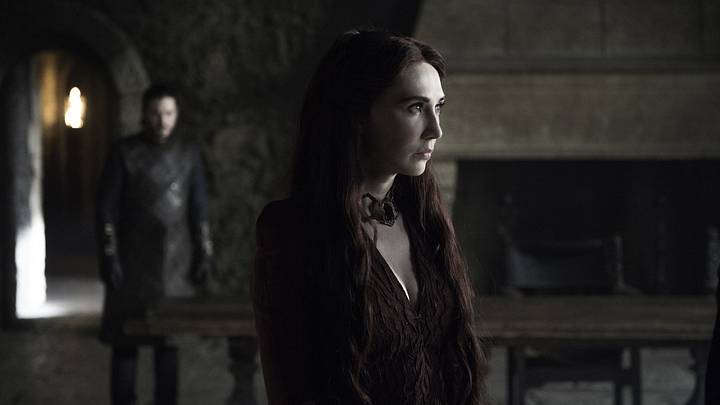
"The Long Night," the third episode of season 8 of Game of Thrones, acts as the climax of the entire series in many ways. Despite the fact that the following three episodes deal with the war for the Iron Throne, the Battle of Winterfell in "The Long NIght" marks the end of the White Walker storyline, which began with the first scene of the first episode of the show.
In addition to the Night King (Vladimir Furdik) and the entirety of his undead army, several major characters don't make it out of the Battle of Winterfell alive. Some of these characters, such as Theon Greyjoy (Alfie Allen) and Jorah Mormont (Iain Glen), have been major players since the beginning, while others, including Edd Tollett (Ben Crompton), Beric Dondarrion (Richard Dormer), and Lyanna Mormont (Bella Ramsey), served as recurring fan favorites. However, one important character's demise in particular represents a major shift for the final episodes of Game of Thrones, setting up the outcome of the series' final battle.

The death of Melisandre
Melisandre makes her only appearance in Game of Thrones season 8 in "The Long Night," and actress Carice van Houten even earned an Emmy nomination for her fantastic performance. After her absence throughout most of season 7, Melisandre returns to Winterfell for the final battle against the undead, using the power of R'hllor to ignite the Dothraki's swords ahead of their initial charge. However, in one of the most harrowing images of the episode, the cavalry's flames quickly go out in the distance, implying that these Dothraki warriors met a dark fate, literally and figuratively.
Melisandre later reunites with Arya Stark (Maisie Williams), offering some advice to the younger Stark daughter who particularly hates her after what she did to Gendry (Joe Dempsie). Melisandre earns Arya's trust after repeating the mantra of her late swordplay mentor, Syrio Forel (Miltos Yerolemou), "What do we say to the God of Death?" With this in mind, Arya later kills the Night King using the same Catspaw Assassin's Valyrian steel dagger which effectively started the war in the first place. With the Night King's death, the rest of the wights and White Walkers he created crumble.
With her purpose complete, Melisadre removes her necklace. As shown in season 6, without the necklace's power, Melisandre shows her true age, appearing as an incredibly old woman. Now, without the need to put the necklace back on, Melisandre allows herself to age to dust.

What does Melisandre's absence mean for the rest of the series?
For a fantasy series, Game of Thrones is relatively light on its magical elements. Some key pieces of magic from the books, such as the Starks' warging, are heavily downplayed for the series, as evidenced by the title shifting from A Song of Ice and Fire, a name which evokes the mysticism of the natural world, to Game of Thrones, a title which is much more grounded in the series' politics.
Alongside Bran Stark (Isaac Hempstead-Wright), who has assumed the mantle of Three-Eyed Raven by the show's final season, Melisandre represents the magic of the World of Ice and Fire better than any other major character on Game of Thrones. As a priestess of R'hllor, Melisandre is the series' main "witchy" character. Although her magic is always inconsistent and often misguided — such as when her visions in the flames convinced her that Stannis Baratheon (Stephen Dillane), a character who unceremoniously dies in season 5, well before the White Walkers make their way south, would be the Prince That Was Promised — she is still able to make impossible things happen, such as her resurrecting Jon Snow (Kit Harrington), the likely actual Prince That Was Promised.
Given her death in episode 3, Melisandre does not appear throughout the rest of season 8. Without her, as well as the Night King and the somewhat similarly empowered Beric Dondarrion present, the rest of the series feels far less magical. This sets the stage for a more grounded final battle for the Iron Throne in King's Landing, with Daenerys Targaryen's (Emilia Clarke) forces, weakened heavily from the Battle of Winterfell, against Cersei Lannister's (Lena Heady).
Despite the heavy losses on Dany's side, and the fact that Euron Greyjoy (Pilou Asbaek) is able to kill one of her two remaining dragons with a sneak attack prior to the battle, Dany easily wins, decimating Cersei's army as well as the entire city of King's Landing. This is because Dany utilizes her ace in the hole: Her last remaining dragon, Drogon. Since Bran remains in Winterfell for the battle, and Melisandre has died, Daenerys and Drogon remain the only magical or otherworldly characters present for the Battle of King's Landing, which explains how easily they overpower everyone else on the battlefield.
While Melisandre likely wouldn't have changed the outcome, especially because, if she cared about matters so trivial as who sits the Iron Throne, she likely would have fought alongside Daenerys anyway, the simple appearance of a witch would have deemphasized the sheer power of a dragon in a clash where one side is able to win because of their single magical element. Thematically, Melisandre's death ends the era of magic on Game of Thrones, and Drogon, as one of the final magical survivors, cannot be topped, despite Cersei's powerful scorpions and armies.
For more from the world of Westeros, make sure to stream House of the Dragon on HBO Max.
 Add us as a preferred source on Google