

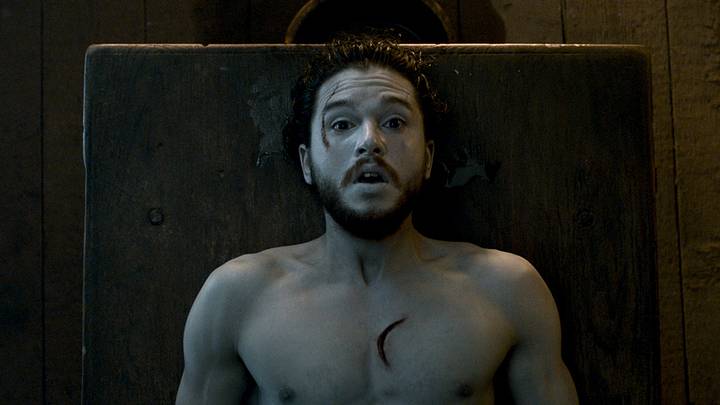
Fans spent the entire lead-up to Game of Thrones season 6 wondering if Jon Snow (Kit Harington) had survived or not. Season 5 ended with the fan-favorite Lord Commander stabbed to death in a mutiny, and while Game of Thrones is no stranger to killing of crucial characters, it seemed as if Jon still had a role to play in the story, especially with growing tensions among the Night's Watch, the Free Folk, and the encroaching undead.
Game of Thrones season 6 opens with confirmation that Jon is, indeed, dead, but in the second episode, Melisandre (Carice Van Houten) is able to resurrect him. This new Jon Snow essentially acts as the series' lead from here on out, but several of his pre-death storylines fall to the wayside as a consequence.
In fact, one major plot beat that took up nearly an entire episode back in season 5, and four whole chapters in the source material, George R.R. Martin's A Song of Ice and Fire books, is resolved with a single sentence.

"You have Castle Black"
Immediately after Jon's resurrection, he executes the four men who killed him, including Ser Alliser Thorne (Owen Teale), Jon's longtime enemy within the Watch, as well as Olly (Brenock O'Connor), a young boy who Jon took under his wing, whose betrayal stung most of all. As Lord Commander of the Night's Watch, Jon has the authority to do so, having previously decapitated Lord Janos Slynt (Dominic Carter) for disobeying his orders.
However, this execution is Jon's last act as Lord Commander. Since the Night's Watch vow famously states "[My watch] shall not end until my death," Jon is technically no longer under this oath, since he already died. Relieved of his duties, Jon removes his black cloak and hands it to Eddison Tollett (Ben Crompton), a.k.a. "Dolorous Edd," his closest friend remaining within the Watch, and simply says to him "You have Castle Black."
Then, Jon declares "My watch has ended," freeing him up to go on to reunite with his sister, Sansa Stark (Sophie Turner), take back Wintefell from the Boltons, and be declared the new King in the North by the end of the season.

What happens with the Night's Watch?
The end of Jon's time at Castle Black marks a major change for the Night's Watch's role within Game of Thrones. Given that most major characters depart from Castle Black with Jon, the Watch receives far less screen time from here on out, leaving most of Edd's time as Lord Commander unexplored, especially since the character only appears in one episode of season 7 and dies relatively early on in season 8.
The Night's Watch likely remains divided after Jon's exit. Jon made several controversial decisions as Lord Commander, including working with the Free Folk, typically the Night's Watch's enemies, and welcoming in their refugees from Hardhome. This resulted in the mutiny that killed Jon, and divided the Night's Watch in half.
Edd, as Jon's friend and confidant, took his side on the matter, but the series never explores if he is able to unite the Watch once more as Lord Commander, or if it's still plagued with inner turmoil.
Additionally, Edd's quick appointment to the position of Lord Commander implies that he's only the acting Lord Commander, a position previously held by Alliser Thorne between the death of Jeor Mormont (James Cosmo) and the next election. However, Game of Thrones never features nor discusses a follow up election to officially replace Jon.
Edd is still acting Lord Commander at the time of his death during the Battle of Winterfell, so the selection of the next Lord Commander never receives any real attention within the story. Ironically, since Jon Snow ends up sent back to the Night's Watch in the series finale, he could end up as his own official replacement.
In contrast, Jon Snow's election for Lord Commander receives a great deal of focus back in season 5, when he narrowly defeats Ser Alliser for the position by one vote. The third book in the A Song of Ice and Fire series, A Storm of Swords, dedicates two of Jon's chapters, as well as two of Samwell Tarly's (John Bradley), to discussing the electoral process in even more depth, and ends in a landslide victory in Jon's favor.
Martin's lore establishes this as an important tradition, and yet Edd, the Lord Commander during the most pivotal moment of the Night's Watch's existence, the fight against the undead, is never actually officially elected. Perhaps a more complete final two seasons would have been able to devote more time to the Night's Watch after Jon's exit, or even acknowledge what happened under Edd's leadership.
For more from the world of Westeros, make sure to stream House of the Dragon and A Knight of the Seven Kingdoms on HBO Max, along with all eight seasons of Game of Thrones.
 Add us as a preferred source on Google