

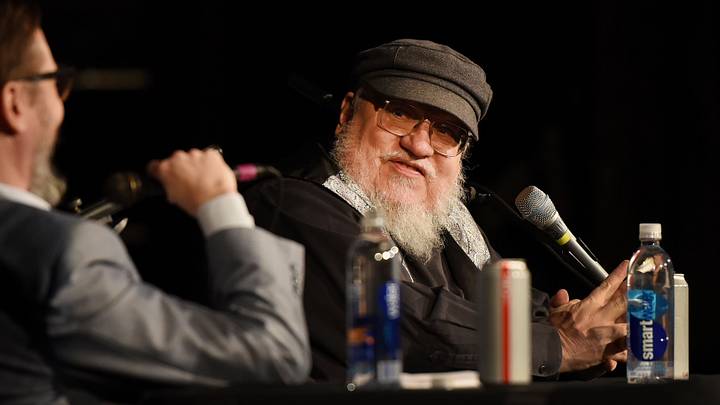
It's quite alright to feel however you want to feel about author George R.R. Martin. It's okay to be frustrated, annoyed, impatient, or just angry at the man who created, but has yet to complete, one of the most incredible fantasy worlds literature has ever read. You are not alone.
A Game of Thrones, Martin's first installment of the planned seven-book series, A Song of Ice and Fire, was published in 1996. 30 years ago! Book two, A Clash of Kings, hit shelves two years later, and book three, A Storm of Swords, two years after that. It took five years for the fourth volume, A Feast for Crows, to come out, then six more before the release of the fifth book, A Dance with Dragons. Then… nothing. Here we are, a decade and a half after A Dance With Dragons, and there is a real possibility fans will never see the final two books, The Winds of Winter and A Dream of Spring.
In many ways, it doesn't matter anymore. HBO aired eight seasons of Game of Thrones — 73 episodes in all — seven of which came out after the fifth book published. Martin allowed someone else to finish his story.
Unlike The Wheel of Time author, Robert Jordan, who famously dictated the ending to his 14-volume epic tale to family members on his deathbed, Martin is still here and still writing. The Wheel of Time story was finished thanks to the family and author Brandon Sanderson. Meanwhile, Martin has published nine other works related to the Song of Ice and Fire world since 2011, if you account for the novellas which preceded Fire & Blood like "The Princess and the Queen."
Martin has been active, writing other things, producing projects for television and and streaming platforms. He just hasn't finished his most important work.

How did George R.R. Martin change literature forever?
Love Martin or not, he did one unheard-of thing that has changed fantasy specifically and literature generally. He killed the clear-cut hero, the main character of the ensemble cast of A Game of Thrones, at the end of that book.
Think about that for a moment. What if Jordan had killed Rand al'Thor at the end of The Eye of the World? Or Egwene? Or Mat? Or Perrin? What if J. K. Rowling had killed Harry Potter at the end of Harry Potter and the Sorcerer's Stone? Or Hermione? Or Ron? It's unthinkable, right?
Yet, Martin had the courage to do something few authors would even dare. If you read the books before the show aired, remember that moment of absolute shock when mad King Joffrey ordered Ned Stark's head to be chopped off. This came after Ned made a deal with Joffrey's mother, Cersei, to go to the Wall and take the black.
When HBO adapted that scene in the ninth episode of Game of Thrones season 1, audiences across the world were shocked. You don't kill the hero of your story in the first season. That just isn't done. But Martin did it.
There was plenty of warning that something like that could happen. Martin left many signs throughout A Game of Thrones, telling people this wasn't your normal fantasy fare. Jaime Lannister pushed a child out a window to his supposed death just because he caught Jaime and his sister having intimate relations, a secret which only reveals its full implications much deeper into the story.
Later, King Robert forced Ned to kill Sansa's innocent direwolf for something Arya's wolf did. Martin was clearly willing to break the rules, but that one pen stroke that slew Ned at the end of the book broke the mold forever. It also served as a harbinger for things to come in the next four books and the television series.

Nothing was sacred in A Song of Ice and Fire. With Ned's stunning death, the world Martin was building flew into chaos at full speed. There were way more villains than heroes throughout the series. Some villains become heroes and vice versa. There were moments of redemption and other moments when redemption was thrown away.
Ned was just the first of many heroes to die in A Song of Ice and Fire, but his end was the most shocking. It hadn't been done before in fantasy in this way, but that surprise death forewarned everyone that this was something different. Much of what Martin did in these books inspired other authors such as Joe Abercrombie and Steven Erikson to delve into harsher worlds than fantasy readers had seen before.
30 years after the publication of A Game of Thrones, the fact stands that George R.R. Martin changed the fantasy genre forever.
 Add us as a preferred source on Google