

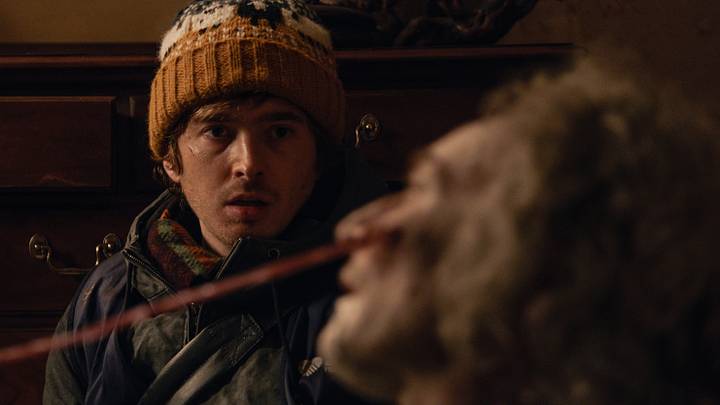
Fans feared they might never see the day, but at long last we have a Resident Evil movie that actually feels like it was made by someone who has played and loved the video games. Barbarian and Weapons director Zach Cregger's new take on Capcom's iconic horror franchise has been incredibly well received so far, smashing all expectations at the box office. As of this writing, the film has racked up over $200 million globally in its first two weeks, putting it on track to outpace every other Resident Evil film adaptation — and it isn't even close to running out of steam yet.
A huge part of what has made Cregger's take on Resident Evil so successful is that Constantin Films actually hired a bona fide horror director to make a legit horror film. That might sound like a given, but Resident Evil has seen its run of middling adaptations that failed to capture the tense tone of the most famous horror video game series in existence. The six-movie series created by director Paul W.S. Anderson which stars Milla Jovovich was a box office success, but after its first film it gradually leaned more and more into the gonzo action side of the franchise in a way that failed to capture the sheer terror that often comes with playing the best Resident Evil games. Johannes Roberts' 2021 reboot Welcome to Raccoon City was a step in the right direction, but it committed the folly of trying to cram two games' worth of material into one film, and ended up underserving both plotlines as a result. And the less we say about Netflix's TV show adaptation the better; not even an incredible performance from the late, great Lance Reddick could save that one.
Cregger's movie is built differently. While those aforementioned adaptations leaned into Resident Evil's fairly convoluted lore to varying degrees, this new film jettisons just about all of it in favor of a simple, original story about a medical courier just trying to stay alive long enough to get to his destination. It captures the feeling of playing a Resident Evil game, where you constantly dread what's going to jump out at you next even as you force yourself down that shadowy corridor toward it. It's a testament to how well the movie pulls this off that the few times it does mention any crumbs of story from the games — like the bioweapon experiments of the Umbrella Corporation that caused Raccoon City's zombie outbreak in the first place — it treats them with such disinterest that they become comedic info dumps...yet the movie somehow still remains an extremely fun and engaging watch regardless.
While much has been said about the success of Cregger's Resident Evil movie and how well it captures the spirit of the video games, there's something interesting about its approach that stood out to me. Comparisons abound for how this new film stacks up to previous adaptations, but there's one crucial element that has been overlooked: a Resident Evil movie like Zach Cregger's simply could not have been made during Paul W.S. Anderson's day, or even in 2021 when Johannes Roberts made Welcome to Raccoon City. The building blocks for it didn't exist yet.

Hollywood is finally taking video game adaptations seriously
There are two primary reasons that Cregger's Resident Evil film was possible today. The first is that video game adaptations as a whole have evolved tremendously in recent years, with a slew of hits going over so well that Hollywood is finally giving these stories the respect they deserve. From the brooding pathos of HBO's The Last of Us to the family-friendly box office juggernaut Super Mario Bros. movies, we've seen a number of video game adaptations not only succeed where they've typically failed in the past, but do it in such immense fashion that they can't be ignored.
As a result, these adaptations are getting better budgets and support than ever before. Resident Evil (2026) had a reported budget of $75 million; that's three times what Welcome to Raccoon City got in 2021, and more than double Anderson and Jovovich's first film in 2002. Ironically, Cregger's movie is the scrappiest of the lot; it has the feel of an indie horror movie, which fits with the director's sensibilities, but also has the money to go all out with gore and set pieces when necessary. The result speaks for itself.
Beyond the behind-the-scenes details, Resident Evil also premieres at a time when we're seeing a greater variety of video game adaptations than ever before. While The Last of Us adhered closely to its source material, we've also seen hits like Prime Video's Fallout weave entirely original tales. Resident Evil hews more toward the latter than the former, further cementing this storytelling strategy as one that can work for video game adaptations. It's a relatively recent development for these sorts of game films and movies, and we've now seen more proof than ever of how it can succeed.
Resident Evil (2026) is massively influenced by the RE Engine games
The other reason that a Resident Evil adaptation like Cregger's couldn't have been made a decade ago is because the games which inspired it largely didn't exist then. For as much as Resident Evil (2026) leans on some of the franchise's most recognizable and classic elements, like the Raccoon City setting, it wears the influence of more recent titles firmly on its sleeve.
If you aren't familiar, game developer Capcom has been on a generational run with its horror franchise over the past nine or so years. Following the divisive release of the action-heavy Resident Evil 6 in 2012, the studio took its time to get back to its horror roots. The result was 2017's Resident Evil 7: Biohazard, a terrifyingly fresh take on the franchise's classic formula that featured the new protagonist Ethan Winters, as well as a first-person camera for the first time in the series' history. This was the first title Capcom developed with its in-house video game engine — the RE Engine — and it laid the groundwork for a series of subsequent hits that includes remakes of Resident Evil 2, Resident Evil 3, and Resident Evil 4, as well as new entries like Resident Evil Village and this year's Resident Evil Requiem.
Outside of some roadbumps with Resident Evil 3, every single one of those titles I just listed was warmly received by the fandom — and brought in legions of new fans besides who hadn't grown up with the original games released in the 1990s and early 2000s. It's hard to find a game studio that has had more consistent success than Capcom with its RE Engine Resident Evil games. Needless to say, they've gotten a massive boost in sales from the hype surrounding Cregger's film as well.

I mention all this because despite being set during a parallel version of the Raccon City incident — which forms the basis for Resident Evil 2 and 3 — Zach Cregger's movie actually has much more in common with Resident Evil 7. Many of the games feature a skilled protagonist, whether that's the elite S.T.A.R.S. team of the early games or Leon S. Kennedy, government agent extraordinaire. But RE7's Ethan Winters is just a regular guy who gets caught totally out of his depth, just like Bryan (Austin Abrams).
There are other commonalities. Resident Evil (2026) features a few segments that utilize a first-person camera, something which would not have fit at all with the series before the release of Resident Evil 7. Its spooky farmhouse setting that serves as Bryan's first stop on his tour of horrors also evokes shades of the Baker House, the Louisiana farmhouse where Ethan is trapped with a deranged family who has been mutated by a mysterious black substance known as the Mold. Ethan's story concludes in Resident Evil Village, with a similarly tragic arc to Bryan's fateful ascent through the hospital.
That's not to say that there aren't Easter eggs or nods to the games outside the Ethan Winters saga as well. The film's final hospital sequence calls to mind Resident Evil 3, whose remake vastly expanded on the hospital section of the original to make it a far more atmospheric and terrifying experience. Bryan finds shotgun ammunition in the farmhouse which takes it design from Resident Evil 4. The RV he's forced to enter in the tunnel outside Raccoon City is similar in design to a bus clogging the streets of the city in Resident Evil 2, where you just know something awful is waiting inside. And while a seemingly invincible "stalker enemy" that relentlessly pursues the protagonist originated with Resident Evil 3: Nemesis (1999), it's only with the RE Engine games that it's truly become a recurring mainstay of the series across nearly every recent entry.
Zach Cregger's favorite Resident Evil games give insight into the film
Zach Cregger's Resident Evil is an homage to the franchise at large, but it's very clear that he's a fan of the newer run of games which were released after Anderson's movie series finished its run in early 2017. We don't even need to speculate about it; Cregger himself named his top 5 Resident Evil games before the film's release during an interview with IGN at San Diego Comic-Con, and every single one of them is part of the RE Engine era of games.
His top five, from lowest to highest, are Resident Evil 7, Resident Evil Village, Resident Evil Requiem, Resident Evil 2, and Resident Evil 4. When pressed, he specified that he's spent "way more time on the remake" of Resident Evil 4 than the original, which revolutionized third-person shooter games when it released for the Nintendo GameCube in 2005. Capcom's remake, which dropped in 2023, is one of the rare examples that arguably improved upon an already perfect, utterly iconic game.
That love of the newer titles in the series is evident in Zach Cregger's Resident Evil. So while it does still pull elements from the classic games, it also deserves its flowers as a Resident Evil adaptation that is truly of its time — and fully grasps the horrifying scope of the many games which influenced it.
Resident Evil (2026) is now playing in theaters.
 Add us as a preferred source on Google