

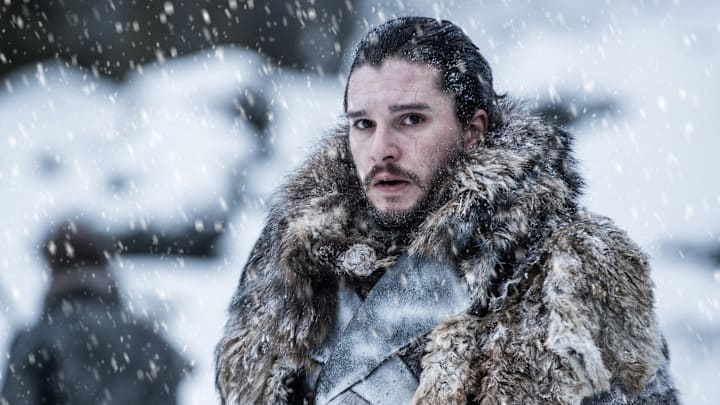
Game of Thrones was as much about the unforgettable characters as it was about politics and pageantry. The twists and turns and battle charges would not be half as meaningful if we weren’t as invested in the complex, deeply human figures who were constantly blurring the line between right and wrong. Some we openly rooted for, others we loved to hate, and a few we secretly loved and were judged for it if our friends found out.
In honor of the 15th anniversary of the show, created by David Benioff and D. B. Weiss based on George R.R. Martin's incomplete magnum opus series, A Song of Ice and Fire, here are the 15 most iconic characters who defined Game of Thrones.
Before we get to the main list, here are some honorable mentions: Hodor, Olenna Tyrell, Ramsay Bolton, Jorah Mormont, and, despite her little screen time, Lyanna Mormont.

15. Ned Stark
Game of Thrones became what it is with Ned Stark’s (Sean Bean) shocking death in season 1, kickstarting the show’s episode 9 curse. Up until that point, many viewers who hadn’t read the book were fully convinced that Ned, the good-hearted and honorable nobleman, was the primary protagonist of the show. He was also a good father, a good husband, a good friend, and, as we later find out, a good brother.
Ned's execution sent a strong message that the show was not bound by traditional storytelling rules, establishing a world in which characters die regardless of status or intention, rather than relying on plot armor. In the show, his death plunged Westeros into the series of devastating events that gradually unfold in the upcoming seasons.

14. Sandor Clegane (The Hound)
The Hound (Rory McCann) inarguably had one of the most believable 180-degree arcs in the show. Somewhere between his time as Joffrey’s guard dog who cared little about the lives he was taking and becoming Sansa’s savior, fans started to root for the cynical, dry-witted man.
His true redemption came in his quiet moments with Arya during their travels, where we got to see a different, fatherly side of him hidden underneath all the trauma-fueled asperity. His face was permanently burned by his brother, Gregor “The Mountain” Clegane, when they were kids, and bore a lifelong scar, trauma, a fear of fire, and a grudge to show for it.
It all culminated in the final confrontation with her brother, stranded within the flames of Red Keep, giving fans the “Cleganebowl” payoff they had been craving for years.

13. Tywin Lannister
Tywin Lannister (Charles Dance) was terror wrapped in royal silk. He commanded every scene he was in, be it skinning a stag while lecturing his son or dismissing the king with a double-edged metaphor. The Lannister patriarch’s cold competence is what made the House of the Lion the realm’s most feared family.
His Hand of the King brooch, for the most part, was a formality. He was the de facto ruler of the Seven Kingdoms (or nine?) for three seasons. Among all the characters, he probably knew how to play the game of thrones the best. Unfortunately, he wasn’t the world’s greatest dad, and that, eventually, led to his downfall.

12. Drogon
I almost didn’t include Daenerys’ ride in this list, but then a friend reminded me that “there’s no Game of Thrones without Drogon.” I partially agree with the sentiment, and I fully agree that the CGI dragon was one of the best bits of the series.
Sure, the show is held up by Machiavellian politics, but we all remember wondering every season when we would get to see the dragons next. Drogon (and Viserion and Rhaegal) represented magic in a world where there was very little of it left.
He was beautiful and majestic, and his mere presence was half the power Dany wielded. Drogon also set a new precedent for live-action dragons at a time when there weren’t many of them.

11. Joffrey Baratheon
Joffrey Baratheon (Jack Gleeson) was possibly the most hated teenager in television history, a feat credited to Gleeson’s chilling performance. He was one of those villains who was not only cruel but also mistook it for strength and was often annoyingly wrong about it. Even his mother and grandfather were fed up with him at times.
He was a product of Lannister incest, but lacked the cunning of Cersei or the skills of Jaime. His ascension to the throne acted as one of the catalysts for the War of the Five Kings, specifically when he ignored his council and ordered the execution of Ned Stark.
Joffrey was a spoiled child with a crown, reminding viewers that the greatest threat to a kingdom isn't always a foreign invader, but an unfit king. His agonizing death at the Purple Wedding remains one of the show's most cathartic milestones.

10. Varys
Varys (Conleth Hill) was the master of whispers, and every move he made proved beyond doubt that information was almost as lethal a weapon as a sword in the world of Game of Thrones. Born into extreme poverty and slavery, and surviving abuse as a child, Varys rose through the ranks of nobility and survived the dangerous waters of King’s Landing by knowing secrets and what they were worth to whom.
Varys was the ultimate pragmatist, often forming a fascinating intellectual duo with Littlefinger. However, while Littlefinger thrived on chaos, Varys sought stability. His loyalty was never to a person but to the idea of a competent ruler for Westeros. This conviction eventually led him to support Daenerys Targaryen and ultimately cost him his life.

9. Petyr Baelish (Littlefinger)
If you just forget the Night King for a minute, which isn’t that tough to do given how little we knew about his intentions by the end, Petyr Baelish (Aidan Gillen) was truly the real villain of Game of Thrones. He toppled the first domino of conflict by making Lysa Arryn murder Jon Arryn, getting her to blame Cersei for it, and then lying to Catelyn about Tyrion being responsible for the attack on Bran’s life.
His goal was not to win or lose in the short run, but simply to create chaos, which, naturally, is a ladder. He intended to climb it to the very top, and he nearly succeeded, but then the player got outplayed. He started the whole series of events by manipulating two sisters, and it was a pair of sisters who brought him down from his ambitious ascent to power.
Call it irony, or poetic justice, but watching Littlefinger, who had always been a step ahead of everyone, beg for his life in his final moments, was so glorious. That is how you know what an impact the character has on the mayhem that Game of Thrones was.

8. Brienne of Tarth
Brienne of Tarth (Gwendoline Christie) might be one of the very few pure embodiments of honor in Game of Thrones. Steadfast in her morals, she never wavered from her vows, even when pitted against the worst adversities. Sworn first to Renly Baratheon and later to Catelyn Stark, Brienne grew from a likable side character to quite the pillar of integrity.
From the moment she is introduced, Brienne exists at odds with the world around her. She was mocked for her appearance, dismissed because of her gender, and denied the recognition she had more than earned, which made her knighthood scene all the more precious.
I explain later why Jaime's leaving her made sense to me. However, removed from that, Brienne 100% deserved better. Given that she survived to the end, I like to believe she found it, especially since Tormund Giantsbane is also alive and well beyond the wWall. It’s also fun to know now that she was a descendant of Ser Duncan the Tall from A Knight of the Seven Kingdoms.

7. Sansa Stark
Sansa Stark (Sophie Turner) was one of my favorite characters on the show, and I liked her even more every time she was picked apart by some fans for being a “dumb little girl,” especially in comparison to her sword-wielding sister. But strength takes many shapes and forms, and as Sansa and Arya quietly acknowledged after their reunion, they may not have survived each other’s battles.
She was a child, thrown into a grown man’s game out of nowhere. Her naive, idealistic dream of marrying Joffrey and becoming a queen was not forged in a void. The world around her shaped it. She was not brought up on lessons in strategy and statecraft at Winterfell. Still, she learned her way in King’s Landing and beyond, sifting through the manipulation and abuse of figures like Cersei, Littlefinger, and Ramsay Bolton.
By the end, she emerged as a competent leader who prioritized her people’s welfare and independence, and was embraced by them as the Queen in the North. There is a reason why Turner was one of the very few Game of Thrones actors who were happy with their ending.

6. Jaime Lannister
They say every story needs a villain, but the best villains are the ones you secretly like (actually, Stephanie Garber said that). Introduced as the arrogant “Kingslayer” who slept with his sister and pushed a kid out of a castle window to keep that a secret, Jaime Lannister (Nikolaj Coster-Waldau) sure seemed a man without honor at first.
However, every passing episode gradually peeled open layers of character development. Underneath the blond hair, the Kingsguard armor, and all the cockiness of being one of the best swordsmen of Westeros, the man was wracked with guilt, vulnerability, and inner conflict. His redemption through his bond with Brienne was a slow-burning, well-earned one.
His knighting of Brienne before the Battle of Winterfell, making her the first woman of the Seven Kingdoms to become a knight, is one of the best scenes of the little-liked season 8. Many do not like the turn his arc took when he left Brienne and everyone else to be with Cersei. But I felt it was in line with who Jaime was — flawed and contradictory — and the unforgiving nature of Game of Thrones verse.
He had his share of wrongdoings, including assaulting his sister at her dead son’s grave, and it made sense for his fate to be doomed and entangled with Cersei until their last breaths, whether you believe in incestuous love or not.

5. Jon Snow
Jon Snow (Kit Harington) was the quintessential protagonist. No one should be blamed for assuming he would eventually be promoted to the “true” main character. He had the archetypal hero’s journey, with an underdog beginning, outcast status, reluctant leadership, and a resurrection from the dead. The eventual revelation of his secret royal parentage further fueled expectations, but it did not matter much in the end.
Jon was the show’s moral compass, often to a fault, much like his “father” Ned Stark. He carried the weight of honor in a dishonorable world, choosing duty over desire, and sometimes paid a price for that.
Fans often argue that his righteousness had no place in a story like Game of Thrones, and perhaps that is true. But every story, even one as gritty as this one, needs that one character who would unsheath a sword and prepare to face a charging cavalry all by themselves, for it would be the right thing to do.

4. Tyrion Lannister
Game of Thrones revolutionized television in many ways, one of which was putting a character like Tyrion Lannister (Peter Dinklage) in the front and center. In a show of grey characters, he became a fan-favorite pretty early on, advising Jon Snow to wear his status as a bastard like armor and slapping his nephew, the insufferable Joffrey, in back-to-back episodes.
Dinklage’s Emmy-winning performance turned Tyrion into the show's earnest heart, with fierce intelligence and a sarcastic sense of humor. His courtroom speech while on trial for allegedly murdering Joffrey was one of those signature, hard-hitting scenes that the show became famous for. Also, we all rejoiced when he finally got to kill his father, that too while he was on the chamber pot.
Like most others, Tyrion’s arc took an uncharacteristic turn towards the end. Up until then, he was easily one of the most eloquent, smart-witted, and politically aware characters in the entire story. Never loved by his father or sister, insulted for his condition at every turn, and underestimated despite his high station, Tyrion’s journey from being the despised son to the Hand of Queen for Daenerys is one of the show’s most compelling journeys. As a wise man once said, “A very small man can cast a very large shadow.”

3. Arya Stark
If there’s one main character no one could find a reason to hate, it was Arya Stark (Maisie Williams). As an orphan child making her way through Westeros under a disguise, it could’ve been very difficult to hold on to her convictions. But circumstances did not break Arya, although they nearly killed her multiple times.
The funniest part about Arya being so loved is that almost none of it has to do with the fact that she killed the main antagonist of the show, the Night King. She had one of the most interesting arcs in the story, going from the aftermath of the butchering of her family to becoming Tywin Lannister’s cupbearer, to learning to be one of the Faceless Men on Braavos, to taking her revenge against the Freys, which remains one of the most satisfying retributions in the entire series.
In the finale, we watch her set sail to explore the unknown lands west of Westeros. Her post-Game of Thrones adventures would be a great two-season story if HBO is looking for spinoff ideas. They can even throw in Jaqen H'ghar here and there, for nostalgia’s sake.

2. Daenerys Targaryen
In many ways, Game of Thrones was supposed to be Daenerys’ (Emilia Clarke) story. After House of the Dragon introduced Aegon the Conqueror’s prophecy, many deemed that Dany is the “Prince(ess) that was promised,” given she did quite a bit of heavy-lifting against the whitewalkers.
For most of the series, she was built up as the character to root for, with equal measures of mercy and ruthlessness. Some changes were made for the show, such as her immunity to fire, which deified her from the get-go. Then came the dragons, the armies, and the loyalty she inspired through her actions, which brought figures like Tyrion and Varys onto her side.
I have always been of two minds about her evil turn. It could have been avoided, but it also would’ve fit the general grim tone of Martin’s universe, where things don’t follow the usual script, especially if one is a Targaryen. However, it is almost unanimously agreed that it could have been done better, with more context and time to buttress her eventual snap.
Still, that doesn’t necessarily put a damper on her moments from the earlier seasons, be it coming out of fire with three baby dragons, or burning the slave master, or leading the Dothraki charge on Drogon against the Lannister army. Her popularity also paved the way for the success of House of the Dragon.

1. Cersei Lannister
Cersei Lannister (Lena Headey) was neither a hero worth rooting for nor a villain with a rightful cause. She’s a third, more complex, deeply flawed character, one that women of her position often become to wield power in a world like Game of Thrones. That makes her, in my eyes, the most fitting embodiment of the tenets of the show.
It is true that she lost her mother as a child, was never valued by her father as an heir, and her husband was in love with a dead woman. She was tortured and humiliated in public, and one by one, lost the only thing she ever truly cared about: her children. It is also true that she was merciless from the beginning to everyone who even minutely stood in her path, manipulated and betrayed her way to the top, and caused countless deaths.
Her atrocities were many, and she was beyond redemption, and in my honest opinion, deserved a better ending. By better, I mean a more gruesome one, fitting for her crimes. Nevertheless, Headey played the clash of intentions in Cersei with such depth and complexity that her cold cruelty felt earned, and her rare vulnerabilities seemed earnest, whether she was blowing up a sept full of people or grieving her daughter.
Also, some of the most iconic lines from the show belong to her, including “When you play the game of thrones, you win or you die.”

Game of Thrones anniversary month continues! We're celebrating 15 years since the show's premiere all throughout the month of April with more deep dives and retrospectives looking back on Thrones' incredible run. Come along for a return journey to the Seven Kingdoms!
More Game of Thrones:
 Add us as a preferred source on Google