

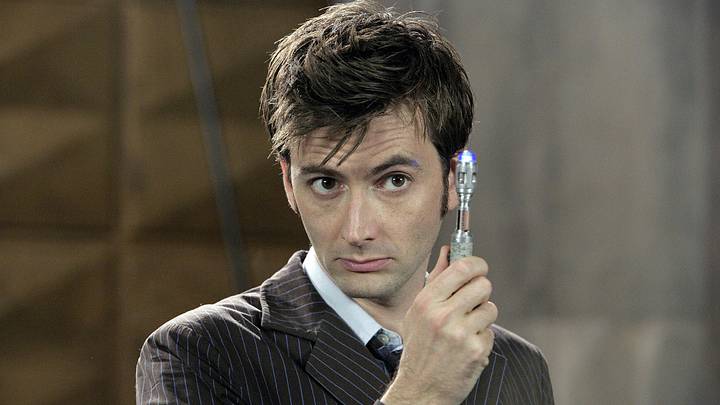
Doctor Who's revival era has introduced one of the show's most iconic villains: the Weeping Angels. Although the lore surrounding the creepy winged statues has been fleshed out since their 2007 debut, they're still incredibly mysterious. In David Tennant's farewell as the Tenth Doctor in 2010, Doctor Who teased a fascinating part of the Weeping Angels' origin story. However, 16 years later, the writers have intentionally refused to offer any more context. All we're left with are theories.
Steven Moffat introduced the Weeping Angels in Doctor Who season 3, Episode 10, "Blink." Once he took over from Russell T Davies as showrunner for season 5, Moffatt wasted no time creating more opportunities for the villains to return. Moffat's successor, Chris Chibnall, also used the Weeping Angels, but the less we talk about Chibnall's time in charge of Doctor Who, the better.
Since Jodie Whittaker's time as the Thirteenth Doctor, the Angels have been conspicuously absent from the long-running British sci-fi. So, Doctor Who still hasn't acknowledged a very compelling moment from 2010.
Doctor Who's throwaway Weeping Angels tease in "The End of Time" explained
Timothy Dalton's Rassilon serves as the final villain faced by David Tennant's Tenth Doctor. The leader of the Time Lords' plan in "The End of Time" is to destroy all of creation and leave only his people's non-corporeal life force in existence. It's a little mustache-twirly, but it does at least create an absolute threat. What's especially interesting about the plan is that Rassilon takes a vote on whether it should go ahead. You can read what he says about the vote's outcome below.
"The vote is taken. Only two stand against, and will stand as monument to their shame, like the Weeping Angels of old. Now the vanguard stands prepared, as the children of Gallifrey return to the universe. To Earth."Rassilon, "The End of Time."
With everything that's happening at this point in the story, it's easy to just miss or ignore the significance of Rassilon's Weeping Angels reference. It can be analyzed to death, though. Not only are the two anti-apocalypse Time Lords seen being forced to stand in the recognizable hands-over-the-eyes pose, but Rassilon's dialogue quietly confirms some sort of shared history with the Weeping Angels. Infuriatingly, Davies' script moves on the moment very quickly. In 2026, we still don't know for sure what Rassilon was really talking about.

The leading theory of what Rassilon's Weeping Angels reference meant
Doctor Who fans began feverishly discussing this moment, and the debating hasn't really stopped since. One theory has been arrived at as more likely than most. In short, Whovians have sort of softly accepted as headcanon that Weeping Angels are disgraced or fallen Time Lords. In other words, Time Lords do things or express thoughts that oppose those of their people's dogma, and are then punished by being forced into the Weeping Angels pose. Over the centuries, their bodies calcify until they turn into stone – or at least something very similar to stone.
This theory is supported by the fact that Weeping Angels also have a temporal connection, like the Time Lords. Although the Angels do eventually become more murderous, they're introduced as fairly merciful killers. In "Blink," being touched by an Angel sends someone back in time, and the Angel absorbs the energy left behind by the life the unfortunate individual would have lived. In the Doctor's words, they "zap you into the past and let you live to death."
Granted, this isn't a power that Time Lords possess. Not without a TARDIS, anyway. On the other hand, there's nothing to really disprove that this power isn't just something that manifests as they slowly become Weeping Angels. That being said, perhaps the biggest sign that this theory doesn't ring true is the sheer number of Weeping Angels in the universe. There have been so many of them shown since their debut in "Blink" that it seems unreasonable for the Time Lords to cast out so many of their own people just because they disagreed with certain courses of action.
Furthermore, the Doctor would surely have mentioned this origin story by now if it were part of the official canon. What I think is more likely is that Davies just wanted to deepen the mystery surrounding the Angels without giving much thought to the fallout of Rassilon's dialogue. The showrunner's work during the Disney era with Ncuti Gatwa's Fifteenth Doctor certainly proves a tendency to do just that. I doubt we'll ever get a solid answer to whether the Angels are fallen Time Lords. I don't think they are, though.
"The End of Time" also teased created another Doctor Who mystery
The Doctor's family tree is one of the biggest enigmas in Doctor Who history, even before Chibnall tore it to shreds with the Timeless Child twist – I still haven't forgiven him for that. In 2010, though, none of that had happened yet. As such, Claire Bloom's mysterious Time Lord character in "The End of Time" had featured in a few small cameos in the lead-up to Tennant's farewell. She was one of the Time Lords covering their eyes like the Weeping Angels.
It's never been confirmed on-screen who this woman was, despite the Doctor appearing to recognize her when she removed her hands from her face.
In an expanded edition of 2008's Doctor Who: The Writer's Tale, showrunner Russell T Davies discussed this moment. Although he admitted he "liked leaving it open," he also said, "it's meant to be the Doctor's mother." Now, I'm a firm believer that a canonical reveal like this needs to be something that happens on screen, rather than something that's explained at a later date by the writer. Even if Davies intended to make Bloom's character the Doctor's mother, I struggle to accept that as part of the official lore because of the on-screen ambiguity.
Therefore, just as we've been left to wonder why Rassilon chose to mention the Weeping Angels in "The End of Time," we're also left with the question of exactly who that woman was who was posing like one of the stone villains. The Doctor's mother is certainly one possibility, I will admit. But without a more traditional explanation of who Bloom was playing, this part of Doctor Who lore remains unconfirmed as far as I'm concerned – just like the Angels' origin story.
Doctor Who returns with a Christmas special this December.
 Add us as a preferred source on Google