

It's rare that a film adaptation outshines its source material but science fiction has given us several remarkable examples where the movie not only matched the book but it surpassed it.
Some of these films even won Academy Awards, proving that great adaptations can be both critically acclaimed and artistically superior. Here are eight sci-fi movies that prove sometimes Hollywood gets it right.
8. Arrival (2016) — Won Best Sound Editing
Denis Villeneuve's Arrival follows linguist Dr. Louise Banks when 12 alien spacecraft land at various locations around Earth. Recruited by the U.S. military to decipher the aliens' language and understand their intentions, Banks learns to communicate with the seven-limbed "heptapods" while experiencing vivid visions that become key to understanding the aliens' true purpose and her own future.
The thought-provoking masterpiece earned eight Academy Award nominations including Best Picture, Best Director and Best Adapted Screenplay. It won Best Sound Editing, with critics praising Amy Adams's performance as one of the year's best even though she was controversially snubbed for a Best Actress nomination.
Based on Ted Chiang's novella "Story of Your Life," the film takes a more intimate emotionally resonant approach while adding crucial dramatic tension. The book's complex physics discussions and Fermat's Principle of Least Time are simplified for broader accessibility, allowing the emotional core which is a mother's love for her daughter despite knowing tragedy awaits, to shine through more powerfully.
Screenwriter Eric Heisserer added elements like international tensions threatening to spark war and a climactic scene where Banks must prevent global conflict, creating stakes that don't exist in the more contemplative novella. The film's twist, revealing that Banks's "memories" of her daughter are actually visions of the future, lands with devastating emotional impact thanks to the visual medium's ability to manipulate time perception. Even Chiang himself approved, calling it "both a good movie and a good adaptation."

7. Jurassic Park (1993) - Won 3 Oscars (Visual Effects, Sound, Sound Effects Editing)
Steven Spielberg's Jurassic Park takes us to a remote island where billionaire John Hammond has created a theme park featuring cloned dinosaurs brought back to life through genetic engineering. Before opening to the public, he invites paleontologist Dr. Alan Grant, paleobotanist Dr. Ellie Sattler and mathematician Ian Malcolm to endorse the park's safety.
When a disgruntled employee sabotages the security systems, the prehistoric predators break free, turning the inspection tour into a fight for survival.
The groundbreaking blockbuster won all three Oscars for which it was nominated. The revolutionary combination of animatronics by Stan Winston Studios and CGI by Industrial Light & Magic created dinosaurs so realistic they remain impressive three decades later.
While Michael Crichton's 1990 novel is packed with fascinating scientific detail and explores complex themes about genetic engineering and chaos theory, Spielberg's adaptation made crucial improvements. The film streamlined the technical exposition that bogs down the book, letting the wonder and terror of the dinosaurs shine.
Characters became more likable and nuanced, particularly Hammond, who transforms from Crichton's despicable capitalist villain into Richard Attenborough's misguided but sympathetic dreamer. The film also smartly toned down the graphic violence and made it accessible to wider audiences. Most importantly, Spielberg understood that showing dinosaurs on screen would always be more impactful than reading about them.
6. Blade Runner (1982) - Won 3 BAFTAs (nominated for 2 Oscars)
Ridley Scott's Blade Runner is set in a dystopian 2019 Los Angeles where former police officer Rick Deckard is forced out of retirement to hunt down four rogue "replicants" — bioengineered humans with superhuman abilities but limited lifespans. These synthetic beings, led by the charismatic Roy Batty, have illegally returned to Earth seeking their creator and a way to extend their lives.
While the film was nominated for two Oscars (Best Art Direction and Best Visual Effects) but didn't win, it claimed three BAFTA Awards for Best Cinematography, Best Costume Design and Best Production Design. The film's neo-noir aesthetic and groundbreaking visual design influenced sci-fi cinema for decades, eventually earning it recognition as one of the greatest films ever made.
Philip K. Dick's "Do Androids Dream of Electric Sheep?" is a brilliant but unconventional novel filled with strange concepts like artificial animals as status symbols, the Mercerism religion and mood organs that let you dial your emotions. The book follows a married bounty hunter who wants to buy a real animal to impress his depressed wife.
While Dick's themes are really big, the narrative can feel scattered and confusing. Ridley Scott's adaptation stripped away the more esoteric elements to focus on a noir detective story with deeper questions about humanity and consciousness. By removing Deckard's wife and the animal obsession, the film makes him a more relatable loner whose relationship with the replicant Rachael becomes the emotional center. Most critically, Roy Batty's "Tears in Rain" monologue gives the film an emotional climax that elevates it into a moment of pure cinema that no page could replicate.

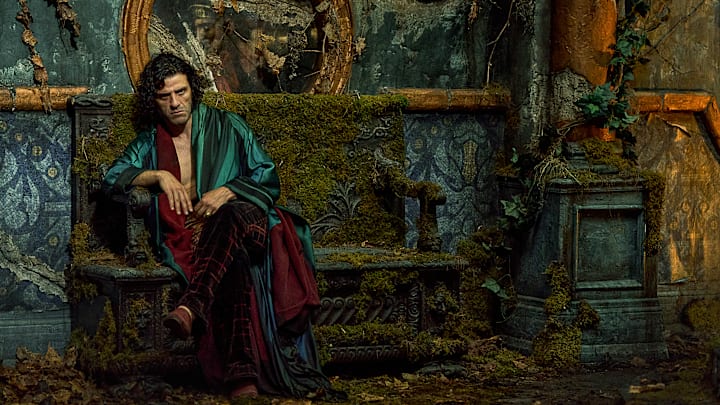
5. Frankenstein (2026) - Won 3 Oscars (Production Design, Costume Design, Makeup and Hairstyling)
Guillermo del Toro's Frankenstein follows Baron Victor Frankenstein in 1850s Europe, a brilliant but egotistical surgeon expelled from medical school for his radical experiments. Finding a wealthy benefactor to fund his blasphemous quest to conquer death itself, Victor uses body parts harvested from battlefields to reanimate a full human being. But when Victor condemns his creation to death, the Creature survives and sets out to find his creator, leading to a tragic confrontation in the Arctic between father and son.
Del Toro's gothic epic earned nine Academy Award nominations including Best Picture, with del Toro receiving nods for Best Adapted Screenplay. The film took home three Oscars for its stunning visual craftsmanship, with critics particularly praising Jacob Elordi's deeply emotional performance as the Creature, which many considered the best of the year.
This is admittedly a hot take on this list. Mary Shelley's 1818 novel is a literary masterpiece and del Toro's film doesn't replace it so much as complement it with a different emotional emphasis. The book is a tragedy about hubris and societal rejection ending with both creator and creation dying in despair. Del Toro's version reframes the story through his signature lens of compassion for monsters into a meditation on forgiveness and the possibility of redemption.
The film adds crucial backstory, making Victor himself a victim of his cruel father, which creates a cycle of abuse that explains his inability to love his creation. Most significantly, del Toro changes the ending where instead of dying in mutual hatred, Victor and the Creature reconcile, with Victor urging his creation to embrace life and find love. This hopeful conclusion makes the film emotionally devastating in a different way than Shelley's nihilistic finale. As del Toro explained, "your heart will be broken, you will be pulverized, and the sun will rise again, and you're going to have to keep living." For the modern audiences, that message resonates more powerfully than Shelley's warning about unchecked ambition.
4. The Martian (2015)
Ridley Scott's The Martian follows astronaut Mark Watney when a violent storm forces his crew to evacuate Mars. Impaled by debris and presumed dead, Watney wakes up alone on the Red Planet with limited supplies. He must use his ingenuity and scientific knowledge to survive until a rescue mission can reach him, if NASA can even figure out he's still alive.
Andy Weir's novel is beloved for its meticulous scientific accuracy and Watney's problem-solving approach to survival. But the book often reads like a technical manual, with pages of detailed calculations and Watney's extensive internal monologues about botany and engineering. Ridley Scott's film keeps the science but makes it cinematic, cutting away the excessive exposition.
Matt Damon brings warmth and humor to Watney that makes him immediately likable, while the film balances the Mars sequences with NASA's rescue efforts in a way that creates better dramatic pacing.
3. Planet of the Apes (1968)
Franklin J. Schaffner's Planet of the Apes follows astronaut George Taylor as he crash-lands on a mysterious planet where apes are the dominant species and humans are primitive, mute creatures. Captured and caged by the apes, Taylor struggles to prove his intelligence while uncovering the shocking truth about this strange world and humanity's place in it.
Pierre Boulle's French novel "La Planète des Singes" is more satirical than the film, with the protagonist ultimately returning to Earth only to find apes have taken over there too. The film, scripted initially by Rod Serling and directed by Schaffner, changed it into a biting commentary on civil rights, nuclear war and human arrogance. The famous twist ending where Taylor discovers the ruins of the Statue of Liberty is one of cinema's most iconic reveals, far more powerful than the book's ending. The film's social commentary feels urgent and relevant, while the book reads more like science fiction satire. Plus, the makeup and performances by Roddy McDowall, Kim Hunter and Maurice Evans gave the apes genuine personality and made the reversed society feel unsettlingly real.
2. Ready Player One (2018)
Steven Spielberg's Ready Player One takes place in a dystopian 2045 where most of humanity escapes poverty and despair by spending time in the OASIS, a massive virtual reality universe. When the OASIS creator dies, he leaves behind a contest to find three hidden keys in the virtual world and win control of the entire OASIS. Wade Watts, a teenage "gunter" (egg hunter), races against a sinister corporation to solve the puzzles and claim the prize.
Ernest Cline's 2011 novel is dense with 1980s pop culture references and spends considerable time explaining Wade's real-world poverty and the OASIS's technical details. Steven Spielberg's adaptation streamlined the plot dramatically, replacing the book's more esoteric challenges (reciting entire movies from memory, playing vintage arcade games) with more cinematic set pieces like a thrilling race through New York City and a terrifying sequence inside The Shining's Overlook Hotel.
The film's visual imagination brings the OASIS to life in ways reading about it probably never could, and Spielberg wisely focused on the adventure and relationships rather than drowning viewers in nostalgia. While some fans prefer the book's deeper dive into gaming culture, the movie creates a more accessible and emotionally engaging experience.
1. The Running Man (1987)
Paul Michael Glaser's The Running Man is set in the dystopian future of 2017 where the global economy has collapsed and America has become a totalitarian police state that controls its population through violent game shows. The most popular is The Running Man, where convicted criminals are hunted by "stalkers" wielding deadly weapons in a gladiatorial arena broadcast live to millions. Ben Richards, a police helicopter pilot framed for a massacre he refused to commit, is forced onto the show by its ruthless host Damon Killian, where he must fight professional killers for a chance at freedom.
This is perhaps the most controversial entry because Stephen King himself wasn't a fan of the adaptation. King's 1982 novel is bleak, where Richards is a desperate, scrawny, tuberculosis-ridden man who enters the game voluntarily to earn money for his dying daughter's medicine. The game spans the entire country for 30 days and the book ends with Richards hijacking a plane and crashing it into the Games Network headquarters in a suicide attack, killing himself and hundreds.
The 1987 film starring Arnold Schwarzenegger throws most of that out the window and somehow creates something more entertaining. Director Paul Michael Glaser transformed the grim story into pure 80s action spectacle, complete with neon aesthetics, over-the-top villains with wrestling personas and Schwarzenegger's legendary one-liners. Richards becomes a muscular action hero instead of a desperate everyman, the game takes place in a confined arena instead of across America, and the ending sees Richards expose the corruption and win as a people's champion.
The film trades King's venomous anti-establishment rage for crowd-pleasing entertainment, but it works brilliantly as satire in its own right. Richard Dawson's performance as the sleazy chain-smoking host Killian is pitch-perfect. The stalkers Subzero with his razor-sharp hockey stick, Buzzsaw with his chainsaws, Dynamo the opera-singing electric maniac, and Fireball with his flamethrower, are ridiculously campy yet memorable. The film's prescience about reality television, deepfakes, media manipulation and surveillance culture feels more relevant today than when it was made.
Where the book is punishingly bleak and the film is absurdly fun, the movie succeeds by understanding its medium. King's novel works as a literary gut-punch about systemic oppression, but Schwarzenegger's version recognizes that cinema can deliver social commentary through spectacle and satire and not just despair. The 1987 film is pure 80s cheese and that's exactly why it's become a cult classic that people still quote decades later. "I'll be back." "Only in a rerun."
The book makes you think about society's ills, and the movie makes you enjoy thinking about them while Arnold defeats a guy named Buzzsaw with his own chainsaw. Sometimes entertainment that knows what it is beats literature that's too heavy to lift.
 Add us as a preferred source on Google