

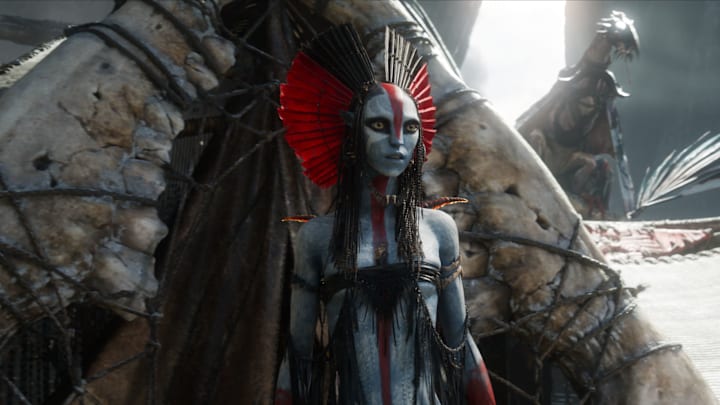
In a year that has been packed-to-the-gills with big, ambitious cinematic swings, James Cameron’s Avatar: Fire and Ash has emerged as the most audacious, bold, and no-holds-barred insane film of 2025. The storied auteur returns with his third Avatar film and goes all-in on this universe in a way that I, frankly, didn’t realize was possible. The result is somehow both the longest film in the franchise thus far as well as the most fly-by-the-seat-of-its-pants experience of the series. Avatar: Fire and Ash is the funniest, most exciting, most emotionally affecting, most vulnerable, most stunning, and most horny film of the trilogy, resulting in the kind of exceedingly rare idiosyncratic theater-viewing experience that only James Cameron can deliver.
For years now, Cameron has been renowned for his ability to build upon an original film with an inspired, high-concept sequel. His second feature film ever was Aliens, which saw him take Ridley Scott’s claustrophobic and dread-filled sci-fi horror film and turn it into a full-blown science fiction-action blockbuster, all while keeping it anchored in the protagonist of the first film, Ellen Ripley, as played by Sigourney Weaver. In 1991, he pulled off a similar feat, this time with a sequel to one of his own films, in the form of Terminator 2: Judgement Day. Like Aliens, T2 delivered a sequel that featured a much larger scale, yet still homed in on an extremely personal scope. Fascinatingly, for his first sequel in three decades, Cameron delivered yet another slam dunk a few years back, in the form of Avatar: The Way of Water; a sequel that built upon the first film and dug deeper into the characters in wonderful fashion.
But now, Avatar: Fire and Ash poses a daunting question: what does a James Cameron three-quel even look like? Infamously, the director shied away from both the third Alien film and the third Terminator film, each of which would go on to receive disappointing receptions in his absence. But here, Cameron was fully committed to continuing to chart the course for the series. And watching what Cameron does with Fire and Ash is kind of incredible, because he’s able to take that tried-and-true sequel formula he’s long-since perfected and apply it in fascinating new ways.

Like the very best of Cameron’s work, Avatar: Fire and Ash is a film that both expands and excavates. On a narrative level alone, the script penned by Cameron, Rick Jaffa, and Amanda Silver stages a cross-cutting, vastly varying epic. Whereas the prior two films were predominantly contained in their number of locations, Fire and Ash traverses an insane amount of ground across its runtime, both literally and metaphorically. And of course, like an unstoppable freight train, the film just keeps building momentum as it goes, building up to an absurdly gargantuan final battle with no less than several dozen key players involved. But on top of that expansion in terms of scale, the film also burrows deep into the bones of this story, these themes, and these characters. If anything, the all-too-human emotions at the center of this thing rise to meet the massive size and scale of the visuals in truly startling fashion.
What makes Fire and Ash even more shocking is the extent to which Cameron is clearly playing without bumpers. That is to say, whereas Way of Water saw him smartly taking things a bit easy on audiences, allowing the long-gestating second installment in the franchise to double as a reintroduction of sorts to this story and world, Fire and Ash immediately thrusts audiences back into the thick of it and very much expects you to keep up. Where the original film built such a cohesive and immersive world, and the second film nurtured these characters into fresh and interesting creations, the third film takes all of the previous groundwork and uses it as a springboard to reach bold new heights. This is a film that bets everything on audiences being keen to explore nittier, grittier, and altogether more gonzo corners of Pandora, and it reaps the rewards of that brazenness as result.

Avatar: Fire and Ash is a feast for the senses
It feels wrong to not talk about the technical aspects of the film, but I simultaneously don’t really know what to say about them other than they are so breathtaking my jaw was frequently on the floor. While all of the films have implemented these insanely detailed computer-generated effects and motion capture elements alongside some real-world sets and human performers, Fire and Ash takes this fidelity and synchrony to a whole new level. To be honest, the brain boggles to even begin to keep track of what is real and what isn’t, especially if you’re further immersed in the film via IMAX, 3D, high frame rate, or any blend therein. It’s an all-consuming viewing experience, one that can’t help but leave you a bit shell-shocked by its end.
Perhaps the single greatest testament to creative opportunities Cameron and company are able to take advantage of through the use of these boundary-pushing effects comes in the interpersonal, quieter scenes between the family at the film’s core, the Sullys. There’s a scene in the first act where a central tension that has been simmering just beneath the surface between Jake (Sam Worthington) and Neytiri (Zoe Saldaña) comes roaring to life in palpable fashion, and the resulting exchange is a thoroughly moving and compelling bit of dramaturgy. In the middle of this ludicrously expensive, fully CGI sequence, the humanity of it all cut through in such a way that the technical elements completely left my periphery and all I saw were Worthington and Saldaña, delivering a pair of powerhouse performances and selling the shit out of meaningful, authentic dialogue.

And then of course, there’s the action. James Cameron is one of the kings of the cinematic action setpiece, and he’s never staged more elaborate, more multifaceted, and more white-knuckled action sequences than he does here. With a full arsenal of seemingly boundless technology at his disposal, Cameron crafts increasingly complex setpieces that remain so deeply rooted in character, theme, and emotion, all while delivering ever-raising stakes and non-stop thrills. It is heart-in-mouth action in the best of ways, with Cameron hellbent on one-upping himself at every turn, and constantly succeeding.
Verdict
Avatar: Fire and Ash is absolutely insane. Despite initial plans to do a five-film series, Cameron has been pretty outspoken during this press tour that he may decide to ultimately allow Fire and Ash to serve as a conclusion of sorts. While I don’t really believe this will be the end, I will say that it’s clear why Cameron feels that way: he clearly left everything he had on the field with this one. Avatar: Fire and Ash might not be for everyone, but it will be everything for the people it is genuinely for. This is the most James Cameron movie James Cameron has ever made, and if you can’t get down with that, I think you might be living your life wrong.
Movie grade: A
 Add us as a preferred source on Google