

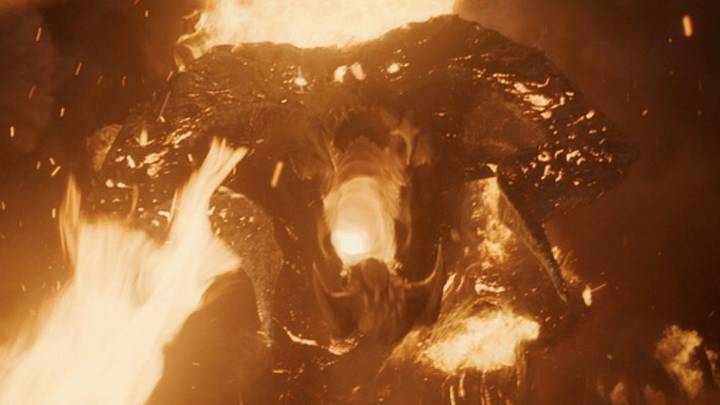
In less than a week, we'll get to watch the season 3 finale of The Rings of Power, and if there's one thing we can say with certainty, it's that the time has come for the Balrog to make its grand re-entrance into Prime Video's Lord of the Rings show.
So far the series has played coy with the Balrog, primarily showing it during season finales as a way to remind us that it's still a threat deep in the caverns beneath the Dwarven city of Khazad-dûm. That trend seems to be continuing. We know for a fact the Balrog will appear in season 3, because The Rings of Power has shown it in trailers and features it prominently in marketing artwork for the season. More, it's been announced that Simon Pegg (Hot Fuzz, Shaun of the Dead) will voice the creature, so not only will the Balrog appear, it will speak for the first time ever.
While the jury remains out about how palatable a verbose Balrog might be, it's a good time to brush up on some Tolkien lore and refresh our memories about what the Balrog has done so far in the series. After all, it's easy to forget when it appears so sparingly.

The Balrog's origins lie in the First Age
In Tolkien's legendarium, the Balrogs feature primarily in the First Age, when they are some of the most terrifying lieutenants working under the Dark Lord Morgoth, Sauron's former boss. In Tolkien lore, there are two classes of what are essentially angels under Eru Ilúvator, the God of this fictional universe: Valar and Maiar. Think of them as greater and lesser angelic beings.
All the wars of the First Age stem back to one Valar, named Melkor, who was jealous of Eru Ilúvator's ability to create. He fell from grace, took on the name Morgoth, created a number of twisted beings including Orcs, and unleashed terror across Middle-earth for centuries. Of all Morgoth's creations, the Balrogs were the most feared. They were Maiar, the same class of being as Sauron himself and the Wizards like Gandalf, who were turned to the shadow and given immense, formidable new forms. If you've seen Peter Jackson's Lord of the Rings films, you know all about how powerful the Balrogs can be.
Throughout the First Age, the Balrogs secured a number of key victories for Morgoth, winning battles and slaying heroic Elves like Fëanor, the great craftsman who created the Silmarils. However, by the time Morgoth was defeated in the War of Wrath and the First Age ground to a close, the Balrogs had mostly been destroyed. The only known one to survive hid in the Misty Mountains, deep in the caverns below Khazad-dûm.
It's there that the story of The Rings of Power picks up. In Tolkien's lore, the Balrog doesn't do a whole lot during the Second Age; instead, it's woken during the Third Age by a descendant of Durin IV, leading to the destruction of Khazad-dûm and the subsequent showdown with Gandalf. Amazon's show is taking a different tack.
Recap: What did the Balrog do in The Rings of Power seasons 1 & 2?
Despite the fact that the Balrog more or less sits out the Second Age in Tolkien's legendarium, it's had a recurring presence in The Lord of the Rings: The Rings of Power. In season 1, it appeared very briefly during the season finale, essentially as a tease showing that it was slumbering fitfully beneath Khazad-dûm. There was also a blink-and-you'll-miss-it Easter egg where several Balrogs are just visible in the background during the series' opening montage of the War of Wrath.
The Balrog played a slightly more substantial part in the season 2 finale. After being driven to extreme greed by his Ring of Power, King Durin III (Peter Mullan)opened a mine deep below the city, while his son Durin IV (Owain Arthur) begged him to stop. As the two Dwarves argued, the Balrog reared its head, prepared to charge through the breach and up toward the city. In a moment of heroic redemption, Durin III leaps at the monster, hitting its fiery sword with his axe and setting off an explosion that causes a rock slide, sealing the Balrog in once more.
To date, that's all we've seen of the Balrog in The Rings of Power. But we know for a fact that is going to change in the final two episodes of season 3.
What lies ahead for the Balrog & Khazad-dûm?
One of the most visually stunning scenes of the trailers for The Rings of Power season 3 shows Sauron (Charlie Vickers) himself confront the Balrog. The monster swings its massive, fiery sword down at the Dark Lord, and he catches its blade on his crown. Considering how much the marketing has made of the Balrog having lines voiced by Pegg, it seems likely that Sauron will have a conversation with the fallen Maiar, perhaps convincing it to ally with him against the Dwarves.
The bigger question is whether the Balrog will actually do anything to Khazad-dûm this season, or in the show at all. It feels like an enormous, demonic Chekhov's gun that has to go off at some point, since the show has been teasing it more or less from the start. It'd be extremely disappointing if the payoff doesn't deliver.
At the same time, the lore is fairly clear: the Balrog doesn't destroy Khazad-dûm until the Third Age, after it slays King Durin VI. This is the whole reason that Gimli is surprised to find the city fallen in The Fellowship of the Ring, because it was still a thriving metropolis in his own lifetime. If The Rings of Power has the Balrog clear out Khazad-dûm this much earlier, it stands to open an enormous plot hole for the overarching saga.

Another possibility is that The Rings of Power could establish a cycle, with the Balrog rising as a threat to Khazad-dûm before being subsequently sealed away again, only for it to reappear centuries later to wreak havoc on Durin IV and Disa's descendants. Whatever happens, the Balrog will appear in these final two episodes of season 3. Here's hoping the show utilizes this iconic Lord of the Rings monster to the fullest.
The Rings of Power season 3 finale premieres Tuesday, November 24 at 9:00 p.m. ET / 6:00 p.m. PT on Prime Video.
 Add us as a preferred source on Google