

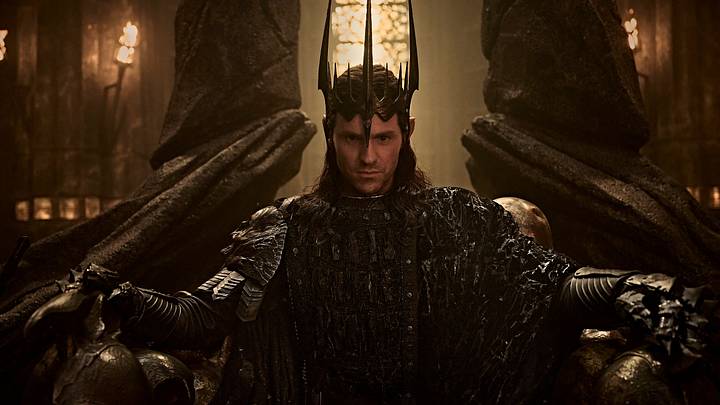
Sauron (Charlie Vickers) in The Lord of the Rings: The Rings of Power has a new wig (or three) each season, and in season 3 he finally becomes the Second Age baddie of our nightmares. The show has included word-for-word adaptations of Sauron material in The Silmarillion, as well as noncanonical Second Age shocks, and season 3 is no different. Here’s how the books and season 3 differ, where the show is headed, and how it may be adding to a decades-long discourse on literature’s greatest villain.
Thank the Valar that the wonderful Vickers plays Sauron every season, or we might get wiglash from all the U-turns. If season 1’s Halbrand, an original character, was a hot take on Sauron and season 2’s Annatar was faithful, season 3 gives “hot Sauron” a whole new meaning. Immersed in the fires of Mount Doom, he’s trying to forge the One Ring by trial and error invented by the show. It runs from the exploding Orc in episode 1 and into the mission of Marnûkh (Adam Young) to find the last Elven-smith with the secrets of ring-making.

Celebrimbor’s ghost
J.R.R. Tolkien never said anything about Celebrimbor’s ghost haunting Sauron the way it does in season 3. But Celebrimbor (Charles Edwards) and Sauron were partner smiths for around 500 years. In Unfinished Tales, Sauron fills Celebrimbor with arrows like he did in season 2, and it’s not hard to imagine that coming with some inner conflict. The psychological depth season 3's back-and-forth gives Sauron provides his fall with a tragic element. The show isn't the first release to draw this out, with the villain a similarly tragic figure in Blind Guardian's Silmarillion concept album Nightfall in Middle-earth.
In Unfinished Tales, Sauron went a step further and paraded Celebrimbor's corpse into battle, a moment known affectionately in the fandom as “Celebrimbanner.” Celebrimbor’s body hanging on Sauron’s forge wall in season 3 is close enough.

The forging of the One Ring
Tolkien didn’t specify in graphic detail how Sauron made the Ring. He said that it was forged in secret in Mount Doom and, in Morgoth’s Ring, that the process imitated Morgoth pouring his own essence into Arda. The Ring contained gold, in which the Morgoth-element was substantial.
In The Return of the King, Frodo says: “The Shadow… can only mock, it cannot make: not real new things of its own.” Indeed, the first Dark Lord, Morgoth, sought the Imperishable Flame of creation in The Silmarillion and failed. Next, he strayed from Eru’s theme in the world-generating Music of the Ainur to try to create his own vision of Arda, the world of The Lord of the Rings. This, too, failed. As Eru, Middle-earth’s God, tells him, “No theme may be played that hath not its uttermost source in me.”
True creation is really just the remit of Eru Ilúvatar, and everything else is a kind of sub-creation, as Tolkien expressed in his letters. A bookshop manager called Peter Hastings wrote to Tolkien in 1954, arguing that evil couldn’t create, and Tolkien’s draft response roughly agreed. Showrunner J.D. Payne spoke to Deadline about putting this idea into the show.
Sauron was good before he was evil, the pupil of the blacksmith Vala, Aulë. According to The Silmarillion, Sauron remained mighty in the lore of those people, even despite everything that happened in LotR. Whatever he made back then, it seems to be respected forever. But by season 3, Sauron has broken bad, despite being at full power. So while no book details Sauron’s struggle to forge the One Ring with Celebrimbor’s corpse on a pike, maybe the struggle was real.
#TROPspoilers
— The Blue Wizard on Wheels💍🧙♂️👨🦼🏹 (@wizard_wheels) November 11, 2026
"For you have it in you.. To be a conqueror. A sorcerer, a king."
My overall opinion now is I think Theo is going to be the future Witch-king of Angmar.#TheRingsOfPower pic.twitter.com/KCIuStsNE2
Is Theo the Witch-king?
Before Sauron manages to forge the One Ring in season 3, he gets back to his roots as Thû, the necromancer of the Wizard’s Isle. This early version of Sauron in The Lay of Leithian had ghosts doing his bidding, as seen in episode 2 when he talks to Theo’s father. The show invented the identity of Theo’s father.
Vickers told Nerdist that Sauron spots “a certain darkness” in Theo (Tyroe Muhafidin) and realises there’s more to the young man than he thought. So it seems Sauron wasn’t just manipulating Theo when he told him he may have inherited certain powers and could become a sorcerer.
This implies that Theo might become the Chief of the Nazgûl, the Witch-king of Angmar. His sword hilt in episode 4 is surprisingly similar to the Witch-king’s in Peter Jackson’s The Lord of the Rings movies. Theo is already losing control to Sauron, so it will be intriguing to see how the show squares this with him powering up into one of the mightiest sorcerers of his time. That is, if he stays on Sauron’s side.

The Fall of Númenor
Despite the internet’s clamour in season 1, Sauron is canonically hot until the fall of Númenor. Unfortunately for Galadriel (Morfydd Clark) and Celeborn (Jamie Campbell Bower), unwittingly embroiled in the season 3 Sauron love triangle described by the showrunners, that probably won’t happen until the end of season 4. The Rings of Power’s Númenor storyline is adapting the Akallabêth chapter of The Silmarillion, and it’s only just getting started.
In the Akallabêth, the ego of Pharazôn (Trystan Gravelle) swells so big that Númenor can no longer contain it. He sails to Middle-earth, takes Sauron prisoner, and finds out the hard way why Sauron means “the Abhorred” in Quenya. After Sauron's body is destroyed in the Akallabêth, he is so damaged that he can no longer disguise himself in fair forms. Long live Vickers’ Sauron, may season 5’s wig strike fear into the hearts of all Men and accompany some kind of disfigurement.

Sauron’s lieutenants
With season 3’s canonical Khamûl the Easterling (Zubin Varla), and a possible Witch-king, on his side, Sauron would have less to worry about during his sojourn in Númenor in The Rings of Power. Especially with a Balrog alongside, although Sauron and Durin's Bane didn't team up in the books. They could be running his forces while he works his magic abroad. The Nazgûl were indeed up and running long before Pharazôn took Sauron across the Sundering Seas, so it would make total sense for the show to reflect this.
It would also make huge sense for the show to give at least one of the Nine Ringwraiths a tragic backstory. After all, they were nine ambitious men who accepted a gift and paid the ultimate price. Their long, slow corruption is a fascinating tale that Tolkien left untold.
The Lord of the Rings: The Rings of Power season 3 is streaming now on Prime Video, with the final two episodes arriving on November 25. Catch up on the new characters introduced in season 3.
 Add us as a preferred source on Google