

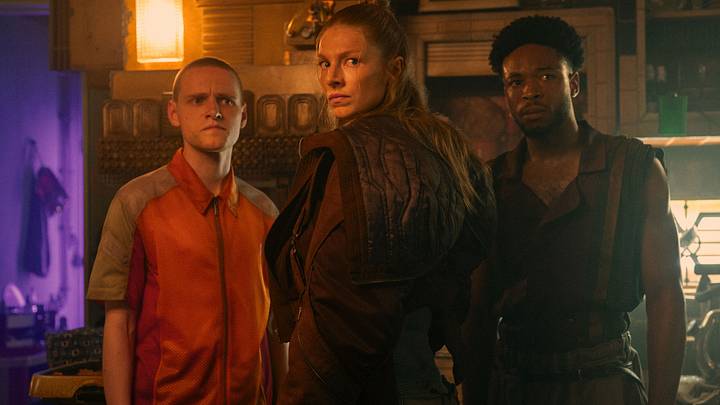
Generally speaking, Blade Runner 2099 is more of a soft reboot for the franchise than a continuation of the movies. Still, because the Prime Video series takes place within the same canon as the 1982 original film and Blade Runner 2049, showrunner Silka Luisa and company still needed to acknowledge what had come before.
Of course, 50 years have passed in-universe since the Ryan Gosling-led project. That's a lot of time for things to grow and change, which is exactly what's happened. Set in the wake of the Replicant Uprising, humans have been subjugated and relegated to being second-class citizens.
That, on its own, is a compelling dystopian narrative. When it's considered exactly how it connects to Blade Runner 2049's biggest twist, 2099 feels even richer with dark, off-screen worldbuilding. It's all hidden in plain sight.

Deckard & Rachael's daughter was almost definitely the catalyst for the Replicant Uprising
K (Ryan Gosling) spends much of Blade Runner 2049 believing himself to have been born and not made. The movie revolves around his journey to explore his lineage. He goes on to falsely assume that Deckard (Harrison Ford) and Rachael (Sean Young) are his parents. Sadly, he's only circling the truth rather than nailing it.
K eventually figures out he's a fairly traditional Replicant, but that Deckard and Rachael did actually have a daughter. As a Replicant herself, Rachael's ability to reproduce galvanizes the Earthside Replicants who are hiding from the Blade Runners. They believe they should be able to grow their own numbers. The movie ends before we see any kind of real fallout from the discovery.
Unfortunately for the Replicants, Rachael is heavily implied to have been intentionally designed by Dr. Eldon Tyrell (Joe Turkel) to be able to have a child. It's not the miracle it seems on the surface, nor is it a feat anyone has been able to repeat since his death. As such, by the time of Blade Runner 2099, there have been no more natural-born Replicants.
The number of Replicants has still boomed, though. After coming together and taking control of the building formerly known as the Tyrell Corporation headquarters, the Replicants are free to make as many of themselves as they can or want. Without the possibility of natural reproduction being dangled in front of them and then pulled away, this shift in power may never have happened.

Blade Runner 2099's ending makes Replicant reproduction an even more pressing matter
The iconic Blade Runner pyramid that begins 2099 as the Replicant Birthing Center ends the show as a pile of rubble. Other than the small facility set up by Julius (Tom Burke) to transform existing Replicants into Nexus-1s, there's basically no other way for new Replicants to be made.
Furthermore, other than the two Nexus-1s in existence at the end of the show, all existing Replicants are pre-installed with an expiration date. While they are still the dominant force on Earth, that can't last unless they can replace themselves.
The fact that existing Replicants can neither reproduce nor birth additional "adult" Nexus models suggests they'll eventually just sort of gradually fade from existence. This would lead to humans reclaiming the Earth, and the Blade Runner universe ending as we know it.
Thankfully, 2099 offers a strong, last-minute hint that suggests all is not lost for the Replicants. With Ray (Maurizio Lombardi) seemingly recovering Julius' remains, the former looks positioned to help more Replicants transition into being Nexus-1s; for a price, of course.
Plus, with Ray being revealed as the man behind an attempted resurrection of the Tyrell Corporation, this could ultimately mean that Tyrell is back in control of the Replicant population, bringing the story full circle. If the Replicants step out of line, Ray stops helping them. Simple.
Whether or not the franchise will ever show us any of this, or if it'll be left entirely up to our imaginations, is unclear. On paper, Blade Runner 2099 is a miniseries that isn't currently intended to get a direct follow-up. Maybe if we're lucky, we'll get another 50-year time jump down the line to see what's going on. Alternatively, maybe the new Blade Runner game will shine a light on matters.
All episodes of Blade Runner 2099 are streaming now on Prime Video.
 Add us as a preferred source on Google