

I remember almost a decade ago when I decided to watch Blade Runner for the first time. Its sequel, Blade Runner 2049, was coming out, so I wanted to be well-informed. Ridley Scott's vision of the dark future became one of my favorite movies of all time, deeply entrenching itself in my personality and taste for entertainment since. But the sequel is still my favorite of the two. Denis Villeneuve's signature sleek sci-fi style and unconventional storytelling gave the rainy, grungy, neon streets a fresh evolution that stayed true to the cult classic's cyberpunk neo-noir roots. It's been nine years since Blade Runner 2049 was released to stellar reviews but not a strong box office pull, so I was afraid we'd never get to see what became of the Replicant uprising.
But miraculously, Amazon MGM Studios took the risk on an expensive endeavor for a niche genre with Blade Runner 2099. I was happy, yet worried, of course. For the most part, they made a good attempt at adapting this beloved IP into a limited series. It works better than I expected, and I'm glad to have hours upon hours of new Blade Runner content to obsess over. And yet, the story does take some bold swings that don't fit neatly into the overall universe, and it ends up unnecessarily snuffing out the original movie's fire.

Blade Runner's LA is bigger and more alive than ever
Showrunner Silka Luisa's Los Angeles feels like we never left the '80s original. The city streets are busy and cluttered like clogged arteries. There's a deep layer of grunge and wear, giving us an old, rotting city with people squirming like termites between the alleys, streets, and interconnected megastructures. It's unquestionably a Blade Runner city. However, one might have expected LA's design in 2099 to have evolved a little since 2049. It's almost a little stagnant in its style. There was a change in Villeneuve's interpretation, which was very sleek and empty––as if humanity was cleaning itself of Replicant influence. Some would've argued it was too clean. Well, now it's dirty again, just as gorgeous, and still giving us the dusty brutalist vistas we connect with.
I do love how the cinematography has a bit of noise, as if filmed in another time. It adds another layer that makes it feel more like Ridley Scott's vision. A stark contrast to Villeneuve's smooth look, both in the city's design and in how it looks through the lens.
The technology throughout the series is a marvel to look at and listen to. It's incredible that every single prop looks handmade or manufactured by real brands for this specific production. Every personal computer module, radio, plastic container, and miscellaneous item looks like it belongs there, even if they are new inventions––which does come up in the plot. Some technology from 2049 makes it here, too, and I admired how the tools were kept tactile and grounded, while still exploring new ideas. Every machine breathes through its clunky motors, growling guttural feedback as it struggles to process every input. Drones click and chirp like orcas hunting in the sea. Even medical instruments wrap around people with strange tubes, almost symbiotic-like. The attention to detail is astounding, allowing you to see just where some of the budget is going, and I'd say it was a budget well spent.

Memorable music and stellar sound design
I will be looking for a vinyl of this soundtrack, and am hoping there's an extended version of the intro. The jazz and synth notes merge perfectly into something that invokes loneliness and longing, and a strange spiritual essence trying to emerge from the techno bass.
Through the music alone, even though it's an entirely new soundtrack, you can tell this is a Blade Runner score without much context. You often aren't told a character is a Replicant or a Blade Runner, but almost every scene, and especially the interrogations, has that distinct flavor that hints at their natures. The ominous bass booms between a character's lines, adding weight and rhythm as the pressure builds, especially when a Replicant acts like their usual curious, uncanny-valley selves as they poke at someone's mind. It feels a lot more like Scott's Blade Runner, since, as I remember it, it wasn't a scene structure Villeneuve picked up, both the sound profiles and the strange Replicant behavior. I'm glad to see its influence seeping into Blade Runner 2099 because it makes it stand out from other sci-fi stories and their signature motifs.

Captivating characters, loose lore, and a troubling twist
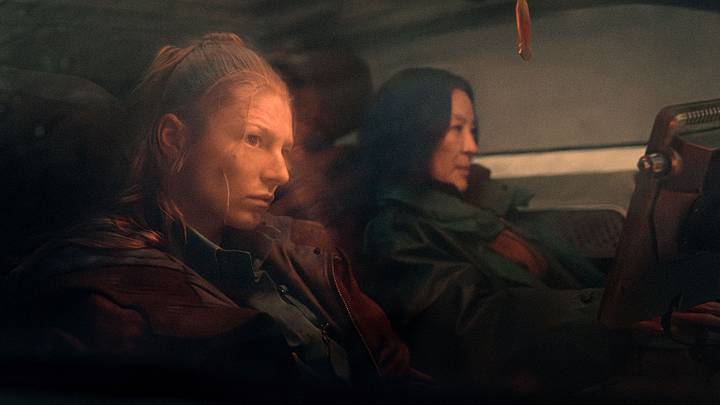
Blade Runner 2099 follows Cora (Hunter Schafer), a human pretending to be a Replicant Blade Runner, and Olwen (Michelle Yeoh), a real Replicant Blade Runner who's on the verge of death. In 2099, the replicants won their uprising, and now they control LA, pushing humans down the chain of command so that they have no control at all. Replicants know when they'll die down to the day. Short lifespans still, but they can spend their years doing what they want, mostly.
Cora desperately needs to find a McGuffin, and her cover as a Blade Runner is the only way to get it. It just so happens that Olwen is on a case that merges lanes toward Cora's goal (unbeknownst to Olwen, of course), so they work on it together, begrudgingly. It's fascinating how the perception of Blade Runners has flipped. Once a human role (Officer Deckard, played by Harrison Ford, if you believe he was human), or at least a human-controlled role (Officer K, played by Ryan Gosling, was a Replicant made to hunt down rogue replicants in 2049), is now a mantle of power for Replicants, and humans hate Blade Runners as much as they hate Replicants for taking their home.
This hatred brews in many characters, but the finished solution looks different for all of them. As things heat up, chemistry changes, and their once ironclad worldviews melt away and cool into entirely different ideas, whether positive or negative. One of my concerns was that the story would feel too much like an ensemble cast rather than a neo-noir following one detective very closely. For the most part, it succeeds in giving us the intimate investigation experience, even with two lead roles shared between Yeoh and Schafer's characters. However, in some scenes, the pacing and situations can start to feel like a different universe entirely. Blade Runner isn't known for speed, but for a slow and methodical approach. In the first half of the series, I think it works spectacularly. In the second, not so much. I much prefer the moments that have fewer characters on screen, left with their thoughts rather than being overly emotive.
There comes a point where Hunter Schafer's character basically blurts out the show's theme, and another character holds a grudge against a Replicant he's never met to an almost unreasonable degree. Both humans and Replicants think the other group is all the same. That sort of trope can get old pretty fast, and Blade Runner has never been about that hatred dynamic at its core. It's always focused on individuals and their specific wants. Of course, Blade Runner is no stranger to social movement and change. It was pulled off well in Blade Runner 2049, but it didn't overshadow Officer K's, a.k.a. Joe's, personal story with Deckard.
Cora and Olwen make a great buddy cop duo. It's like a detective neo-noir mixed with a spy thriller, as one keeps secrets from the other as they follow leads from one interesting locale to the next. It creates excellent tension, and their relationship is in a constant ebb and flow. They share more qualities than they'd like to admit. Both dead inside, clinging to something that would make them human. They're a perfect match as work partners, and I like how their dynamic is explored.
A quick praise for the combat––it's grizzly and realistic. It doesn't delve into sci-fi weapons versus other far-future gizmos, thankfully. Characters stick to guns, and when one's too close for comfort, the knuckles tighten up. The combat gets creative in some sequences, using the environment to even the playing field against a more powerful enemy, making for some satisfying kills. The Replicants are intimidating, rightfully so. It only lends more credit to how Cora and Olwen manage to solve their problems, but more so to Cora, as she is just a human.

The Voight-Kampff test is portrayed in this series interestingly, as there are lots of added details that make the test more intense and inquisitive. It is expanded upon and even uses red light, a passionate color, to get a stronger reaction out of the Replicants. However, I don't quite get why the Replicants, who are in power, would still enforce the Voight-Kampff test upon themselves to detect empathy. It's not explored that far. I can only assume it's because Replicants wanted to make themselves distinct from humans, rejecting empathy. But the Replicants who led the uprising back in 2049 embraced their humanity, even reclaiming Tyrell's famous quote "More human than human" for themselves as a sign of empowerment. Freysa's (Hiam Abbass) quote is unforgettable to me. "Dying for the right cause is the most human thing we can do." What changed? It's more than a little surprising, and honestly disappointing, that Replicants would willingly chain themselves with the psychological programming used to keep them controlled by humans.
It's hard to mention this without spoilers, but an important supporting character also wants the series' McGuffin to achieve a grand goal. At first, it seems admirable, despite its troubling ethics. But after some thought, the logic falls apart. I'm surprised neither Cora nor Bebeto (Dimitri Abold) pick up on it. Which, if they did, would have saved them a lot of pain.
Where Blade Runner 2099 really started to lose me was with its big twist. It tries to evolve the lore and involves the bankrupt Tyrell Corporation. Surprisingly, the Wallace Corporation isn't mentioned at all, unless I missed it. It was always Tyrell's patents and inventions they used, I suppose. Without getting into spoilers, Blade Runner 2099 tries adding a new angle to a rule we always knew about Replicants. From what I know, it falls into retcon territory. It was done well enough that I didn't hate it by the end as a standalone story, and it became believable after processing the monumental physical and philosophical consequences. But connected to the overall canon, it's hard to accept. It leaves a lot of questions that upset the background history the more you think about it. If you know about Blade Runner comics, novels, and games, then the plot holes become glaringly impossible to ignore. I would've preferred it was left alone. With what we've known as canon for so long, Blade Runner 2099 doesn't sit neatly in the timeline of things. Even if you ignore the comics, novels, and games as "extra legacy" stuff, what was introduced steals the thunder from what made the original movie's philosophy and Roy Batty's story so special.
Conclusion
Blade Runner 2099 is an absolutely gorgeous and, at times, thought-provoking series that had great sci-fi ideas, and executed them to the best of its ability. However, every new entry in an IP, especially connected to a cult classic from decades past, is going to carry extra expectations and the weight of responsibility for what it adds to the saga. It's not enough to be a good story; it should also respect what came before. I can imagine there'll be a rift between fans who will take well to the changes and those who won't. As a huge Blade Runner fan myself who wanted to love all of it, it's too much to ignore, even though I loved its strong, smooth start until its rocky finish.
Verdict: 6/10
Blade Runner 2099 streams all eight episodes November 25th exclusively on Prime Video.
 Add us as a preferred source on Google