

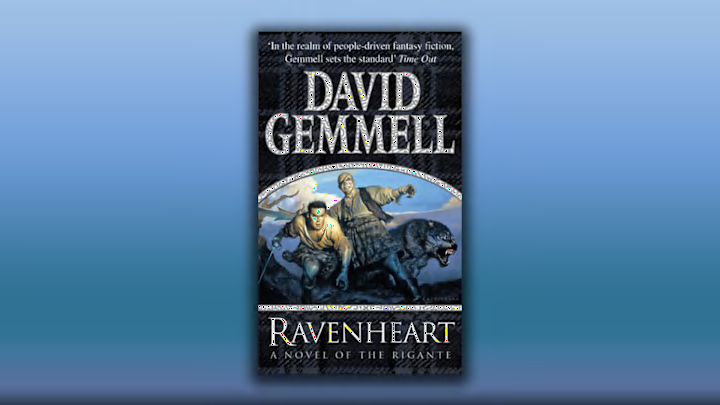
The third book in David Gemmell's Rigante series is unusual in one major area. This four-volume heroic fantasy series is almost two different duologies. The first two books feature Connavar and Bane as the focal points. They just happen to be father and son, but there are only a couple of very brief instances when they speak to each other.
While there are 17 years between the first two books, 800 years pass between books three and four. The last two books form a second Rigante duology.
The first two books take place in an alternate dimension from our own, but it runs parallel to pre-Roman occupation of Briton. Stone represents Rome, and the Rigante represent the Britons. The timelines from our history and that of the books are not exact. The Varls represent the Danes, Norse, Angles, and Saxons that descended upon Briton after the Romans departed, but that timeline is sped up in the books.
Ravenheart takes place eight centuries later. The world of the Rigante is more industrially advanced than our world was after the same amount of time. There are cannons, muskets, and even rifles. Comparing that to our world, 800 years after the Romans conquered the Brits, Alfred the Great was a king in pre-medieval Britain, trying to unify the kingdoms to stand against the various Viking invaders.
The Rigante still have a presence in the area that can be approximated as present-day York, but in Ravenheart, they are a conquered people. Many have migrated to the northern highlands (Scotland) to escape the scrutiny of their Varlish (English warlords).
The Rigante have limited rights. They can't bank money or own a sword or gun. They can't own a horse taller than 14 and a half hands. Their rebellions have been put down, and now, those Rigante who live in the Varlish towns hardly resemble the proud people of the first two books. They aren't even allowed to mingle with Varlish during festivals and public events.
- Book review: Sword in the Storm, book one of David Gemmell's Rigante series
- Book review: Midnight Falcon, book two of David Gemmell's Rigante series
Ravenheart is the beginning of a story of the reclamation of the lost Rigante spirit
Gemmell does an incredible job of updating the world he developed in the first two books. The land of the Rigante is a mystical one, based on the power of earth magic. In the first two books, a few Seidh (magical beings) are still present in the world, trying to manage what magic is left. But humans destroy magic much quicker than they create it, and the Seidh are leaving this plane of existence.
By the time of Ravenheart, the magic is all but gone. A few people still have the druidic magic that was more prevalent 800 years earlier, but they do not have the powers that once existed.
The namesake character in Ravenheart is Kaelin Ring. He is a descendant of Connavar and Bane, now relegated to mythical heroes of the past, rewritten as Varlish rather than Rigante. But some Varlish know the truth.
Kaelin is mentored by Jaim Grymauch, an old-fashioned Rigante relic of the past. He is big, loud, and a drunk, but he draws people to him, and he adds magic to the world through his actions and personality. Jaim tries to harness the rage and violence that lurks just below the surface within Kaelin.
As good as Jaim is, and as much as he tries to teach Kaelin the best parts of the Rigante culture, Kaelin cannot contain the violence within him. He is forced out of Eldacre, and he migrates to the highlands, where the Rigante enjoy more freedoms than the populated south.
The narrative in Ravenheart is better paced and more interesting overall. Gemmell's character development is much better than the first two books, as he spreads out his points of view to several secondary characters who offer different perspectives.
Maybe it is the more familiar, more industrial setting, but Ravenheart was an easier read than Sword in the Storm and Midnight Falcon, even for history buffs. The ease of reading also had to do with its improved narrative. Gemmell was a veteran fantasy writer when he did these books, but the later volumes of this series are better than the earlier ones.
Another great thing about Ravenheart is it is obviously a bridge book, setting up the series finale. It's even more impressive how smoothly the story ticks along. It is a quicker and easier read than the first two, but part of that is that the basics of his world were already established. Still, because of the 800-year jump, Gemmell did have to spend time advancing the story and building his more modern world within the one he already created.
The characters and their stories are well written, and the narrative is consistent with the established world is believable. Ravenheart is the best book of the series so far.
 Add us as a preferred source on Google