

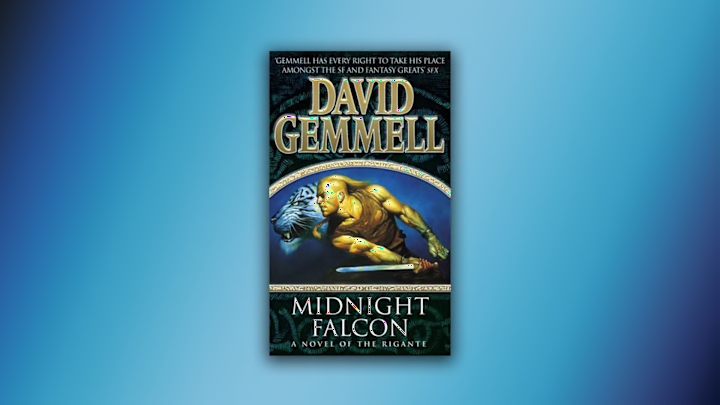
Midnight Falcon is the second book in David Gemmell's Rigante series. It takes place 17 years after the Sword in the Storm but doesn't continue the story of Connavar, though he does play a role in this volume.
Instead, this story centers around Connavar's illegitimate son, Bane. Like Connavar, Bane grows up without a father in his life. Conn, who lost his wife, Tae, because he was with Bane's mother, Arian, instead of with Tae. Connavar's infidelity and subsequent loss of his wife leave him bitter and unable to face the consequences, one of which is Bane's birth.
Bane grows up bitter and longing for his father's attention. He tries to gain Connavar's affection in positive ways, but his father just turns his back. After his mother's death, Bane becomes an outlaw, living in the mountains of Keltoi.
Bane has one friend from his childhood: Banouin. Banouin has plenty of issues of his own. He is the child of the Stone merchant by the same name and the witch Vorna, who saved Connavar's life as a child. Banouin the senior traveled with Connavar when the young warrior wanted to witness the powerful army of Stone. Banouin is killed before seeing his son, and Banouin the younger also grows up without a father.
The two boys suffer for different reasons during their childhood but remain friends. When Banouin decides to go to Stone to be a scholar, Bane accompanies him. As they travel south, they save a man and his daughter. Bane falls in love with the daughter, but the strangers from Stone are being tracked by agents of the government because of religious reasons.
The assassins track down the man and his daughter, killing both and severely injuring Bane, who tried to defend them. Not thinking Bane would live, Banouin abandons Bane and leaves for Stone on his own. Bane survives his injuries but is now bent on revenge.

How Midnight Falcon differs from the first Rigante novel
In both books, the hero, first Connavar and then Bane, leaves Keltoi. Their journeys, however, are much different. Where Conn loses Banouin and seeks revenge on his killers and joins the Stone army for a while, Bane decides to become a gladiator.
Bane is seeking vengeance on Voltan, the man who slew his love. Voltan is a former gladiator that is now an elite warrior. One of the things Gemmell didn't do very well in Sword in the Storm is develop secondary characters. That is much improved in Midnight Falcon.
One of those characters readers come to know is Rage, a retired gladiator who becomes Bane's mentor. Rage is fleshed out fairly well and is a central character in this story. Rage works to train Bane as he progresses through the ranks of gladiators.
Bane eventually makes it to Stone and has a chance at his revenge. While in Stone, readers get to know Jasaray, the emperor of Stone. While Jasary is mentioned in the first book, he is fleshed out much more in the second.
In both books, there are many parallels between Keltoi and Briton, Stone and Rome, and Jasary and Julius Caesar. At one point in Midnight Falcon, Gemmell ends all speculation by mentioning that the world of the Rigante is just one dimension and that Stone took on other similar forms in other dimensions, including that of Rome.
One of the parallels is that of religion. In these books, a religion that preaches peace and love similar to the early teachings of Christianity. People who find solace in the religion are persecuted in Stone, just as the early Christians suffered at the hands of Rome.
Eventually, Bane exacts his revenge on Voltan and even saves Jasaray's life with the help of Rage. Bane decides to go back home to Keltoi. He now has some wealth to his name from his victories in the coliseum and rewards from Jasary.
Back in Keltoi, he settles on a farm in the mountains and remains isolated. Banuoin, after studying in Stone, also returns to Keltoi as a scholar and a priest. He also maintains some of the mystical powers he received from his mother, Vorna.
Despite Jasary's promises of peace to Connavar's envoys to Stone, the emperor invades Keltoi with the goal of crushing King Connavar, the Rigante, and all the other Keltoi tribes united under Conn.
As this is heroic fantasy, there has to be a big battle, and Gemmell doesn't disappoint. The story as a whole unfolds with a few twists and turns, including a brief moment of conciliation between Bane and his father.
Not as much worldbuilding was required for this book, as the setting was well-established in book one. There was improved character development, especially for characters apart from Bane. Still, that development isn't as deep as other authors such as Joe Abercrombie and John Gwynne.
The gladiator storyline was an interesting one, and Rage was an intriguing character. The religious thread of the plot will probably have a bigger impact on the last books of this series, so it was good that Gemmell laid some foundation for that too.
Midnight Falcon is a worthy follow-up to Sword in the Storm and moves the story along satisfactorily, laying the groundwork for the third and fourth books of David Gemmell's Rigante series.
 Add us as a preferred source on Google