

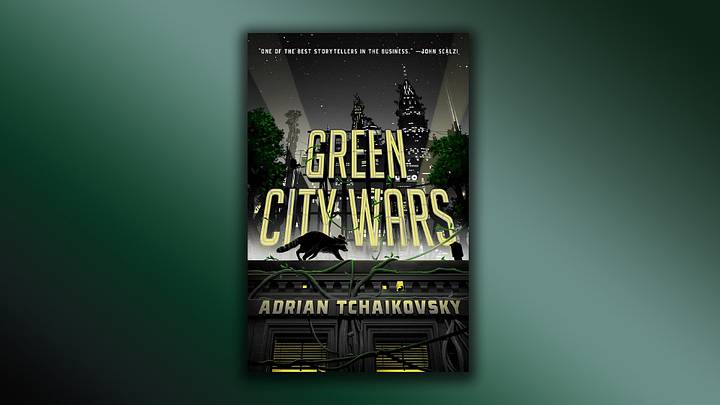
Adrian Tchaikovsky's worlds are usually distinct and often explored from non-human perspectives used to examine human society from the outside. His latest novel Green City Wars follows that same approach, this time with the urban animals sharing our world.
These animals have been genetically engineered into sapience and put to work, quietly keeping a gleaming solar-powered city running while its human residents enjoy a guilt-free utopia. They fix the pipes, collect the waste, maintain the grid. And all of it is invisible, all of it thankless, bound together by one cardinal rule: do not bother the humans.
Our guide through this world is Skotch, a freelance raccoon PI scraping by on small jobs in the city of Neuwien Gunstadt. He's not exactly thriving. Then a former employer dangles a job in front of him to find a missing mouse scientist. Sounds simple, but it absolutely isn't. Before Skotch knows what hit him, he's caught in the middle of squirrel gang wars, rat mob politics, a terrifying weasel assassin and secrets that could unravel the whole fragile system holding the animal world together.

The characters, the worldbuilding — an absolute joy
The world in this book is so special. Tchaikovsky clearly had the time of his life building this thing, as he had shared with us in a written interview. Every species has its own place in the social pecking order, its own slang, its own grudges. The animals depend on a substance called Plantgent to maintain their sapience, and the control of that substance is basically the source of all the political chaos Skotch walks into. It's all done in a way that rewards attention, and there were moments where I had to put the book down just to appreciate how much thought went into it.
Skotch himself is a joy. He's a raccoon who gets called "trash-panda" and "Herr Bandit" as slurs, a guy who keeps tripping over his own scavenging instincts while trying to maintain his dignity as a professional. There's real warmth to him and a quiet sadness too. He's a good creature in a world that doesn't particularly reward goodness. I found myself rooting for him so hard and I'm sure you will too.
The supporting cast is equally vivid. A chatty pigeon sidekick, a femme fatale weasel, a terrifying snapping turtle boss, anarchist parrots (yes, really). Every character feels like they belong exactly where they are, doing exactly what their species would do if you gave them sentience and a city setting.
Tchaikovsky is not shy about explaining how this world works, who runs what, which faction hates which other faction and why. There were stretches where one might feel a little buried in politics and worldbuilding before the story really finds its feet. If you hit those sections and feel a bit lost, stick with it because once everything clicks into place and the pace picks up, the book becomes genuinely hard to put down.
The big concepts sitting under all the fun are real and sharp. This is a book about labor and about who does the invisible work that keeps society running. It's also about the pharmaceutical control of entire populations and what that does to ideas of freedom. It asks whether a society built on unseen exploitation can ever really be called a utopia but doesn't lecture you about any of it of course.
Verdict
This is one of those books I'll be pressing into people's hands for a long time. It's funny, it's dark, it's strange in all the right ways and underneath the talking animals and the noir trappings, it has something genuinely meaningful to say.
Tchaikovsky keeps proving he's one of the most inventive writers today and Green City Wars is another reason why. It's definitely going to be one of my favorites for a long, long time.
Rating: 5/5 stars
 Add us as a preferred source on Google