

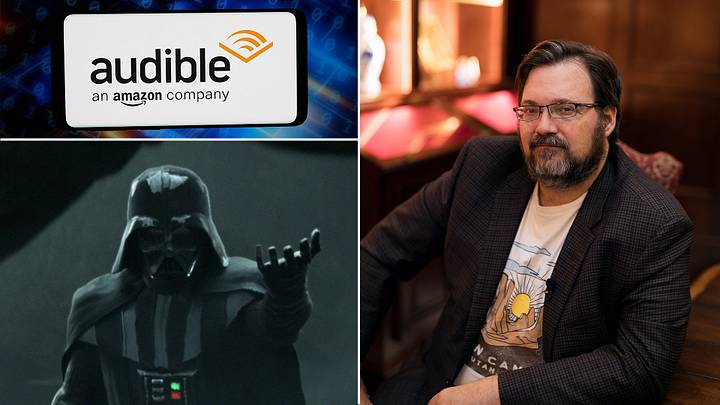
Few authors in the world have the sort of public profile of Brandon Sanderson, one of the most prolific writers of fantasy and science fiction of our time. But even more impressive than Sanderson's output and how well he's navigated his career is the fact that he's kept his integrity front and center all the while, doing everything he can to help make the business of writing better for other authors whenever possible. From founding podcasts like Writing Excuses to his well-known lectures on writing and publishing at Brigham Young University (which are available to watch for free on YouTube), Sanderson often goes to bat at times when others might simply remain quiet and focus solely inward instead.
Nowhere has that been clearer in the past few years than his battle with Audible, Amazon's proprietary audiobook platform. Just as Amazon has become a behemoth that accounts for the lion's share of physical and ebook sales, Audible utterly dominates the audiobook market. In 2025, it was estimated that Audible accounted for roughly 90% of audiobook sales in the U.S. and UK, which is about as close to a complete monopoly as you can get. That makes some sense — they were the first major audiobook platform and had a huge hand in popularizing the format — but at this point they have no real competitors to stop them from hitting authors and publishers with detrimental terms if they so choose. Which they have. Repeatedly.
Sanderson first called all this out in 2022, when he decided not to release audiobooks for his four Secret Project novels funded via his record-shattering Kickstarter campaign on the platform. At the time he called Audible's royalty structure "unconscionable," saying that it amounted to authors making less from the platform's digital storefront than they would even in a break & mortar bookstore, which has considerably higher overhead costs. For reference, according to Sanderson, video game creators and musicians often make between 70-80% on digital sales; Audible, meanwhile, only gives authors 40% — if their title is exclusively listed on the platform. If it's a broader release that's also listed on, say, Barnes & Noble, that number drops to 25%. This wouldn't be as much of a problem if Audible wasn't pretty much the only game in town, but they are, so it is.
In early 2024, Sanderson provided another update which seemed more optimistic on his website, saying that the team at Audible was working with him to create a new royalty system that paid authors better and was more transparent, though there were still gaps between what he believed would be fair and what Amazon was willing to concede.
"I didn’t refuse to put my books on Audible out of retribution or to declare war; I did it because I wanted to shine as powerful a light as I knew how on a system that highly favored the audio distributors over the authors," he wrote on his blog. "I was convinced that the people at Audible really did love books and writers, and that with the right stand taken, I could encourage them toward positive change."
At the time, it seemed like he was right, and change was on the way. That was two years ago. Now, we finally have another update about Sanderson's ongoing attempts to use his platform to force Audible into more equitable business practices with its authors. And unfortunately, the news ain't good.
Brandon Sanderson and Janci Patterson discuss the problems with Audible's updated ACX terms
Sanderson spoke about the ongoing issues with Audible during a livestream celebration for the release of his latest book Blightfall, where he and co-author Janci Patterson answered fan questions. One asked if Sanderson had any update about his negotations with Audible, and Sanderson, who is notoriously candid with his readers, opened the floor to get into it.
"I'm preparing a video...I'm gonna talk about the fact that Audible is just not doing what it should again," Sanderson said with resignation. "We gave them about two years...I gave them some time, I got the data. The data is not good. So what you've heard from other people is true."
Patterson got into even more detail, saying that there's an angle to Audible's latest terms for authors she hasn't seen discussed much, which she takes great issue with:
"Right now where we're at, indie authors have until the end of the year to opt into the new terms or our books are pulled down. And that's fine for me...except that I have worked with audiobook narrators, and there's been a program through ACX for years where I contract with an audiobook narrator and instead of paying them upfront, I split royalties. And I've done that on some of my smaller books because I know these books are not going to make a ton of money back, and it's usually new narrators who are just on the platform, they need some credits and it's kind of like a mutually beneficial thing, right?"
"And this was Audible's pitch to them," Sanderson added. "They came up with all this. ACX is their program."
"Yes...and now, some of these books have been approved this year, and I have the power to just not renew them, and that gets pulled down and that audiobook narrator has no say, and never gets paid," Patterson continued. "Like, this is bad for authors. It's terrible for authors. But it is so much worse on those audiobook narrators and it makes me so mad, and I don't see anybody talking about it."
"It's very Darth Vader, 'I've altered the deal,'" Sanderson said. "You signed up for one deal...they're just like, [shrugs], 'We're altering it.'"
That of course is a reference to The Empire Strikes Back, where Darth Vader cuts a deal with Lando Calrissian to use Han Solo, Princess Leia, and Chewbacca as bait to capture Luke Skywalker for the Empire, only to later tack on the additions of handing Han over to the bounty hunter Boba Fett and keeping Leia and Chewbacca as Imperial prisoners once they were all in Calrissian's custody. It's a fairly damning parallel to draw.
It's that lack of a choice when the deal changed that seemed to grate on Patterson most. "At least I get a say," she said. "At least I get to decide if I pull the books down or not...but of course, I'm not going to do that to my audiobook narrators. So I have the say of whether I'm a terrible person or not, and I'm not going to be and I'm going to accept the deal because that's what I need to do for them. But it's awful."
"The deal is awful," Sanderson agreed. "The new terms that they promised us would be so much better are not so much better."
Sanderson concluded that he's "preparing a long form video, but it's going to take a while because it will have to go through multiple lawyers." This is because he needs to be absolutely certain that whatever data is revealed in the video is something he's actually allowed to share.
Suffice to say, it sounds like this is a pretty thorny topic, and it's a credit to him that he's not backing down on it even though Audible is the largest audiobook company in the world, which is a branch of one of the largest corporations in the world, period. It's not quite David and Goliath, since Sanderson himself is an extremely prominent author, but perhaps let's call it Goliath against a much larger, skyscraper-sized Goliath.
Audible is currently changing the way their royalty model works, and it's looking like BAD news for authors. Please consider checking out the petition to stop them screwing us all over.https://t.co/U4koVtVoWx
— Rob J. Hayes (Epic Fantasy Author) (@RoboftheHayes) August 12, 2025
Why is Audible's new royalty model bad for authors?
If you're curious about the royalty model Patterson and Sanderson are referring to, you can find a breakdown of it in the ACX help center. On the surface, Audible's new royalty system may seem beneficial, since it does see a rate rise to 50% for exclusive titles and 30% for non-exclusives. However, the rub is in the way the royalties are calculated. Rather than being paid out on a title-by-title basis for subscription models like Audible's premium membership, which gives users one audiobook credit a month, the royalties are actually pooled based on everything a person listened to that month — including titles that Audible gives out for free as part of its All You Can Listen program, called the Plus Catalog.
In essence, if you use a credit on an Audible audiobook, but also listen to several free All You Can Listen titles in the same month, the royalty payout from that credit is split among all those titles instead of fully going toward the one you actually spent it on. The third video in the help center article linked above breaks down how it works.
This all may sound a little confusing, and obviously I'm far from an expert. Which is why it's always great when there are experts we can listen to. Michael J. Sullivan is a legend in the indie fantasy space, who has published more than 20 books in his fantasy world of Elan that began with the self-published hit Riyria Revelations series. He took to Reddit after the terms were first announced to air some of his "grave concerns" about them.
"While the headline announcement increases the royalty percentage as promised, buried in the fine print are scenarios which will lead to reduced royalties for authors who will be forced to subsidize money from their work to pay for titles in Audible's All You Can Listen program," Sullivan wrote. "In short, they're taking money from higher value titles—that people pay for—to give to lower value titles that Audible themselves describe as 'free.'"
Sullivan and his wife/business manger, Robin Sullivan, started a petition imploring Audible to "tweak" its policy in ways that they believe are more equitable and transparent, not only for authors, but for consumers as well. If this topic interests you, I'd highly recommend checking it out
"I do not believe the new royalty model is in the best interest for the vast majority of audiobook authors, nor do I think it is aligned with how listeners would expect the creators of these stories to be compensated," Sullivan said. I'm inclined to agree.
The more authors with sizable followings like Sanderson, Patterson, and Sullivan speak out about the problems with Audible's new terms, the more likely we are to actually see enough pressure on the company to improve them. So spread the word, and keep an eye out for Sanderson's upcoming video on his dealings with Audible whenever it drops.
 Add us as a preferred source on Google