

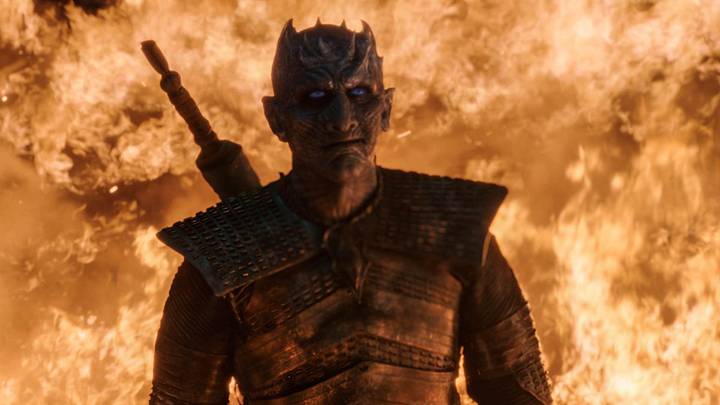
Game of Thrones spent a good portion of its runtime building up the threat of the undead army, led by the taciturn and terrifying Night King (initially played by Richard Brake before Vladimir Furdik took over the role for season 6 and beyond). From the show's very first scene, Thrones portrayed the undead as the ultimate threat, the horrifying monsters up North that can prove an existential threat to humanity, making the squabbles for the Iron Throne seem like a frustrating distraction.
However, the final battle against the undead, the Battle of Winterfell, which featured in season 8, Episode 3, "The Long Night," proved to be the only major battle between the living and the dead. While audiences had seen small glimpses of what the White Walkers could do, such as during season 5's Hardhome massacre and season 7's wight quest beyond the Wall, this climactic clash becomes the only time viewers can see the undead army at its maximum strength.
This is because, at the end of the episode, Arya Stark (Maisie Williams) kills the Night King, which also destroys the rest of the White Walkers and wights that he turned. While many fans felt disappointed that the main threat of the series can be taken out with a single stab, and that Jon Snow (Kit Harington), whose battle with the Night King had been teased for seasons, never got to directly face off against him, Arya being the one to deliver the final blow subtly symbolizes how Game of Thrones always goes against the grain, turning a classic horror trope onto its head.
Arya's last night alive (or so she thinks)

The episode preceding "The Long Night," titled "A Knight of the Seven Kingdoms" (not to be confused with the Game of Thrones spin-off of the same name), focuses on the calm before the storm as the main cast prepares for the ensuing battle against the undead. Everyone suspects that this will be their last night alive, so they spill secrets, confess feelings, and cross items off of their bucket lists.
Towards the end of the episode, Arya sleeps with her longtime friend Gendry (Joe Dempsie). This is implied to be Arya's first time having sex, something she wants to experience at least once before her death. However, their union doesn't last long, as just afterwards, the undead army arrives, and after the battle, Arya breaks up with Gendry, preferring not to feel tied down to him.
Arya Stark, horror movie heroine?

Game of Thrones tends to use horror movie imagery and filmmaking techniques when it comes to the White Walker storyline. Many of their earlier scenes feel like they were ripped straight from a classic zombie film, and the Battle of Winterfell's library and crypt sequences in particular are among the scariest in the entire series.
As such, it is worth mentioning that Game of Thrones subverts a classic horror trope in having Arya kill the Night King. In many horror movies, the characters who have sex end up getting killed by the monster soon after, often as a way to "punish" them narratively. However, in having Arya kill the series's main monster just after losing her virginity, Game of Thrones challenges this somewhat cruel trope. Instead of being disciplined for having sex, the narrative practically rewards Arya for it, giving her a big hero moment just after doing something that most horror films would have killed her over.
Why does Game of Thrones play with this trope?

Throughout its run, Game of Thrones became famous for subverting classic genre conventions. For example, the show killed off its assumed leading character, Eddard "Ned" Stark (Sean Bean), by the end of season 1, shocking audiences (who hadn't read the original books) who expected to follow Ned for the remainder of the series.
The show later plays with the trope of having a deceased character's successor child avenge them when Ned's son Robb (Richard Madden) is unexpectedly and brutally murdered at the now famous Red Wedding.
As such, in showcasing Arya killing the Night King just after having sex, Game of Thrones returns to its subversive roots just before the series ends. While the show typically plays with conventions from the fantasy genre, its expansion to horror tropes ties back in with its tendencies to keep audiences on their toes.
While a satisfying Jon vs. Night King showdown would end a more typical fantasy series, Game of Thrones reminded audiences one last time in "The Long Night" that it is anything but typical.
For more from the world of Westeros, make sure to tune into House of the Dragon season 3 when it premieres on HBO and HBO Max on Sunday, June 21. A Knight of the Seven Kingdoms season 2 is due out sometime in 2027.
 Add us as a preferred source on Google