

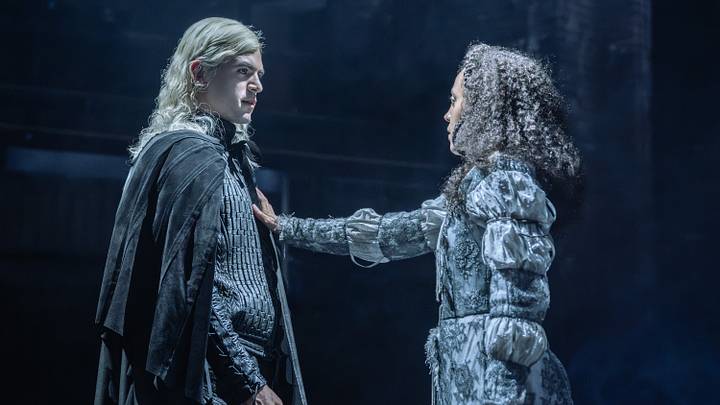
In the recent stage adaptation of George R.R. Martin’s Game of Thrones: The Mad King, now playing at the Royal Shakespeare Theatre in Stratford-upon-Avon, England, several canon secrets are revealed. Even though George R.R. Martin and his team were actively involved throughout the creative process, I can’t say the play is in any way 100% canonical. Nevertheless, some of the changes and revelations written by playwright Duncan Macmillan are still interesting and worth discussing.
One noteworthy change is attributed to Lyanna Stark, who is introduced as a greenseer, possessing magical abilities wielded by other characters in A Song of Ice and Fire, like Bran and Bloodraven. While we do not know if this is canon in George R.R. Martin’s books, her stance as the Knight of the Laughing Tree and her connection to the old gods might have served Macmillan as the inspiration to make this addition to her character in the play.
By giving Lyanna supernatural access to prophecy and dreams, the play radically changes how we understand her decision to run away with Rhaegar, but it also gives agency to one of Martin's most deliberately mysterious characters. Let’s unpack how Lyanna’s magical abilities are displayed and how her story is fleshed out on stage.

How Lyanna’s greensight is showcased in The Mad King
Lyanna is described as a greenseer, a warg, and a dreamer — all three things at once. Her abilities are mentioned multiple times during the play, by Lyanna herself and her brothers. When the Stark siblings meet Howland Reed for the first time, Ned tells him that “Lyanna is a greenseer, a warg.” Let’s dust off what each of these terms mean.
A warg is a skinchanger who can enter the mind of a wolf or dog. Greenseers, meanwhile, possess greensight, a form of supernatural perception associated with prophetic visions, dreams, and weirwood trees. The greenseers of the Children of the Forest were also powerful skinchangers.
While a warg is a skinchanger, not every skinchanger is a warg, and having green dreams is not the same as being a greenseer. In A Dance with Dragons, Bloodraven explains the difference to Bran in these terms: “Only one man in a thousand is born a skinchanger, and only one skinchanger in a thousand can be a greenseer.”
If we apply the books' terminology strictly, however, I'm not entirely sure that Lyanna’s on-stage character necessarily makes her a greenseer. She is clearly a warg and a dreamer; whether her dreams come from greensight is less clear.
In the first scene featuring Lyanna in the second act, news of her father Rickard and brother Brandon’s deaths reaches the Tower of Joy. Lyanna feels guilty for contributing to the deaths of her father and brother, as emerges from her speech recounting what happened after the Tourney of Harrenhal. She confesses to the audience that, as she was travelling through the Riverlands, she kept looking for Rhaegar in dreams and begging him to find her: “Come to me,” she says, like a spell. And somehow, Rhaegar finds her. “That’s when they died,” she says, referring to the moment they saw each other again — the moment that set in motion the events that would lead to their deaths.
As the story unfolds in the second act, we see Lyanna getting more and more obsessed with the prophecy; she begs Rhaegar to teach her what he knows from his years of study. He refuses, giving up on the prophecy and his duties as Crown Prince in the name of love. But this doesn’t stop Lyanna, who continues to study scriptures and ancient scrolls on her own.
It’s clear that what drives Lyanna is not just the desire to solve a riddle: she is grief-stricken and her guilt is eating her away. She only wants to find a way to justify her irrational behavior and give meaning to the deaths of her father and brother. The audience sympathizes with Lyanna and walks with her in a grief that stays with her until the end of the act.
From this speech, we gather that Lyanna is able to communicate with Rhaegar through dreams. When he dies on the Trident, she even says she “can’t feel him anymore.” Her panic induces her to go into labor and die in childbirth.

Dreamers & Dragons
In George R.R. Martin’s world, the term “dreamer” is mostly used in reference to Targaryens; what they have are dragon dreams. Several Targaryens are called dreamers, starting with Daenys the Dreamer, and later Daeron the Drunken, Daemon II Blackfyre (introduced as John the Fiddler in "The Mystery Knight" novella), and Maester Aemon, who dreams of seeing the shadow of dragons on the snow, and hears “the crack of leather wings.” Daenerys also has her own prophetic dragon dream: she dreams that she is Rhaegar riding to the Trident, only she is mounted on a dragon rather than a horse.
Daenerys isn’t the only dreamer of her generation. Her brother Rhaegar also dreams of dragons, as we see on stage. He first dreams of Daenerys and her three dragons while holding his newborn son Aegon, and later on the Trident: moments before being fatally hit by Robert’s warhammer, he dreams of a huge black dragon flying towards him, with Lyanna smiling behind it.
Making both Rhaegar and Lyanna dreamers and believers of the prophecy gives their bond a deeper meaning. It adds an even more tragic dimension to their story; they’re a match made by the gods, as they profess on stage. Yet the play deliberately leaves it unclear whether the gods are guiding them or they are simply interpreting their own desires as destiny. That may be the in-text ambiguity voluntarily left by Macmillan.

“Promise me, Ned”: The prophecy in Lyanna’s last words
Making Lyanna interested in prophecies also adds a detail to her death scene with Ned. Her infamous last words, “Promise me, Ned,” are not the only ones she whispers; she also makes her brother promise to never tell her son about the Song of Ice and Fire and the prophecy of the Prince Who Was Promised. She wishes him to make his own path, without the weight of prophecy and dragon dreams on his shoulders.
As sad as this scene is during the play, it is a full-circle moment for Lyanna: after having lived her whole life looking for her path, once she found it in the prophecy, she wished for her son to be spared from the same fate.
In making Lyanna a greenseer, Macmillan gives her agency: she is not abducted — she runs away. And she doesn’t run away with Rhaegar for love only; what drives them, as individuals and together, is prophecy and power. Having devoted much of his life to the search for the Prince Who Was Promised, Rhaegar decides to give up on it. On the other hand, Lyanna is determined to push forward because she believes she has finally found her purpose.
But I wouldn’t say Lyanna’s whole purpose is to give birth to a possible Prince Who Was Promised. Lyanna herself, at the end of her life, doesn’t think this. She wanted to be a knight, to fight for her place in the world; her love for Rhaegar was simply an unexpected turn in the path she had chosen for herself. She simply died too young to fully accomplish her dream. As she says, lying on her deathbed, she still died a knight, with the childbed as her battlefield.
All of this to say that I absolutely love this addition to Lyanna’s character: it gives her and Rhaegar’s love story an even more tragic ending. It deepens the ambiguity that Martin writes masterfully and fleshes out the most mysterious Stark character he’s ever written.
George R.R. Martin’s Game of Thrones: The Mad King is currently running at the Royal Shakespeare Theatre in Stratford-upon-Avon until September 5, 2026. For more information and tickets, visit the RSC's website.
 Add us as a preferred source on Google