

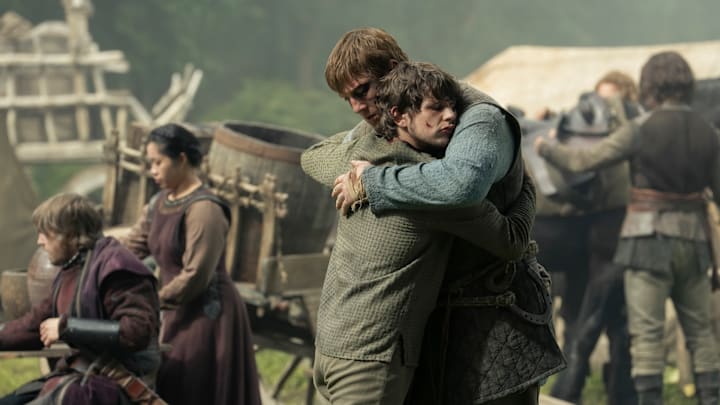
The season finale of A Knight of the Seven Kingdoms has arrived, and with it, the end of a stellar first season for HBO's latest Game of Thrones spinoff. The tourney at Ashford Meadow began as a heartwarming affair before turning deadly serious, and here at the end, the show turns to a contemplative final episode as Dunk (Peter Claffey) ponders the implications of the royal death he just unwittingly had a hand in causing. "The Morrow" is a perfect send off for Dunk and Egg (Dexter Sol Ansell), but it's far from an action-packed affair.
The first season of the show is based on "The Hedge Knight," a novella written by A Song of Ice and Fire scribe George R.R. Martin. And while Martin has had a running feud with the creative team of HBO's other Game of Thrones spinoff, House of the Dragon, he's been effusive with his praise for A Knight of the Seven Kingdoms on account of it being arguably the single most faithful adaptation of one of his written works to date.
But that's not to say the show didn't make changes from the book; it absolutely did, especially here in its final episode, which stretched out a handful of conversations into a full half hour of television. Looking back on the series, which episode did Martin think the most of?
We don't have to guess, because Martin himself appeared on the latest episode of The Official Game of Thrones Podcast, which serves as a companion to the finale of A Knight of the Seven Kingdoms. In an interview with hosts Jason Concepcion and Greta Johnsen, he explains why Episode 6, "The Morrow," is his favorite episode of the season.
Why George R.R. Martin loves A Knight of the Seven Kingdoms' finale
"Well, partly, it's a matter of anticipation," Martin said. "You know, I can look at stories, be it mine or be other people. And since I've been a television producer and TV writer myself, I can say what would be, to my mind, easy and hard. And when I look at some of these things, I say, okay that one's easy. I see that the whole thing is laid out there. Here's the beginning, here's the middle, here's the end, here's a great climax. There's a good battle. Here's all of that, that's fine. But then you look at other things and you say how the fuck can you make it...How do you make that an episode of a television, or how do you make that a motion picture? And when you look at 'The Hedge Knight,' there's a huge climax in episode five, a big climactic battle. And people live, and people die, and things are resolved. But then there's an entire hour after that, the battle is over. What happens there?"
"And I looked at that and said, well, I see it. There are scenes, they are written. They're emotional scenes, they're good character beats, but a lot of viewers don't like that stuff. You know, you always get, oh, it's too talky. It's too slow, but Ira and his team did, I think, an incredible job with it. For me, anyway, episode six has emotional resonance. It has character turns and character decisions that are very important."

Martin touches on an interesting point here. Episodes being too slow or having too much talking and not enough action were common criticisms of House of the Dragon season 2; certainly those things can reel in viewers, but it's a steeper curve to do it with than, say, a big spectacular battle with undeniable spectacle. It's a huge testament to the team behind A Knight of the Seven Kingdoms that they were confident enough in the material to lean into its quiet nature here at the end, rather than inventing other action that would have undercut it. This allows scenes like Dunk's emotional conversation with Maekar to really sing, and the show makes the most of it.
"I was hopeful, but I'm still very pleased with the way it came out. We'll see if the people at home are equally pleased," Martin said.
And so we shall. A Knight of the Seven Kingdoms Episode 6 is available to stream now on HBO Max. What did you think of the ending to the show's first season?
A Knight of the Seven Kingdoms is currently filming its second season. Missing Dunk and Egg already? Check out more of our extensive coverage of the series.
 Add us as a preferred source on Google