

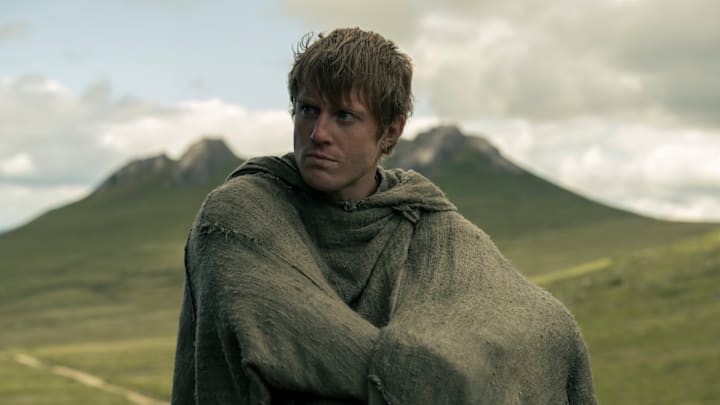
It's surreal to say, but we've already reached the end of A Knight of the Seven Kingdoms season 1. Over the course of six episodes, HBO's latest Game of Thrones spinoff brought George R.R. Martin's beloved novella "The Hedge Knight" to vivid life, delivering arguably the most faithful adaptation of any of the author's works. At the same time, it dove much deeper into the characters and relationships than that fairly short book was able to, with wonderful performances by talented actors, immaculate costuming, spectacular stunts, excellent writing, and a lived-in tourney set that leapt off the screen as though it were a real place.
All this is to say, it's been a hell of a ride. But here at last, we have to talk about how it ends. Following the thrilling trial of seven and devastating death of Baelor Breakspear in the season's penultimate episode, the finale, titled "The Morrow," serves as a contemplative coda to the season. It's all people having reflective conversations, and it's a credit to A Knight of the Seven Kingdoms that it still manages to make that material every bit as riveting as the action, bloodshed, and betrayals that preceded it.
FULL SPOILERS ahead for A Knight of the Seven Kingdoms Episode 6, "The Morrow."

Farewell, Lyonel Baratheon
In many ways, "The Morrow" is a perfect example of why A Knight of the Seven Kingdoms is such an amazing adaptation. The material from the book covered in this episode is essentially just three conversations: Dunk and Valarr Targaryen, Dunk and Maekar Targaryen, and then the final scene with Dunk and Egg. The show adds a bunch of new material in so that we can have a proper goodbye with each of the characters we've come to know and love (or hate) throughout this season, and it makes for a much more compelling ending.
We begin with a stunningly weird music drop of the sort that Game of Thrones or House of the Dragon would never have dared, as some smooth jazz plays while Lyonel Baratheon (Daniel Ings) and his maester (Paul Murphy) look down at Dunk, where he lies recovering beneath his elm tree. A hard cut and a title card later, and we get into Lyonel's conversation with Dunk, where he tries to persuade the hedge knight to return to Storm's End with him.
A major theme running through this episode is that, despite the near-death experience Dunk went through, he actually achieved the thing he set out to: distinguishing himself enough so that some lord or other would want to take him into their service. Dunk receives more than one offer in this episode, and he turns them all down to go on being a hedge knight, having learned the hard way that knightly honor may actually come easier to those not beholden to the whims of lords and politics.
The Lyonel conversation has a ton of highlights, from the hilarious dismissal of his terrible maester, to his proclamation that if Dunk turns down his offer he'll hate him like a brother (the most Baratheon sentiment ever), to his passionate speech about Baelor Targaryen risking nothing compared to the other knights who fought for Dunk. The latter is especially powerful; Baelor's death is the big tragedy of the season, but at the same time, Lyonel does have a point. Baelor betrayed the spirit of the trial of seven, and the gods don't abide a fraud. Daniel Ings sells this scene as he sells all his other scenes this season; I'll be sad not to see him back for season 2, when Dunk and Egg go afield to different locales.

The funeral of Baelor Targaryen
Baelor's shadow looms large over "The Morrow," as it should. We jump next to the funeral for the heir to the Iron Throne, attended by his family members — including, I believe, an uncredited appearance from his father, King Daeron II. The meat of this scene is Dunk's conversation with Valarr, Baelor's grieving son. "How many fathers have died in their sons' armor?" he asks Dunk, a question to which the hedge knight has no answer.
This sad conversation between Dunk and Valarr is such a perfect example of how A Knight of the Seven Kingdoms manages to make even characters who have barely any screentime insanely compelling. This is literally Valarr's only bit of dialogue in the entire season, but because the show has done such a good job establishing its characters, it still hits like a mace to the head. (Too soon?) It's an affecting moment, where Dunk is truly at a loss for why he is alive and the prince the realm had pinned its hopes on is dead. But here, it's also just a moment where a young man is grieving his father. The show sells both sides.

The scene with Valarr leads directly into Dunk's reunion with Raymun Fossoway (Shaun Thomas), which is a nice baum for the soul. Raymun actually just gives Dunk a big ol' hug, which is the sort of thing that happens so rarely in Game of Thrones shows that I may have actually cheered at the screen.
Everyone is in the midst of breaking down camp to leave Ashford, but there's time for a bit of good news: Raymun is establishing his own offshoot branch of House Fossoway, with a green apple as a sigil instead of a red one. And along with his new house, he's taken a new wife: Red the camp follower, now Lady Rowan (Rowan Robinson). She helped him out of his armor after the trial, and one thing led to another, and now, surprise, she's pregnant! Nothing for it but to be wed.
This is a pretty fun scene. Personally, I don't believe that Rowan was pregnant in this moment, but have no doubt she soon will be to secure her place as the new lady of the Green Apple Fossoways. It does hint that some time has passed though; after all, King Daeron had to come all the way down from King's Landing for Baelor's funeral, and it likely took Dunk a little while before he was able to get around as well as he does in this episode. At the same time, that timeframe is a little hazy, since everyone still has bruises and wounds. Not a big nitpick, but one small detail that did trip me up a little.

Dunk is done with princes
Dunk is summoned away from Raymun and Rowan by Maekar Targaryen (Sam Spruell), who has a proposition for the hedge knight: come to Summerhall and continue training Egg (Dexter Sol Ansell) as a squire, while Maekar's own master-at-arms finishes Dunk's training. Just like with Lyonel, this is the exact sort of thing Dunk hoped for when he arrived. But now, he turns it down, saying he's had enough of princes.
This scene might just be my favorite of the episode. "The Morrow" gives Sam Spruell great material to shine as Maekar, and he really makes the most of it, perfectly playing the grief-stricken brother who is all too aware of how this tragedy is going to follow him for the rest of his life. There's also a standout moment drawn straight from the book where Dunk reflects on how the realm may one day need him to have both his feet more than it needed Baelor, which Peter Claffey delivers so well and Sam Spruell reacts to with just the right mixture of derision and guarded emotion. I love everything about this scene.
Of course, we can always count on Egg for a bit of eavesdropping. He hears Dunk turn down Maekar's offer, and he and Dunk part on awkward terms. It hurts to see our leading duo at odds!

A true knight always finished a story
Next we get one of the most interesting scenes of the episode, where Dunk thinks back to what may well be his final moments with Ser Arlan of Pennytree (Danny Webb). As Ser Arlan explains the meaning behind his name, and how in his village young men hammered a penny into an oak tree when they went off to war, Dunk asks a burning question: why did Ser Arlan never knight him? This seems to confirm a subtle theory from the novella, which is that Dunk was never actually knighted by Ser Arlan before the old hedge knight died.
But A Knight of the Seven Kingdoms does love its humor, and rather than make it explicitly clear that that's what happened, Ser Arlan wakes back up after seemingly dying, to cheerily finish off his story. Was that last bit a figment of Dunk's imagination? Did Ser Arlan actually get a second wind and knight Dunk? The show doesn't answer these questions, and it almost feels like the writers knew diehard fans would be rabid for this reveal, and decided to troll them instead of giving it to them. Which I kind of love, if I"m being honest.

Nature versus nurture
After the Ser Arlan flashback, we next catch up with Dunk at the party tent, where a funeral is being held for Ser Humfrey Beesbury. There's a bit of last fun banter with Rowan and Raymun, where he thinks the bees are drawn to the casket by magic and she tells him that they just put the queen bee inside the casket.
The camaraderie is interrupted by Daeron Targaryen (Henry Ashton), who has come to plead with Dunk to take in Egg. Just like with Valarr, it's amazing how well the show has developed Daeron when he's barely had a few minuetes of screen time, and I really like that we get the chance to say goodbye to him just like we do with Lyonel, Raymun, and Rowan.
Daeron raises a really interesting quandary, that if Egg stays at court, he could turn out just as rotten as Aerion (Finn Bennett). He says that Aerion wasn't always a monster, that he was once a "glad child" who loved fishing. In the book, it's very easy to have beyond zero sympathy for Aerion, who is constantly just the worst. The show has done a very good job of making him have his own insecurities and issues that make him a way more interesting character. But what does this mean for Egg?
We find out just how true Daeron's words are in the very next scene, where Egg realizes that his Targaryen hair is starting to grow back, and snatches up a knife (from a dead fish, no less) to go kill Aerion. But Maekar catches Egg approaching Aerion where he lays unconscious in bed. Egg's father simply comes up behind him, placing his hands on his shoulders, and the two share a bitter, sad moment where they're both in tears at how badly their family has been torn apart. Once again, it's a prime example of how even when A Knight of the Seven Kingdoms adds scenes that weren't in the source material, it's doing it so well that they're every bit as good as those from the book. And of course, it helps that the acting from Sam Spruell and Dexter Sol Ansell is immaculate.
Dunk interrupts Maekar and Egg's tender moment, bringing us back around to the final bit of the hedge knight's debate with the dragon prince about Egg's future. In the book, this bit with Maekar is all one long conversation, but it makes sense that the show split it up to drive in a bit more tension. There are some great lines here drawn straight from the text where Dunk challenges Maekar about how Aerion and Daeron turned out, and how taking Egg on the road to be a hedge knight's squire might give him a chance to be different.

Moving on from Ashford Meadow
Maekar doesn't give Dunk an answer, but we don't have to wait long to see how everything resolves. Dunk gets one last nice scene with Raymun Fossoway, who proves he might just be the best buddy anyone in Westeros has ever had when he brings Dunk his horse Sweetfoot back, who the hedge knight sold earlier in the season to be able to afford armor. But Dunk refuses this gift, instead saying Sweetfoot might enjoy living with Raymun as he kickstarts the Fossoway cider business. I love that the show gave Sweetfoot a good happy ending where she'll get to eat plenty of apples.
Dunk hammers Ser Arlan's copper penny into the elm tree where he made camp, then goes to leave. Just then, Egg shows up and says that Maekar ordered him to serve as Dunk's squire. There's a last fun bit of banter between Dunk and Egg as they set out where Egg corrects Dunk about there being Nine Kingdoms instead of Seven. That's a fun bit of nerd trivia about Westeros, and I love that the show snuck it in here in this way. It's great to have a charming outro for Dunk and Egg before they set off.
Our final scene with the hedge knight and his squire shows them riding down the road, as the specter of Ser Arlan of Pennytree rides behind them and makes off into the nearby hedges. I didn't expect this ending to make me so emotional, but boy did it!
But then there's more! We get one final end credits stinger after the title card, which reveals that Maekar did not, in fact, give Egg permission to go with Dunk, as he rages at the fact that Egg is once more missing. This is a fun bit played for laughs, and I like how the show leaves us with a bit of humor, but I'd be lying if I said I wasn't a little torn on it. Maekar having the presence of mind to actually send Egg off with Dunk is an important moment for his character in the book, and the show has undercut it for a joke. I won't begrudge it, but it's the one part of the episode I didn't love.

Verdict
And with that, the first season of A Knight of the Seven Kingdoms comes to a close. It's been a heartfelt, fun, and surprisingly emotional ride, and I already miss Dunk and Egg. "The Morrow" is a quiet off-ramp to the season that's a good reminder that the secret ingredient to this series wasn't the big, epic jousts or bloody twists, but the characters at its heart. It's a huge credit to A Knight of the Seven Kingdoms that it's a confident enough show to dial things back like this, and not worry about trying to amp up the excitement when what we really need is an emotional goodbye. It's a perfect ending to a fantastic season of television.
Episode grade: A+
But don't worry, we won't have to wait too long for more Dunk and Egg! A Knight of the Seven Kingdoms is currently filming its second season, which is slated to premiere on HBO sometime in 2026. And before that, we have season 3 of House of the Dragon coming this June to tide us over. Our exciting year in Westeros is only getting started!
 Add us as a preferred source on Google