

House of the Dragon's most obvious connection is to the Game of Thrones franchise, as the spin-off is currently serving as the earliest point in the HBO saga's timeline. However, there is a project that's over 400 years old that displays many narrative parallels with House of the Dragon, and arguably has done since the Targaryen-heavy spin-off premiered in 2022.
House of the Dragon season 3 episode 3, "Rhaenyra Triumphant," makes the similarities to the centuries-old stage production in question especially undeniable. Given George R.R. Martin's public adoration for the play's writer, I would be very surprised if this were unintentional. Then again, maybe it's just a sign that tales about power struggles are timeless, and inevitably open up the same opportunities for which direction the story should head.

Rhaenyra's current mental state echoes an iconic William Shakespeare line
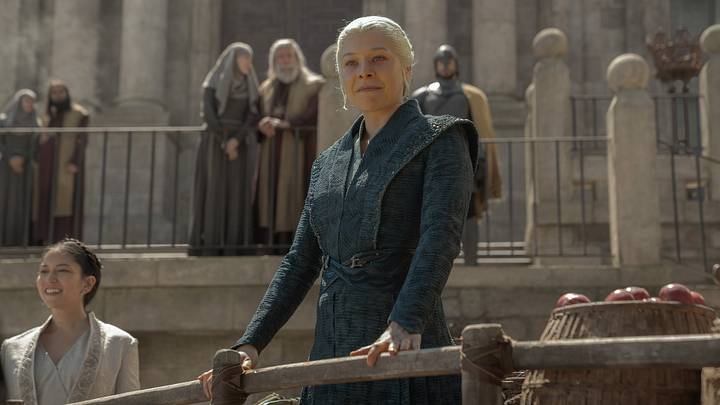
After some understandable doubt about whether the war was worth it in the wake of Jacaerys' death earlier in season 3, Rhaenyra (Emma D'Arcy) finally took the Iron Throne at the end of episode 2. In lesser stories, this could easily be the end of the line. After all, it was Rhaenyra's main goal. But, like its parent show, House of the Dragon has never concerned itself with happy endings.
Instead, episode 3 showcases Rhaenyra's declining mental state as she tries to acclimatize to becoming Queen of the Seven Kingdoms. As is customary with a violent regime change, D'Arcy's character is left trying to balance the loose ends of her predecessor's reign with her attempt to establish the beginning of her own. I still can't get over how intensely D'Arcy's performance made me feel as equally stressed and overwhelmed as Rhaenyra so clearly was. It was an acting masterclass.
As I watched the episode, the immortal line from from Shakepeare's Henry VI, Part 2 started to resound at an ever-increasing volume in my head: "Uneasy lies the head that wears a crown." While D'Arcy's character has already believed herself to be Queen for a while by the time of "Rhaenyra Triumphant," this episode is the first time she has officially undertaken the task. To put it lightly, it's something of a rude awakening and is infinitely more emotionally draining than she expected.
Often misquoted as "Heavy is the head that wears the crown," the Henry VI, Part 2 line rings eerily relevant in this House of the Dragon installment. It also highlights the fact that Rhaenyra is shouldering a lot of the responsibility alone. After casting out most of her former Small Council, the new Queen of the Seven Kingdoms is putting herself through a challenge that none of her predecessors demanded of themselves. As such, her head lies especially uneasily.
Shakespeare Trivia: While the exact date that Henry VI, Part 2 was written has been lost to time, it has been established via historical record to have been completed somewhere around 1590.

House of the Dragon was already very similar to Shakespeare's Henry VI trilogy long before "Rhaenyra Triumphant"
Although Shakespeare was no stranger to writing fantasy epics, the Henry VI trilogy was one of his more grounded affairs. It dramatized the life story of its titular British monarch, without the flashy window dressing of anything too genre-heavy. That being said, it manages to still share several parallels with House of the Dragon. While the Game of Thrones spin-off tells its story with a healthy dose of dragons and magic, Henry VI's War of the Roses can be easily made out among the various strands of the Dance of Dragons.
For example, the line of succession is heavily debated and fought over in both stories. In House of the Dragon, King Viserys I Targaryen's lack of control and authority in the matter, and largely unhelpful level of kindness, are also qualities that apply to Henry VI's title character.
Furthermore, military supremacy starts to become pretty much just as important when it comes to a claim to the throne, rather than the claim itself being wholly legitimate. That's true in both stories. Allegiances also constantly shift. I could go on, but for those who aren't familiar with Shakespeare's work, I would argue that discussing it at too great a length could provide as many House of the Dragon spoilers as reading Fire & Blood would do.
House of the Dragon season 3 is streaming now on HBO Max. Catch a new episode every Sunday on HBO.
 Add us as a preferred source on Google