

Okay, this might sound like a little bit of a wild theory, but stay with me for this.
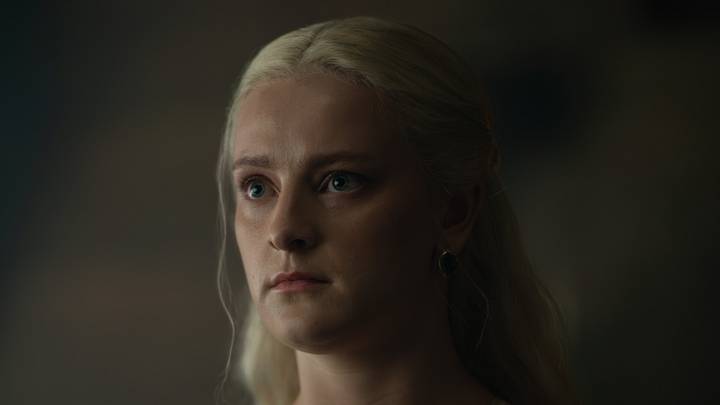
House of the Dragon season 3 ended on a heartbreaking note with the death of Helaena Targaryen. But before her story came to an end, she left behind something significant: a tapestry depicting Rhaenyra Targaryen bleeding on the Iron Throne, surrounded by dragons and reaching hands, all engulfed in flames. This moment from the season finale not only marked the end of a Targaryen who possessed the gifts of a Dragon Dreamer, but may also have foreshadowed the end of Rhaenyra and her reign.
The tapestry was more than just another glimpse into Helaena’s visions. It also brought a new perspective to one of her oldest and most mysterious prophecies from season 1.
Going back to season 1
In season 1 episode 7, during Laena Velaryon’s funeral, Helaena is seen playing with a spider, softly muttering to herself, “Hand turns loom; spool of green, spool of black. Dragons of flesh weaving dragons of thread.”
At the time, her words seemed to describe the inevitable civil war that would soon begin to take shape within House Targaryen. But after watching Helaena spend much of the latest season sewing and embroidering the events of the Dance, there could be a second interpretation hiding in plain sight.
What if Helaena’s prophecy was not only about the Dance, but also about her own role in it? What if she was describing herself as a Targaryen who would eventually weave the story of her family’s destruction into a tapestry?

What did Helaena’s “dragons of flesh” prophecy mean?
Helaena’s prophetic words in season 1 episode 7 arrived at a particularly significant moment in the Targaryen family’s history. The funeral of Laena Velaryon was not only where Aemond Targaryen claimed his dragon Vhagar, and lost an eye for it, but also where the first big, public confrontation between Alicent and Rhaenyra occurred.
Prior to this incident, the Green and Black factions had not yet emerged as political forces against one another, but here is where the divide within the family became harder to ignore and started to take root. The events of that night helped set the stage for the Dance of the Dragons.
When Helaena spoke her prophecy that afternoon, she already seemed to understand that the Targaryen family was about to be pulled toward an inevitable war that would split it into two factions. This was even before the confrontation occurred that night, before the conflict between the two sides became more apparent.
The traditional interpretation of her prophecy fits the unfolding conflict quite well. The “hand” could represent the political figures influencing and manipulating events behind the scenes, pushing the family toward conflict and war. In particular, Otto Hightower, the Hand of King Viserys, helped create the very circumstances that would eventually divide the family, and with it, the realm.
The “spool of green” and “spool of black” are relatively clear, representing the two factions at the center of the civil war, which would eventually fight for control of the Iron Throne.
The phrase “dragons of flesh weaving dragons of thread” could, in one interpretation, refer to the Targaryens and their actual dragons going to war against each other. As they ride into battle with their armies, they weave the devastating events of the civil war into the history of Westeros. Their battles would eventually become what is remembered and recorded long after the war ends.
And, of course, Helaena’s prophecy inevitably comes true. Soon enough both factions and their dragons ride into battle.

Unfortunately, Helaena’s gift as a Dreamer was never properly understood or appreciated by those around her. By the time Rhaenyra recognized her gifts in season 3, it was too late, and the circumstances for her were too harsh. As the war reached its peak, a desperate Rhaenyra was willing to threaten Helaena in an attempt to seek validation as the rightful ruler and use her visions to her advantage.
Helaena also never really had a confidant with whom she could share her dreams, someone who could help her decipher what they meant and perhaps even use that knowledge to protect her family.
Now that season 3 has ended with the tragic end of a Dreamer who left behind a tapestry depicting the symbolic imagery of her prophetic visions, and we know how important the tapestry is to Helaena’s story, connecting the dots reveals another possible interpretation of her season 1 prophecy. That perhaps it was about Helaena herself.

Helaena was weaving her visions of the Dance
One of the most interesting visual details throughout House of the Dragon is Helaena’s embroidery. She is repeatedly shown working on a tapestry while imprisoned in King’s Landing in season 3.
At first, it seems like a small detail for a character who has always been associated with insects, nature, and quiet artistic pursuits. But as the season progresses, we discover that her embroidery is not simply something she does to pass the time. It is connected to the visions she experiences, which she puts into fabric. By the season 3 finale, the tapestry becomes much more significant than a piece of her art; it becomes a record of her prophetic visions.
Back in season 1, when we were first introduced to Helaena’s prophetic abilities, we witnessed her words come to life, either directly or symbolically. She often spoke in fragments, sometimes in cryptic messages and sometimes as literal fortellings of future events.
For instance, when we first heard Helaena’s prophetic words in season 1 episode 6, Alicent Hightower was consoling Aemond about not having a dragon of his own yet. Helaena quietly mentioned that “he’ll have to close an eye” to claim one. This prophecy came true in the very next episode when Aemond snuck out to claim Vhagar, the largest dragon in Westeros, and lost an eye in a fight with Lucerys Velaryon right after. In this instance, Helaena directly spoke of what she had foreseen, rather than in cryptic phrasing.

Considering Heleana’s words in a more literal sense now, “Hand turns loom; spool of green, spool of black. Dragons of flesh, weaving dragons of thread,” seems to point toward herself.
The interpretation of the “hand” remains the same, representing the political players manipulating events and pushing the war into existence. And the “spool of green, spool of black” could refer to both the actual spools of thread used in embroidery and the two factions of the civil war.
But the phrase “dragons of flesh, weaving dragons of thread” could have a more personal meaning. Here, Helaena, a Targaryen herself, could be referred to as a dragon of flesh, who spends the later seasons weaving the visions of her family into thread. She is literally turning the tragic fate of the dragons into a tapestry, expressing what she sees in the only best way she seems to know how.
On interpreting Helaena’s prophetic words this way, her story becomes all the more heartbreaking. She not only carried the burden of a Dragon Dreamer, knowing through vivid visions about the tragic fate of her family, but also became a helpless observer, often unable to change what she had foreseen. At the same time, she was seemingly preserving those visions in cloth, leaving behind a record of the tragedy she witnessed in her prophetic dreams.
Her prophecy from season 1 could therefore have been a foretelling of her own fate. She would eventually become not only a painful witness to her visions coming to life, but also an unofficial storyteller of the Dance, weaving those visions into a tapestry until the very final moments of her life.
As the “hand” continued to turn the loom, pushing both factions into war and bloodshed, Helaena carried the burden of knowing what was coming and putting it into cloth with needle and thread. Ultimately, the tapestry became one of the most significant things she left behind, alongside her daughter, Jaehaera Targaryen.
Interestingly, showrunner Ryan Condal, in the behind-the-scenes featurette, also explained how they wanted to dramatize what Helaena was seeing, or believed she was seeing, without making her visions completely literal. He even described the tapestry as one of the season’s most significant graphics, highlighting how important the tapestry is to the story, especially to Helaena’s story.
Could Helaena have created the tapestry in the opening credits as well?
This is another detail that makes this interpretation particularly interesting. If Helaena’s season 1 prophecy was describing her own future as a weaver of the Dance’s history, could the tapestry in the opening credits actually be her work?
I know this is a bigger leap, but there are a few details that make the theory worth considering.
In season 1 episode 7, Helaena speaks of the “dragons of flesh weaving dragons of thread.” That same night, Aemond claims Vhagar, and the conflict between the two sides of House Targaryen escalates. By season 1 episode 9, for the first time, Helaena is shown sewing while speaking of another prophecy. It is interesting how she is shown sewing for the very first time, and in the same episode, King Viserys dies, marking the beginning of the civil war.
Then, in season 2, the show’s opening credits change from bloodline-inspired imagery to an elaborate tapestry depicting the history of House Targaryen, with threads flowing into the cloth, weaving historical events. The sequence begins with the history of the Targaryens and gradually incorporates the events of the Dance, with new images appearing to be stitched into the fabric as the story progresses.
The change was deliberate. Ryan Condal, in conversation with The Hollywood Reporter, explained that the team wanted the new opening sequence to represent a “living history,” as House Targaryen is now at war. He also described it as the story of the Dance unfolding “literally being stitched into this tapestry.”
That explanation is particularly interesting when placed alongside Helaena’s tapestry work. Although there has been no confirmation connecting the show’s opening credits to Helaena, the visual parallel is difficult to ignore.
We have a character who predicted that dragons of flesh would weave dragons of thread, and subsequently, the show introduces a tapestry depicting the history of the Targaryens. Meanwhile, Helaena is shown sewing images connected to the events she sees in her visions.
We have seen Helaena weave the imagery of Aemond hiding in Harrenhal with Alys Rivers present in it. We have also seen the image foreshadowing her own death, falling onto the iron spikes below the tower of the Red Keep, on her tapestry. And her final and most important work depicting Rhaenyra sitting on the Iron Throne, bleeding, with dragons and reaching hands behind her, all burning in flames, left behind.
These images are strikingly similar in concept to the images woven into the opening credits tapestry. Both use embroidery to preserve the story, with Helaena’s visions often reflecting a more symbolic unfolding of prophetic visions, rather than specifically history.
There is another detail from season 3 finale that makes this theory even more intriguing.
We know that the opening credits continue to evolve, and in the finale, the tapestry sequence ends with the fabric eventually catching fire and burning. The tapestry burning could represent the civil war reaching a destructive turning point, or even the end of this particular chapter of the Dance as the story, as the threads woven into the fabric disappear into ash.
And considering Helaena’s death in the same episode, it is tempting to connect the two.
If we entertain the idea that it is Helaena's tapestry depicted in the opening credits, her death could symbolically mark the end of the story she has been weaving. The person who has been recording the events through thread is gone, and so the tapestry itself appears to reach its conclusion as it begins to burn.
Of course, this does not mean that the war is over, as it will continue to intensify in season 4. There are many more events in the Dance that are yet to shape the history of Westeros. But the visual language of the opening credits, when aligned with Helaena's death, could reflect the possible connection of her embroidery to the tapestry.

Looking back at Helaena’s prophecy from season 1, it seems to operate on more than one level. On one level, it represents the inevitable war that divides House Targaryen and the realm and permanently writes its tragedy into the history of Westeros.
On another level, the heartbreaking interpretation is that it also describes Helaena’s own future as the dragon of flesh who would eventually weave the story of the Dance into a tapestry, preserving the tragedy of her family through thread.
Perhaps Helaena was meant to be the Dreamer who saw the inevitable tragedy coming, became its unwilling witness, and quietly recorded everything she saw in her visions. And in doing so, she played her own part in the history of the Dance, becoming its unofficial storyteller through embroidery.
I would love to see how the opening credits of season 4 change. Will it continue to evolve the tapestry as the war progresses, or will the show introduce another visual representation for the Dance's next chapter?
 Add us as a preferred source on Google