

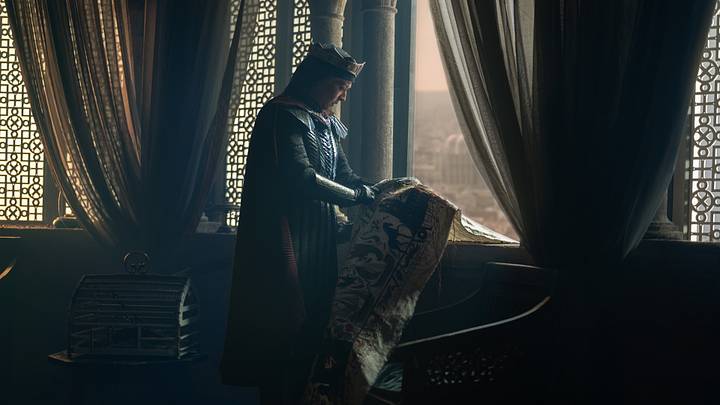
HBO’s House of the Dragon season 3 finale, "The Treasons of Tumbleton," delivered intense battle sequences, major revelations, and heartbreaking endings for some of the show’s biggest characters. But beyond the spectacle, the episode was packed with symbolism and subtle details about where the Dance of the Dragon is headed next.
From hidden clues in Helaena’s tapestry and Alys Rivers’ mysterious past to the deeper meaning behind Rhaenyra’s speech, here are 12 things you may have missed in the House of the Dragon season 3 finale.
- 1. The opening tapestry changes one final time before it burns
- 2. Ormund’s unusual knighting ceremony was really about control
- 3. Why Ormund gives Daeron the title "The Daring”
- 4. Aemond’s nightmare reveals the guilt he is haunted by
- 5. Alys Rivers may have revealed who she really is
- 6. Helaena’s beetle speech carries a heartbreaking message
- 7. Mysaria’s exile may have been about failure, not betrayal
- 8. Helaena’s prophetic dream came true in the courtyard
- 9. Rhaenyra "The Chosen's" speech reveals how much she has changed
- 10. Joffrey’s first appearance at the Grand Sept was a political statement
- 11. "The Treasons at Tumbleton" refers to more than one betrayal
- 12. Helaena’s final embroidery may reveal the future

1. The opening tapestry changes one final time before it burns
The opening credits tapestry features several notable additions in the finale, including the burning Mooton forces, Aegon standing before Sunfyre with his scarred face framed by a red halo, and Sunfyre unleashing dragonfire. The image of Aegon standing before Sunfyre mirrors earlier imagery of Rhaenyra standing before Syrax in the intro tapestry, visually portraying the parallels of both claimants at the center of the war.
More importantly, this is the first time we see the tapestry itself consumed by flames. In the previous intro sequences, the tapestry only bled. Now it burns, symbolising the Dance reaching the peak of its most destructive stage and the beginning of the end for both House Targaryen and its dragons.
Throughout season 3, Helaena's embroidery has functioned as a visual record of her visions, indirectly mapping out the history of House Targaryen's civil war. This pretty much connects Helaena as the storyteller through her embroidery. And with her death in the finale, the burning tapestry may symbolize the end of her embroidery, the end of the tapestry.

2. Ormund’s unusual knighting ceremony was really about control
One of the episode's most curious moments comes when Ormund Hightower insists that Daeron must be knighted before he can be crowned king. At first, it appears to be a traditional knighting ceremony, a gesture of honor, but as soon as Ormund speaks the words, it suggests a deeper motive.
In Westeros, traditionally a prince does not need to be knighted before becoming king. Neither Viserys nor Aegon required knighthood before their coronation. Yet there might be a very specific and manipulative reason why Ormund customizes the oath when knighting Daeron to suit his motives. Beyond the traditional vows, Ormund asks Daeron to swear, “to obey your captains, your liege lord, to fight bravely whenever needed and to do such other tasks as are laid upon you however hard or humble or dangerous they may be.”
This ceremony feels less like a celebration of Daeron and more like Ormund seizing the opportunity to secure his control over a young prince under an oath. By binding Daeron to his vows before battle, Ormund ensures he can use both Daeron and his dragon Tessarion to pursue his motives, not only in battle but during the campaign.

3. Why Ormund gives Daeron the title "The Daring”
Another interesting detail arrives during Daeron’s knighting when Ormund bestows the title “Daeron the Daring.” For book readers, the title immediately stands out as it carries a very different meaning in Fire & Blood. In the books, Daeron earns the title through his actions during the Dance of the Dragons, proving himself brave and capable in battle.
But the show appears to be taking a different approach, as we are yet to see Daeron and Tessarion on the battlefield, much less achieving the legendary feat that made the name famous in the source material. Ormund's decision to grant the title is essentially to create Daeron’s public image. Basically, it's a PR move.
Ormund understands the power of symbolism and propaganda; hence, his plan of minting coins bearing Daeron’s image to promote him as a viable claimant and then use these coins to stir chaos inside King’s Landing. Throughout season 3, Ormund has used Daeron to strengthen his political position, and the new title is also a part of it. It transforms Daeron from a forgotten fourth son into a young prince bold enough to challenge both his siblings, Aegon and Rhaenyra, for the Iron Throne. Rather than letting Daeron’s actions speak for themselves, Ormund uses the title to shape the image of Daeron that he wants the realm to believe.

4. Aemond’s nightmare reveals the guilt he is haunted by
During Aemond’s dream sequence, we hear the voices of a familiar exchange: “Do you remember?”, followed by “I remember nothing.”
This exchange is the dialogue from season 2, episode 6, when Aemond, then Prince Regent, visited the severely injured and bedridden Aegon after the Battle of Rook’s Rest. Following Aegon’s near-fatal encounter with Vhagar’s dragonfire, Aemond questioned his brother to determine whether he would be in trouble or would have the power of the throne to himself for longer.
The fact that this exact conversation resurfaces in Aemond’s dreams suggests that despite his confidence and ruthless exterior, he never fully escaped the guilt and the psychological consequences of attempting to murder his own brother in a reckless act of blind ambition. The memory of that event haunts Aemond, even in his sleep.

5. Alys Rivers may have revealed who she really is
Alys Rivers’ conversation with Aemond may have revealed more than her grief and pain of abandonment. If what Alys revealed is true, she may have just become one of the most mysterious characters in the entire franchise, reshaping everything we know about her.
The details about her past suggest that Alys is the former wife of King Harren Hoare (Harren the Black). Her story implies that she is over a century old and may have lived at Harrenhal since before Aegon the Conqueror’s arrival in Westeros. She reveals that Aegon burned the castle to end Harren’s line, but her son, severely burned, survived. In an attempt to save him, she turned to ancient remedies and powers connected to the old forests. But the remedies failed to save her son and instead backfired, cursing her to live on, forever bound to the castle.
This may help explain her strange healing abilities with which she nursed Aemond back from near death. It may also affirm her apparent connection to Harrenhal itself, and the supernatural forces and entities surrounding it. This revelation makes her a key character who has possibly witnessed Westeros’s history play out in real time. From Balerion the Black Dread torching Harrenhal up in flames to the Great Council where Viserys was chosen the heir to the Iron Throne. Rather than a simple healer, Alys increasingly feels like a witch with ancient knowledge, hidden motives, and possibly a highborn with a long-term plan far beyond the Dance itself.
On the show’s official podcast, as showrunner Ryan Condal hints at Alys' story being far from fully revealed, we can expect more to her mystery than a mother cursed to suffer at Harrenhal.

6. Helaena’s beetle speech carries a heartbreaking message
There's a moment in the finale when Rhaenyra tries to connect with Helaena to get her to eat. This leads to an intriguing conversation where Helaena describes a colorful beetle to Rhaenyra. The blue, gold, purple, turtle-like beetle that survives on the waste of other creatures could be a literal description of an insect. However, we know that Helaena rarely speaks without deeper meaning.
Moments earlier, she questioned Rhaenyra about whether life is simply “not being dead,” forcing her to confront what value she places on ordinary lives during wartime. The beetle may represent the countless innocent lives overlooked by rulers obsessed with the crown, dragons, and prophecies. Helaena sees beauty in the small, vulnerable, and easily ignored, like the beetle, while those fighting the war, consumed by power and destiny, see more worth in victory at any cost, which she finds ugly. Helaena’s brutally honest criticism makes this conversation all the more chilling.

7. Mysaria’s exile may have been about failure, not betrayal
Many viewers must have assumed Rhaenyra’s decision to send Mysaria away may have stemmed from the political tensions and mistrust of intentions. But the finale suggests there is a more practical reason for it.
As the Mistress of Whisperers, Mysaria’s greatest responsibility is information. Yet she fails to uncover one of the most important developments in the war: Aegon and Sunfyre are still alive. Instead, Rhaenyra learns this crucial piece of information from Maester Orwyle.
This failure on Mysaria’s part becomes more significant because Aegon’s survival now strengthens the Greens’ cause politically and religiously. To many among the Faith, his survival is interpreted as a sign from the gods. This failure marks the second time Mysaria proved incapable of gathering essential intel, following her failure to expose the infiltrations responsible for undermining Rhaenyra’s rule and the silent murder of the Gold Cloaks.
Mysaria’s removal from court may not have been a punishment for betrayal, but more like the consequences of no longer delivering results, which is a risk Rhaenyra could no longer afford to take.

8. Helaena’s prophetic dream came true in the courtyard
The previous episode revealed several of Helaena’s prophetic dreams. In the finale, one of those visions manifests before her eyes.
After leaving the godswood, Helaena notices a gray mare attached to a wagon loaded with Mysaria’s belongings. The entire setup, the horse and the wagon, appears identical to the one she saw in her earlier dream, transforming what seemed like a distant vision into reality. For Helaena, this moment likely serves as the final confirmation that the future she foresaw has arrived.
The symbolism of a pale or gray horse has long been associated with death and ominous fate in Westerosi lore. Once she recognizes the mare, she probably understands that the events are unfolding exactly as she saw them, signalling to her that her end is nearing. This moment holds even more weight considering what follows is her tragic death, later in the episode.

9. Rhaenyra "The Chosen's" speech reveals how much she has changed
Rhaenyra’s speech at the Grand Sept may have been one of the most defining moments of the finale, laying bare how Aegon’s survival pushes her into absolute desperation.
She opens her speech by reminding the crowd that King Viserys publicly named her heir before the Lords of the realm. At first her argument is grounded in succession and legitimacy. But as the speech continues, her focus shifts away from politics toward prophecy. The secret of Aegon the Conqueror's dream, a burden closely guarded, once passed from ruler to heir, is transformed into a public declaration as Rhaenyra proclaims that her reign serves a higher purpose.
The timing of Rhaenyra's shift from strategic caution to aggressive measures is significant. Having just learned that Aegon and Sunfyre are alive, while the Hight Septon outright refuses to anoint her yet again, and with the battle of Tumbleton upon them, Rhaenyra realizes that legal claims will no longer suffice. With the realm and the people of the Faith believing that Aegon’s resurrection is a sign from the gods, Rhaenyra counters with her own divine destiny. With the prophecy, she lets the realm know that her ascension isn’t only about the rightful line of succession but that her reign is a part of a divine purpose. In doing so, she not only presents herself as the one destined to fulfill the prophecy but also embraces the title “The Chosen.” Her speech reveals a ruler desperate to validate her reign, increasingly leaning on prophecy, repositioning herself from a contested queen into a destined messianic figure to the crowd.

10. Joffrey’s first appearance at the Grand Sept was a political statement
Prince Joffrey Velaryon’s appearance with Rhaenyra at the Grand Sept isn’t merely to familiarise him with the realities of the crown and its responsibilities, but it also serves as a political statement.
By bringing him before the crowds, Rhaenyra reminds the realm that her line of succession is secured. Every detail reinforces the message: the young prince with a crown of his own, dressed appropriately for his first appearance in public at what was supposed to be his mother’s anointing ceremony.
This move also reflects lessons learned from Viserys’ reign. One of Viserys’ greatest political failures was the lack of reinforcing Rhaenyra’s position in the realm and assuming that naming an heir would be enough. Rhaenyra appears determined not to repeat that mistake, especially considering her very position is currently under threat. By presenting Joffrey publicly, she introduces her heir to the people while simultaneously reminding them that the future of her dynasty extends beyond her own reign.

11. "The Treasons at Tumbleton" refers to more than one betrayal
The title of the episode, "The Treasons at Tumbleton," suggests that the episode is about far more than a single act of treason.
The clearest betrayals come from Ulf White. First turning against Rhaenyra to side with Ormund, he ultimately turns on both factions, unleashing dragonfire on friend and foe alike. Hugh Hammer's actions are more complicated. Motivated to save his wife Kat, he abandons his post at the Dragonpit and flies to Tumbleton. Hugh not only put his duty at risk, but also left Vermithor close to the battlefield, which could have turned out wrong in so many ways. All while refusing to mount his dragon to assist the Black forces when Ulf went rogue.
Elsewhere, Gwayne and Daeron secretly negotiate with Corlys, pursue peace talks with Daemon, and release Corlys without Ormund’s knowledge. Corlys then proposes an alliance between the rival factions, suggesting Daeron wed Rhaena to keep the peace. A suggestion Daemon considers disloyalty to Rhaenyra's cause, leading to him taking Corlys prisoner.
Then there’s the tragedy of Tumbleton itself. The innocent lives caught between dragons and armies suffered the most of them all. In that sense, the battle of Tumbleton becomes a betrayal of the very people the rulers claim to protect. The title refers not to one treason, but to the broader state of the realm where loyalty is becoming increasingly fragile at the peak of war.

12. Helaena’s final embroidery may reveal the future
The most haunting images of the finale arrive in the final moments of the episode. After learning of Helaena’s death, Rhaenyra discovers her tapestry hanging from the window.
The tapestry has two striking scenes from Helaena’s visions embroidered into it. The first image depicts Helaena’s tragic fall from the tower, dressed in green, tears streaming down her face as she descends toward the blades. It confirms that she foresaw her own death long before it happened.
The second image shows Rhaenyra seated upon the Iron Throne with a sword in her hand, flames emerging from behind the throne that engulf a large green dragon, and multiple hands that reach out from the flames. Most striking of all is the red thread depicting blood that covers Rhaenyra’s body, flowing from her crown to the bottom of the throne.
The symbolism in Helaena’s final piece in her tapestry can be interpreted in several ways. It may foreshadow the end of Rhaenyra's reign with her eventual death as Queen during the Dance of the Dragons, or even reference the Iron Throne rejecting her as she bleeds from the wounds inflicted by the throne. Or even depict how dragonfire unleashed bloodshed during her reign, marking the beginning of the end of dragons. Whatever the meaning, Helaena’s final prophetic dream suggests that there is more tragedy consuming House Targaryen yet to come.
Season 3 has ended, but the good news is that House of the Dragon has already been renewed for a fourth and final season, set to release in 2028. A two-year-long wait, and then season 4 will be ready to bring more revelations, new dragons, and new locations to conclude the Dance of the Dragons.
 Add us as a preferred source on Google