

The season 3 finale of House of the Dragon, titled “The Treasons at Tumbleton," was almost universally liked, as this show is at its best when it can use its immense production budget on battle scenes; bonus points if dragons are involved. The episode tied together some of the plot points from the season, some in accordance with Fire & Blood by George R.R. Martin, while often changing course from the book. Let’s analyze the episode in comparison to its source material.
The episode opens in King’s Landing, where Maester Orwyle (who is a prisoner in Fire And Blood, not sitting on the Queen’s Small Council) informs Rhaenyra that Aegon is alive and has made his stance outside Rook’s Rest.
This sends Rhaenyra into a panic, fearing the people’s reaction to knowing her younger half-brother has risen from the dead. The Queen seeks reassurance from Prince Daemon, and her husband speaks strong words of encouragement that will carry Rhaenyra through the trials and tribulations of the episode (and hopefully of next season), giving her the strength to do what must be done to secure her position and their family.

"I'm not bad, I'm just drawn that way!"
I’ve seen many people describe this episode as the beginning of Rhaenyra’s tyrant arc, her descent into madness, and I have to say I do not agree. For three seasons, the Queen has patiently taken every blow and shown patience and compassion, even towards her enemies. Now, she is done with waiting and is ready to use whatever means to defend her rights. It’s no less than what many other (male) characters have done. Unfortunately, it’s clear that the showrunner and at least some people in the writer’s room have a blatant preference for Team Green, so Rhaenyra’s own characterization is often weak and inconsistent and, in this episode, purposely written to appear villainous. However, I still don’t see it.
In an act that is entirely within her rights as queen, Rhaenyra dismisses Mysaria from her Small Council and King’s Landing, despite their intimate scene of reassurance and seduction in the previous episode. In the story, this does not seem to make much sense, a sentiment echoed by the characters of Mysaria and Elinda Massey themselves, although monarchs have been known to exile bad counselors in every age, and Rhaenyra is sending Mysaria off with plenty of gold. In the book, however, Mysaria remains loyal to Rhaenyra (even if sowing the seed of discord between the queen and Daemon) and serves the Queen until her death.
Lastly, Rhaenyra is unkind with her stepdaughter Baela and grounds her—a poor move, given that Baela is a dragonrider who can defend the city and, even if upset, would not switch loyalties. I disliked this interaction and hate that this season has neglected Rhaenyra’s relationships with her family and let their grief fester to this point, when in the book, the family is united through and through. The show has gone to such extents to remove the evil stepmother trope from Alicent in season 1, only to pin it to Rhaenyra with her own beloved stepdaughters.

Rhaenyra the… perfectly sane and logical monarch?
What many consider Rhaenyra’s point of no return is killing the High Septon. Now, apart from the possible consequences of this act, I don’t see it as atrocious as I’ve seen it described. She has tried reasoning with the Septon, asking for what she wanted kindly, then letting him be for weeks/months; then she asked again, clearly stating what his choice would imply. If he doesn’t accept her rule, what else is a monarch supposed to do, allow him to dub her an usurper to all kingdoms? Why should she let sedition go unanswered? Just because he’s a religious figure doesn't mean he’s above the ruling queen.
Eliminating the Septon is what most monarchs in Fire & Blood would have done, and yet a woman is not afforded the same liberty. Here, Rhaenyra finally embraced her role in a way any male king would: if Daemon or Aegon had ordered the High Septon killed, audiences would have cheered for it, but when it’s Rhaenyra doing it, we accuse her of tyranny. If she had let him leave, on the other hand, the audience would have called her weak and unfit to rule.
None of this happens in Fire & Blood, but it’s important to call out the show for its double standards, which do not stem from this episode’s writing but from the showrunner’s clear dislike of Rhaenyra.
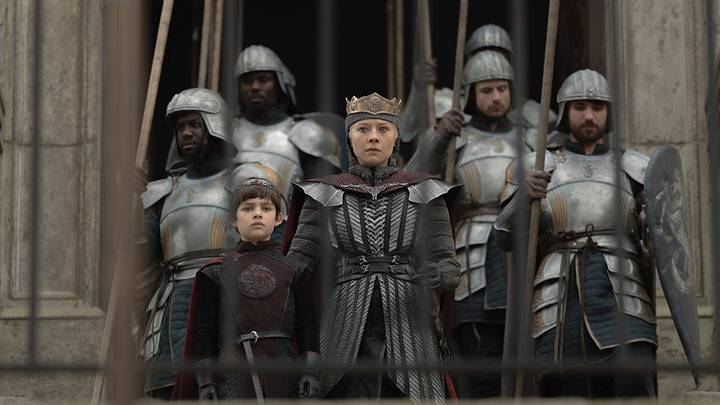
Outside the Sept, Rhaenyra reveals the prophecy of Aegon’s dream, the Song of Ice and Fire, first to her heir, Joffrey, and then to the smallfolk of King’s Landing as a way to justify her ascent, presiding over her own spiritual coronation and presenting herself as a warrior queen garbed in the style of Visenya, the true protector of the realm against the forces that loom.
This is a stance of dramatic irony: to the people in the story, this is a likely enough—if unbelievable—story; however, everyone watching the series knows Rhaenyra is not the Prince Who Was Promised—that title likely belongs to her descendant Daenerys Targaryen, or jointly to Jon Snow, or perhaps their own offspring, and it’s interesting that there would be so much talk about the Prince Who Was Promised the same week that the play Game of Thrones: The Mad King premiered, given that the prophecy is an important plot point in that story as well.

The show fundamentally changed Helaena's demise
In a scene that does not exist in the book, Rhaenyra tries to convince Helaena to eat and orders her force-fed; if she had allowed her half-sister (and her unborn baby) to starve, would that have been a kinder move instead? No, because the writers clearly love to write Rhaenyra into corners. I also want to point out that while Helaena may not have committed any atrocious acts in this war, she is entirely complicit in those committed by her family.
She is a victim of this conflict, but it’s rich of her to criticize Rhaenyra’s morality when she has never done so when her brother-husband Aegon was raping girls and watching his own bastard children fight in the cockpits, or when her mother orchestrated Rhaenyra to be usurped, or when Aemond killed Lucerys. I’m sure the double standard stems from the writers, if not from sweet Helaena as a character herself, who clearly abhors violence in all its forms.
Helaena's suicide is an important plot point that audiences were anticipating, not for the scene itself, but rather because it was likely the point of no return in the relationship between book author George R.R. Martin and House of the Dragon showrunner Ryan Condal. In a since-deleted blog post made in 2024, after reading early scripts for season 3, Martin had lamented that Helaena's suicide would be entirely pointless on the show.
In Martin's Fire & Blood, Helaena still jumps from her window in the Red Keep and dies with her throat impaled on the spikes, but she does so for different reasons. The inciting incident is that her youngest son Maelor has been killed. On the show, Prince Maelor does not exist; he is likely the child in her belly. Helaena commits suicide simply on the basis of understanding that she may never be free.
It is Mysaria, in an act of defiance, who tells Helaena that Aegon is alive and that she will remain captive in the Red Keep. Mysaria being the bringer of this news that leads Helaena to suicide is a nod to the book, where Septon Eustace, one of the sources on the Dance of Dragons, claims that Mysaria had been the one to tell Helaena that her son Maelor was dead.

Plot changes at Harrenhal
After Aemond wakes from Alicent’s attempted poisoning, Alys Rivers—who the book describes as an ancient bastard of some lord of House Strong—is revealed to be the wife of King Harren the Black, the legendary (and cursed) builder of Harrenhal who refused to kneel to Aegon the Conqueror.
To Aemond, Alys recounts that when her son was burned by Aegon’s dragonfire, she sold her soul to witchcraft in trying to find a cure. Her desperate attempts were for naught, and she has lived in loneliness ever since, for over a century. This invented backstory adds nothing to the present plot, except for a villain origin story for Alys, although it doesn’t really justify why she would want to marry a dragonlord rather than bring destruction to House Targaryen in revenge for her son. Sure, it’s a cool backstory at face value; we’ve dedicated an entire article to analyzing it.
Soon after Alys’s revelation, wings flap above Harrenhal, and Aemond runs, thinking Vhagar may have returned to him, but it’s his brother Aegon on Sunfyre, who’s come to exact vengeance. Aemond does not give Aegon the satisfaction of a fight, kneeling and asking for his forgiveness. This prompts an unhappy Aegon to choose the clever path of using Aemond and (the still unaccounted for) Vhagar to fight Rhaenyra.
Nothing of the sort is narrated in Fire & Blood, but the reunion and reconciliation of the Targtower brothers was a good scene to watch.

The (first) battle of Tumbleton
The long-promised battle that has been promised all season finally arrives. Some details of the battle are taken directly from the book, while some others are fundamentally different due to plot changes.
Before the battle, Ormund finally knights Daeron, and the timing is rather odd since the pretender king has done nothing to earn the moniker of Daeron the Daring. In the book, the prince earns his name and knighthood after he and Tessarion bring victory at the Battle of the Honeywine. However, it’s clear that young Daeron is a truer knight in spirit than his noble uncle.
With battle looming, Ormund’s plan to further stain Rhaenyra’s image in the eyes of the people is to place helpless and unwilling children on the battlements of Tumbleton. It’s clear that he, this self-righteous knight and lord, who is supposed to protect the innocent, cares nothing whether Daemon burns these children and clearly hopes that he will rather than sparing their vast majority as he does. Ormund’s cruelty and hypocrisy know no bounds, but nobody dubs him Ormund the Cruel or Ormund the Mad as they would if Rhaenyra had done something similar. Oh, the double standards.

In the book, Ormund shows slightly more courage and somewhat less evil intent, at least choosing to meet the enemy face to face instead of using terrified children as human shields. Fire And Blood says that, "Lord Ormund Hightower sat his warhorse beneath King Aegon’s golden dragon and the banners of Oldtown and the Hightower.” The main difference on the show is that Ormund flies Aegon’s banner (as the King Daeron plot is original to the show) and stays within the walls of Tumbleton and only fights for his life when the Winter Wolves penetrate the city; he is eventually wounded by Roddy the Ruin, and they both are killed by dragonfire.
On the other side of the Hightower spectrum, Gwayne and Daeron clearly care about the death of innocents. Still untrusting of Ormund, they set another plan in motion to try and ensure their survival and prevent the town’s massacre: to use their hostage Lord Corlys as a bargaining chip with Daemon. Gwayne even pleads with Daemon and proposes to divide the realm in two, with Daeron ruling from Old Town and Rhaenyra from King’s Landing.

This idea is taken straight from Fire & Blood, where it’s Alicent who goes to the Iron Throne to beg Rhaenyra to divide the kingdom with Aegon ruling from Oldtown. The show gave this proposal to Gwayne, propelling Daeron instead of Aegon. Corlys suggests that they go for this course, but with Daeron as Lord Paramount rather than king, a sane suggestion that Daemon laughs at but that show Rhaenyra could have considered a few episodes ago. In the book, she refuses Alicent’s proposal with scorn:
"Your sons might have had places of honor at my court if they had kept faith,” Her Grace declared, “but they sought to rob me of my birthright, and the blood of my sweet sons is on their hands.”
A fundamental difference in the battle of Tumbleton is its commander: Daemon.
In the book, Daemon is not at Tumbleton. At this point, Caraxes and Sheepstealer went north, Vermithor and Silverwing southwest, Daemon and Nettles went to look for Vhagar in the Riverlands, whereas Hugh and Ulf were sent to fight at Tumbleton. On the show, Ulf is posted at Tumbleton (where he is playing both sides); Daemon flies there to command his army of Rivermen and the Winter Wolves, while Hugh is stationed at King’s Landing but abandons his post to save his wife Kat at Tumbleton, sadly to no avail. Is that considered one of the titular betrayals, I wonder?
Another big difference is Daeron. On the show, Daeron wishes to participate in the battle on Tessarion, but he doesn’t. In the book, Daeron and Tessarion do fight and contribute to Team Green’s victory.

The Winter Wolves
For all their legendary portrayal, House of the Dragon was rather remiss in explaining who the Winter Wolves are exactly. The Greybeards promised by Lord Cregan Stark to Prince Jacaerys in episode 2x01 are an army comprised solely of old men who choose to go south to fight, as they know they won’t survive the coming winter. Rather than being a burden for their families, they seek a glorious death in support of the rightful Queen Rhaenyra.
The characterization of Lord Roderick Dustin, also known as Roddy the Ruin, is entirely faithful to Fire & Blood: “As the singers tell it, Lord Roderick was bloody from head to heel as he came on, with splintered shield and cracked helm, yet so drunk with battle that he did not even seem to feel his wounds.”
I loved how the show portrayed the Greybeards’ war cry, so vividly described in the book:
“Roddy the Ruin and his Winter Wolves sallied forth from a postern gate, screaming their terrifying northern war cries as they swept around the left flank of the attackers. In the chaos that ensued, the northmen fought their way through ten times their own number.”

Ulf’s double-sided betrayal turned the tide of the battle
If there’s one thing that this season set up really well, it was Ulf the White’s turncloak arc. In the book, both he and Hugh betray Rhaenyra and fight for Aegon instead. In the episode, only Ulf truly betrays Rhaenyra – as Hugh disobeyed her to look for his wife but did not fight for the other side, which I appreciated. Ulf, however, is late to the battle as he is sleeping off a hangover, leaving both sides to impatiently wait for him.
When he does show up, he fights for neither side, burning soldiers on both sides and the innocents in Tumbleton. (Obviously, no one is calling him Mad Ulf as they would a woman, but that’s all right.) His double betrayal was easy to predict, with the way Ormund spoke to him, but refreshing all the same.
The book describes the sack of Tumbleton and its destruction by dragonfire in vivid detail, and the episode certainly shows it. However, while in Fire & Blood the battle is clearly won by Team Green, the show makes the innocents the real losers. Team Black still goes home with all its important players and does not even lose a dragon, as Ulf and Silverwing are escorted back to King’s Landing as hostages. Team Green has lost its main strategic commander, Ormund, while Daeron’s fate is currently unknown. However, with Ormund dead and Aegon being alive, it’s safe to assume that the younger prince will renounce his claim to the throne.
Despite the many differences with the source material, “The Treasons at Tumbleton” is certainly one of the season’s strongest episodes. Whenever series writer Ti Mikkel is involved (who also wrote A Knight of the Seven Kingdoms episode 5), quality is ensured.
Will season 4 follow in this vein? We’ll have to wait and see.
 Add us as a preferred source on Google