

One of the greatest things about the success of the two most recent Toho-produced, Takashi Yamazaki-directed Godzilla films is the way in which they are actively in conversation with the original 1954 Ishirō Honda-directed film. In both literally going back to the immediate aftermath of WWII in Japan (Godzilla Minus One is set in 1947, while Godzilla Minus Zero is set in 1949), and in tonally and thematically returning to something far more akin to Honda’s original work, Yamazaki and co. have brought that 1954 film back into the larger discussion of this franchise in pertinent ways.
In the new film, Godzilla Minus Zero, Yamazaki and his team take some fascinating swings that tie the events of the film even more directly to Honda’s original Godzilla. Through the use of black-and-white footage, the recreation of key moments and visuals, and the larger embracing of these ideas in the metatext, Godzilla Minus Zero manages to make Ishirō Honda’s 1954 Godzilla a key part of its narrative, themes, and filmmaking.
What the heck does any of that mean? Well, in a very unique and subversive way, there is an idea subtly established in Godzilla Minus Zero that perhaps the ‘real-world’ events of these films go on to inspire a filmmaker — this fictional universe’s version of Ishirō Hondo — to make Godzilla movies. There’s not like some secret cameo from the filmmaker Legends of Tomorrow-style or anything like that, but there are more than a few reference points throughout which seem to refer to this kind of a relationship between the events of the Godzilla Minus films and the original work.

For starters, there are several black-and-white photos of Godzilla pinned up on the walls in the Large-Scale Disaster Response Bureau. While some of these are clearly of events or specific moments that took place in the prior film, Godzilla Minus One, there are also pictures that are clear references to promotional images from the original 1954 film. On its own, this could be little more than a clever Easter Egg, but when taken in conjunction with other elements, things come into a bit clearer focus.
Early on in Godzilla Minus Zero, as the core cast of characters and the audience are having (SPOILERS) Ghidora’s whole deal explained to them, the movie uses in-universe black-and-white footage of prior events to provide visual aid. Yamazaki and his team have gone out of their way here to make this look as close as humanly possible to the fidelity and quality of image in Honda’s original film, even down to ensuring that the grain on the digitally-created effects within the footage is synchronous. Not only does this work with the larger themes and intentions of the piece, but it also is just really cool to see on the big screen.
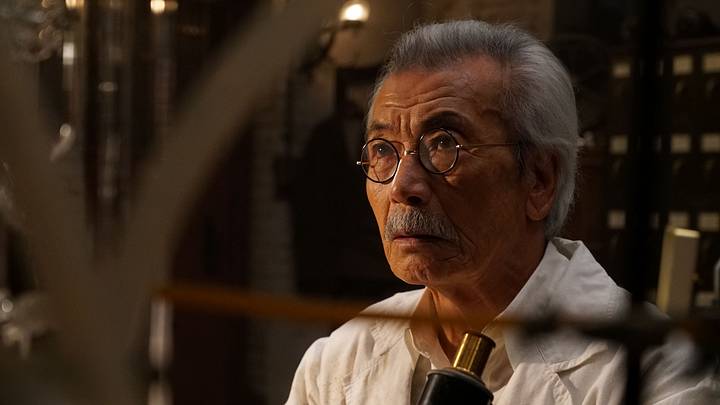
But most importantly, Godzilla Minus Zero is directly about the relationship between real-world horrors and the ways in which societies grapple with them, through fictional expressions or otherwise. The prior film drew some direct lines between things like the bombing of Hiroshima and Godzilla’s attack on Ginza, and Minus Zero makes the iterative connections between these events all the more explicit. Ghidora’s attacks harken back to the collective trauma of Godzilla’s attacks, which in turn harken back to the atomic bombs, all of which is encapsulated so harrowingly in the character of Kanji Murakami (as played brilliantly by Min Tanaka) who has lived through all three.
In this way, this duology of films has always been about the relationship between the real-world terrors of WWII and the fictional monstrosities created by Honda and Toho in 1954. Through a litany of methods, Godzilla Minus Zero makes these connections all the more palpable, making the original Godzilla movie a key part of its larger narrative.
Godzilla Minus Zero is playing now in theaters. Read our review here.
 Add us as a preferred source on Google