

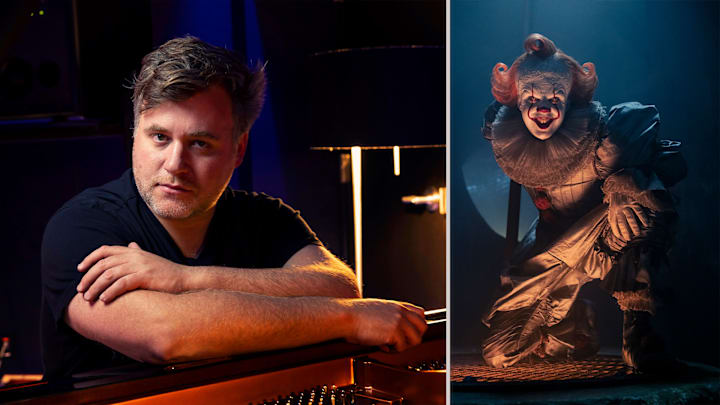
There may be no new episode of IT: Welcome to Derry tonight on HBO, but that doesn't mean we have to stop thinking about it. Over the course of eight episodes, the IT prequel series from Andy Muschietti vastly expanded the world that movie-goers experienced in the IT (2017) and IT: Chapter Two (2019) films. Taking place in the 1962, this version of Derry was drawn from the pages of an interlude in Stephen King's seminal novel, and the show rose to the challenge and then some, delivering some absolutely pulse-pounding sequences of sheer terror.
Music is important for any project, but that feels especially true with a horror story that needs to be able to shift from idyllic calm to creeping dread to run-for-your-life violence on a dime. Fortunately for IT: Welcome to Derry, Muschietti enlisted the aid of his frequent collaborator Benjamin Wallfisch, who scored both IT films. Wallfisch is a multi-award nominated composer who has worked on dozens of films and television shows, including Alien: Romulus, Blade Runner 2049 with Hans Zimmer, and this year's breakout Predator sequel Predator: Badlands, which he co-scored with Prey composer Sarah Schachner. Suffice to say, there was never any doubt that Welcome to Derry was in good hands.
We had the chance to interview Wallfisch about scoring IT: Welcome to Derry, and the passion he holds for his work was obvious. Our far-ranging conversation covered Welcome to Derry as well as Predator: Badlands, the animated film Predator: Killer of Killers, and the latest Alien film. We'll be sharing the full interview later this week, but for now, we're focusing on IT: Welcome to Derry to honor the end of the IT prequel's run.
This interview has been edited and condensed for clarity and length.

WINTER IS COMING: When we were speaking about Predator: Badlands you mentioned coming at it with a fresh slate as much as possible. Was that still your approach when it came to Welcome to Derry, since you had already established your own musical lore, as it were, for the this version of the IT universe when you did the movies?
BENJAMIN WALLFISCH: It was, but In a more nuanced way, because of course it needed to really feel like a very familiar place, that Derry is a character, not just a location. One of [Andy Muschietti's] greatest skills as a filmmaker is the emotional power of what we see on screen, and the emotional authenticity of the storytelling, the dialogue, the acting...everything about it has a truth to it, and it actually makes it quite challenging to score, but also so satisfying because it means that every musical choice has to have that same level of emotional authenticity. Which is at its core what music is, of course, [the] language of emotions.
There's something which always happens when I work with Andy where he's constantly improving me as a composer, he's constantly challenging me, even after all these years of working together. Now it's about eight years of doing it, [Welcome to Derry] was our fourth project toegether. Every time I play [him] a cue, it's a journey of discussion and discovery, and you know...[to] scale that up to eight hours of music, this was a year of working together, and each episode we didn't treat as a piece of television. Each episode was a movie, and we scored each episode literally as an independent film, and independently from the others. We didn't sort of do like a big scoring session for four episodes in one; each one had its own orchestration process, is own mix. It was like we did eight successive movies in a period of eight months. Less, actually. It was really challenging, just in terms of the amount of music.
But I would say that to answer your question, it was definitely about finding core DNA from the movies and the essence of those scores, but, completely needing to reinvent the themes because of all the new characters, the new story, the new time frame.

WiC: The Welcome to Derry score almost sounds a little like a classic Hollywood score, in terms of how there's whimsical material, there's very intense and scary turns...there's an immense range of different musical styles. So you did the full range of those styles for each episode individually, rather than, say, writing the intense cues, then coming back and writing the lighter cues while the children were talking, for example?
BW: Yeah, and it was written sequentially, as well. We started [with] Episode 1, went through the whole season to Episode 8. We started about a year ago, actually, towards the end of 2024. And it was just one of those things where every day there had to be a lot of discipline with the writing...because of course, with a project like this you have to factor in that you're probably gonna write each episode score maybe three or four times by the time you've revised each cue, however many hour of music that is that we probably came up with.
And that's really important to Andrew's process as well, the whole thing is a workshop. Even after, because we were locking episodes as we wrote them, so they were mixed and then they were finished...we were making discoveries later in the process thinking, "Oh my gosh, that's so strong, if only we could plant that seed earlier." And so we would try and piggyback up, you know if they had to open an episode up for some new VF effects or something, we would say, "Can we just have 30 minutes of dubstage time so we can swap out these cues to make this thing hit?" You make these discoveries as you go. So it was a very intense, process, but so rewarding.

WiC: Were there any like musical aspects beyond the workload that differentiated scoring Welcome to Derry from the It movies?
BW: It was a totally different experience on certain levels, but also very familiar as well. At their core, they're led by the emotional power of the Loser's Club, the idea of kids coming together as a group. We have a new loser's club for Welcome to Derry, very different personalities, very different backstories and challenges and all the rest of it.
And of course, Pennywise is a totally different experience than Welcome to Derry. In many ways, It's more vicious, but it's more...we really spend time with Bob Gray, for example, we answer a lot of those questions and we learn about Mrs. Gersh and the relationshp to Bob Gray. And for me, the really fascinating character was Dick Hallorann and his shine ability, and how we think it's sort of, to start with a superpower, but actually it's something that tormented him until he gets control. And the fact that Pennywies edoes something as insidious...or It does something as insidious, as opening the box so he gets exposed. All of that work is done, it gets removed, and then musically what does that mean, you know? It's something that we came up with that vocal texture, [which] becomes something utterly devastating musically. And I imagine that's what's in his head.

So all these choices...they have a relationship to the kinds of choices we were making in the movies, but the story is sidfferent. And the Pennywise entity — sorry, the It entity — only makes its appearance halfway through, as we know. So it was less about Pennywise and more about the concept of the shape shifting entity, and the fact that It can get inside of your dreams and It can [cause] hallucinations and not just physical manifestations.
And also the importance of the backstory, the pillars, the dagger, the military intervention...it's arguably on a much bigger scale than the movies, but they're all so linked to the enormous scale of the book, and we're just running with those ideas and deliberately leaving some questions unanswered but answering others.
When I was doing the IT one movie, we didn't even know if there would be an IT two film at that time. So we sort of decided about halfway through, okay, we're probably gonna do that. So it was just a case of always just doing the bes tmusic I possibly could in that moment for that story and those characters. And then getting a chance to come back to that with [IT: Chapter Two], which was about six years ago now, was of course wonderful because there are so many things I wish I had done in the first movie that I then tried to do in the second. And then the same experience happened in Welcome to Derry. We had a long time between the two, like 5 years, and in between e'd done The Flash and I changed completely as a composer. We were able to just approach something that felt very familiar with a completely fresh mindset, and it needed to be that way given the scale of it.

WiC: Was there any particular episode of Welcome to Derry you were especially excited about the material you were scoring for?
BW: I would say they all had moments which I was really excited about. I would say the last two episodes for sure, and certainly the last episode, which was by far the most challenging and the most ambitious musically. It's on a really big scale, the final episode...we had about a 100 piece orchestra, choir, everything just for that finale secret. I mean, it wasn't literally 100 musicians, we had I think 60 musicians, and then we tracked another 40 and then we did the choir. You think about where we started in Episode 1, which was with a string quartet...when I saw Episode 1, they were still making Episode 8, you know. They were still cutting it, I didn't see any of it. So I knew from the story where it was probably gonna end up, but I had no idea of the scale of it, and I'm really glad we started small so we had somewhere to go.
So I would say the last two episodes [are] probably the ones that were usually the most challenging. But they all had, for me, big highlights each episode.
WiC: Was that growth a planned thing? I can't think of too many other shows, and maybe this is just not knowing behind the curtain quite as well, where the literal group of musicians starts smaller and gets bigger as the series reaches its climax. Was that something you did intentionally or did that happen organically?
BW: I think it was mostly organic. We originally kind of made a choice, Andy and I, like, let's differentiate this from the movies by being smaller, let's see how far we can get with 7 or 8 players and then other, more synthesized sounds. And the answer was, we got about as far as the graveyard chase, and then we realized, this probably needs orchestra. And then from there, we realized it's okay to use orchestra sometimes, and then we can kind of go between the two. But then as the stakes get higher and the scale of things get bigger visually and in terms of the narrative, then it just organically became very much an orchestral sound. Yeah, it wasn't really a a planned thing.
There were definitely some desperate phone calls...well, not desperate, some tricky phone calls to the studio saying, "Look. I know we said we could do it for this budget, but please can we have more money so we can hire a 100 piece band?" And they were amazing. They went with it, and that's why we have what we have.

WiC: As mentioned at the top of this, you've scored more than 75 movies, you've worked in television, you've done animated stuff, you've done live action. Are there any series or franchises out there that you would like to play in that you haven't yet, and why?
BW: That's such a hard question, because for me, every time I get hired on anything, it's a very humbling experience. I feel, genuinely, especially when it's something which has a huge backstory like Alien, or the opportunity to work on Blade Runner with Hans Zimmer, those things are such incredible bucket list moments. But also just musically...you really have to bring that A game. And [you] always have to bring your A game, but there's a certain pressure there which is unique.
I mean, honestly, I think it's less about franchises and it's more about filmmakers, and I'm so lucky, I'm so lucky to develop these relationships with some absolutely amazing artists. I don't want to try and name them all, because I will definitely forget some, but obviously people like Andy and Lee Wennell, David Sandberg, and now Dan Trachtenberg, of course. And I've definitely missed a whole bunch, so that's terrible.
The key thing is that I just want to keep working my friends and with people I love, and where there's a lot of trust. So whatever franchises, or not franchises, standalone movies that they find themselves working in. I'm very excited to be working on Michael Che's next film, we just finished The Conjuring together, and that was a new relationship. That's something we've just started and it's just great to be segueing directly from that to his next project, which is a really cool thing, a really interesting movie, not in The Conjuring universe. And that's, for me, the main thing. It's just to keep working with people I love and being lucky enough to develop new relationships with filmmakers who I look up to and admire.
A huge thank you to Benjamin Wallfisch for taking the time to dive deep on his work with us. We'll be releasing the rest of our interview with Wallfisch in the coming days, where he revealed some surprising details about the score for Predator: Badlands, and discussed his work on Predator: Killer of Killers and Alien: Romulus. If you enjoyed this interview about IT: Welcome to Derry, make sure to check back soon for more!
All eight episodes of IT: Welcome to Derry season 1 are available to stream on HBO Max.
 Add us as a preferred source on Google