

Despite Ramsay's (Iwan Rheon) warning that "If you think this has a happy ending, you haven't been paying attention," plenty of the Game of Thrones protagonists end up in a good place by the time the last credits roll. Bran Stark (Isaac Hempstead-Wright) becomes king, with Tyrion (Peter Dinklage), Brienne (Gwendoline Christie), Sam (John Bradley), Bronn (Jerome Flynn), and Davos (Liam Cunningham) serving on his small council; Sansa (Sophie Turner) leads the North as an independent kingdom; and Arya (Maisie Williams) explores the seas to the west of Westeros to her heart's content. Even some characters who die in Season 8 receive happy endings, such as Melisandre (Carice van Houten), who fades to dust after witnessing the end of the undead invasion, and Ser Jorah Mormont (Iain Glen), who dies defending his beloved Queen Daenerys (Emilia Clarke) before he can see her fall from grace.
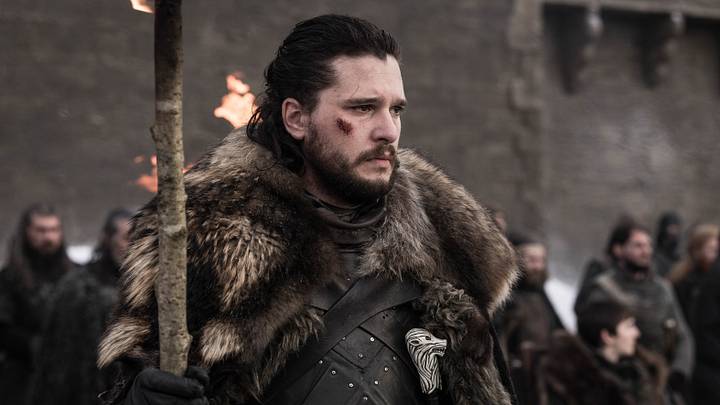
However, despite acting as the series' lead towards the end of its run, Jon Snow's (Kit Harrington) ending is far from happy. Jon's story concludes with him condemned to an inescapable fate after making a controversial choice that is certain to weigh on him for the rest of his life. With its bleak implications, Jon Snow's final scene may tie back to a common Westerosi belief referenced a few times throughout the show, adding an even darker layer to Jon's painful decision.

The death of Daenerys Targaryen and Jon's fate
After witnessing Daenerys' carnage during her assault on King's Landing, Jon discusses his next steps with Arya and Tyrion. Jon is torn, since while he loves Daenerys, he understands the danger she presents to Westeros, especially after having "snapped" upon hearing the ringing of the bells. Knowing what he must do, Jon approaches Daenerys in the throne room, killing her after a kiss goodbye.
Jon is quickly imprisoned for killing Daenerys, and even after his brother (technically cousin) Bran is appointed King, Jon must still answer to the wrath of Grey Worm (Jacob Anderson), livid at the death of his queen. To appease Grey Worm while still sparing his brother's life, King Bran sentences Jon to join the Night's Watch.
Jon had previously served on the Night's Watch, even acting as its Lord Commander for a brief period, before his death and subsequent resurrection opened up a loophole to allow him to leave the brotherhood. On his way out, Jon expressed no desire to ever return, knowing he died at the hands of men who were supposed to be his brothers. Plus, with the threat of the undead vanquished and with a new era of peace seemingly brokered between the Watch and the wildlings, the brothers in black likely have less of a purpose than ever before when Jon comes back. As such, Jon is doomed to spend the rest of his life away from his Stark family, wandering through a directionless existance in a place where he had previously been murdered, a far bleaker ending than most of his fantasy hero peers recieved.

Jon Snow: Kinslayer
Game of Thrones presents kinslaying, or the act of killing a family member, as the ultimate taboo throughout Westeros. When Robb Stark (Richard Madden) executes Rickard Karstark (John Stahl), a distant cousin, Rickard warns him "Kill me and be cursed." Sure enough, Robb suffers these consequences at the infamous Red Wedding not long after Rickard's death. Several other kinslaying characters don't make it out of Game of Thrones alive, including Cersei (Lena Headey) and Jaime (Nikolaj Coster-Wadlau), who have a hand in killing their uncle Kevan (Ian Gelder) and cousin Alton (Karl Davies), respectively. Even Tyrion, who survives the series despite killing his father, Tywin (Charles Dance), greatly suffers immediately thereafter when he flees Westeros in a crate, preparing to "drink himself to death on the road to Meereen."
As of the series finale, Jon is also a kinslayer. Since Bran and Sam discovered that Jon is actually Aegon Targaryen, the trueborn son of Rhaegar Targaryen (Wilf Scolding) and Lyanna Stark (Aisling Franciosi), he is related to Daenerys. Given that Rhaegar is Daenerys' older brother, Jon has killed his own aunt.
Perhaps Jon's bleak ending is the consequence of his kinslaying. While Game of Thrones does not depict Jon's death after he kills Daenerys, he still receives narrative punishment towards the end of the story. In universe, this could be the result of the curse Rickard warned Robb about, since Jon's sentencing to the Night's Watch takes place shortly after the death of his aunt. Additionally, Jon is sent back to the Watch as a direct consequence of killing Daenerys, tying the old Westerosi tradition to the new King's decree.
For more from the world of Westeros, make sure to stream House of the Dragon season 3 on HBO Max.
 Add us as a preferred source on Google